Stainless steel is chosen when corrosion would otherwise end a part's life early — valve bodies and pump shafts, food and medical equipment, marine hardware, fasteners that can't be allowed to seize. It is also one of the easiest materials to get wrong in sourcing. 304 and 316 look identical on a bench. Poor segregation between stainless steel and carbon steel during machining, grinding or handling can introduce free iron contamination and contribute to surface corrosion. And a machine shop that handles stainless occasionally will quote it the same way it quotes mild steel, then discover the tool wear.
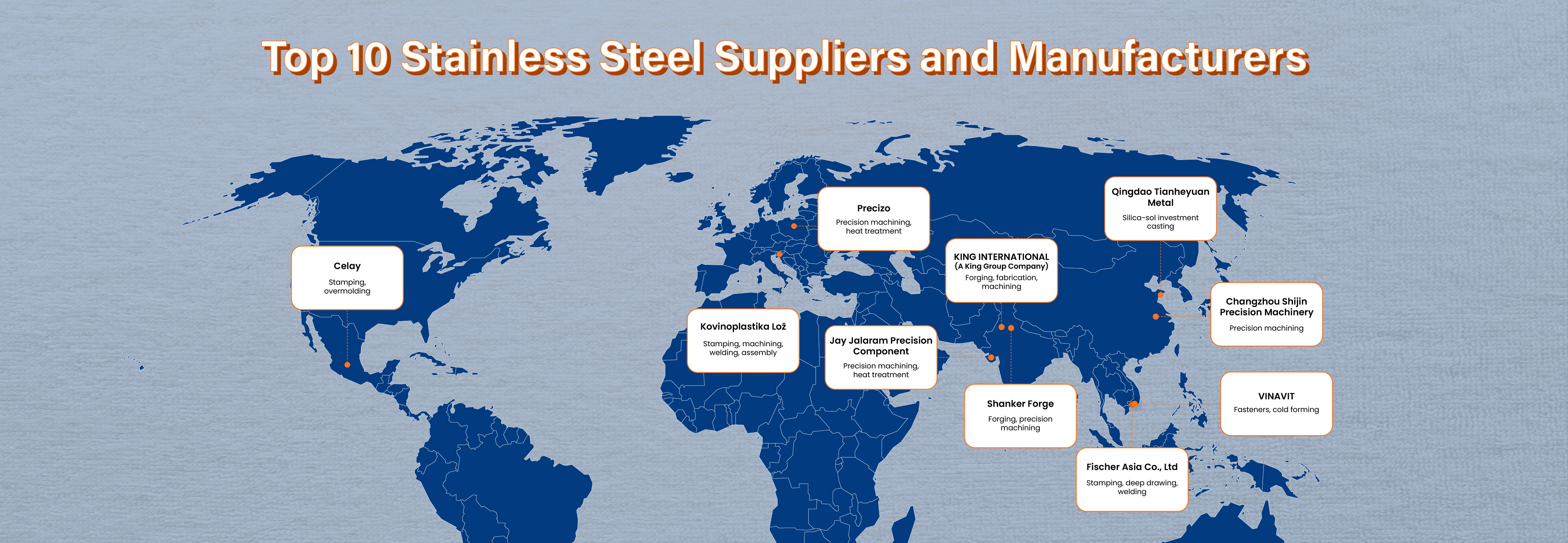
MESH Works has 1929 stainless steel suppliers in its network across 40+ countries. The ten below cover investment casting, precision machining, stamping and deep drawing, forging and fasteners across China, India, Vietnam, Poland, Slovenia and Mexico.
How We Selected These Suppliers
Every supplier on this list has been visited in person by a MESH Works engineer and assessed against 45 points covering manufacturing capability, equipment, quality systems, capacity, engineering support and logistics, documented with photographs and video from the factory floor.
The shortlist was built on four criteria:
Stainless steel as a working material in the supplier's production, not only a listed commodity
A process stainless is commonly made by — investment casting, machining from bar, stamping and deep drawing, forging, cold forming
Current certification appropriate to the industries served
Demonstrated capacity in that process, confirmed during the audit
Some suppliers work across several materials and appear in other guides in this series; where that's the case, the entry below focuses on their stainless-relevant capability.
10 Stainless Steel Suppliers at a Glance
# | Supplier | Location | Key process | Certifications | MESH rating |
1 | Kovinoplastika Lož | Stari trg pri Ložu, Slovenia | Stamping, machining, welding, assembly | IATF 16949, ISO 9001, ISO 14001 | 4.89 |
2 | Changzhou Shijin Precision Machinery | Changzhou, China | Precision machining | IATF 16949 | 4.84 |
3 | KING International | Ludhiana, India | Forging, fabrication, machining | IATF 16949, ISO 14001, ISO 45001 | 4.75 |
4 | Fischer Asia | Ho Chi Minh City, Vietnam | Stamping, deep drawing, welding | IATF 16949, ISO 9001 | 4.73 |
5 | Precizo | Płock, Poland | Precision machining, heat treatment | ISO 9001, ISO 14001 | 4.70 |
6 | Shanker Forge | Faridabad, India | Forging, precision machining | IATF 16949, ISO 9001, ISO 14001, ISO 45001 | 4.44 |
7 | Celay | Celaya, Mexico | Stamping, overmolding | ISO 14001 | 4.31 |
8 | Jay Jalaram Precision Component | Rajkot, India | Precision machining, heat treatment | IATF 16949, ISO 9001 | 4.21 |
9 | Qingdao Tianheyuan Metal | Qingdao, China | Silica-sol investment casting | IATF 16949, ISO 9001, ISO 14001, PED 2014/68, AD 2000 | 4.13 |
10 | VINAVIT | Ho Chi Minh City, Vietnam | Fasteners, cold forming | ISO 9001, ISO 14001, ISO 45001 | 3.88 |
How this list was created. These suppliers were selected from the MESH Works network based on stainless steel capability, manufacturing process, on-site audit findings and supplier profile information. The MESH rating is a platform-level supplier indicator and is not an independent industry-wide ranking or an audit score. Capability and certification data comes from MESH supplier profiles and audit records. Capabilities, grades and capacity should be confirmed against your specific requirements before qualification or award.
1. Kovinoplastika Lož d.o.o. — Stari trg pri Ložu, Slovenia
A Slovenian manufacturer with more than 70 years in industrial production, combining forming, machining, welding and assembly.
Capabilities
Stamping and laser cutting
CNC machining, VMC and HMC
Welding
Assembly
IATF 16949, ISO 9001, ISO 14001
Industries: automotive, appliances, energy equipment, lighting, valves and instruments, electronics, construction, agricultural machinery
The value here is the combination. A stainless assembly that needs cut, formed, machined and welded components usually means three or four suppliers; Kovinoplastika Lož handles all of it under one quality system, within the EU.
View Kovinoplastika Lož on MESH Works →
2. Changzhou Shijin Precision Machinery Co., Ltd — Changzhou, China
A high-precision machining specialist operating from a production facility of more than 15,000 square metres.
Capabilities
CNC machining, VMC and HMC
Stainless steel among its core commodities
IATF 16949
Industries: automotive, aerospace, medical instruments, high-speed railway and subway, energy equipment, valves and instruments, appliances, electronics
Stainless work-hardens under the cutter, which punishes a shop that treats it like mild steel with tool wear, poor finish and missed tolerances. A dedicated precision machining operation with medical and rail customers is one that has had to get stainless right.
View Changzhou Shijin Precision Machinery on MESH Works →
3. KING INTERNATIONAL (A King Group Company) — Ludhiana, India
A TÜV-certified contract manufacturer working in partnership with OEM clients across forged, stamped, precision-machined, welded and thread-rolled parts.
Capabilities
Forging, stamping, precision machining, thread rolling
Welding, fabrication, laser cutting, tube cutting
Steel and investment casting
Coatings and surface treatment, assembly
IATF 16949, ISO 14001, ISO 45001
Industries: automotive, agricultural machinery
KING is the one-supplier option for stainless components that need several processes — forged, then machined, then welded into an assembly. For multi-process parts, consolidating those steps under one quality system is often worth more than finding the best specialist for each.
View KING International on MESH Works →
4. Fischer Asia Co., Ltd — Ho Chi Minh City, Vietnam
A manufacturer of tooling, metal stamped components, CNC machined parts, welded subassemblies and finished assemblies for automotive and industrial customers.
Capabilities
Stamping tools and dies designed and built in house, including progressive and deep-drawing tools
Mechanical and hydraulic press stamping
CNC milling and turning
MIG/MAG welding (manual and robot), spot, projection and laser welding
Welding, machining and measuring jigs
In-house assembly with testing and quality control
IATF 16949, ISO 9001:2015
Deliveries to the US market and to automotive OEMs, with references including VinFast, Porsche, Audi and Ziehl-Abegg
Austenitic stainless work-hardens and springs back more than mild steel, so deep drawing it depends heavily on tool design. Building the tools in house means Fischer Asia controls the part of the process where stainless stamping usually goes wrong.
View Fischer Asia on MESH Works →
5. Precizo sp. z o.o. — Płock, Poland
A metal machining company operating since 1989, producing single parts and complex assemblies as a Tier 1 supplier to OEMs.
Capabilities
CNC turning (2-, 3- and 4-axis), CNC milling to 5-axis, CNC spline hobbing, CNC grinding
Deep hole drilling, broaching, thread rolling and milling
Heat treatment in house: induction hardening, volumetric hardening, tempering, carburising
Robot and semi-automatic MIG welding, powder hardfacing
Stainless steel, alloy steel and carbon steel
ISO 9001, ISO 14001
Industries: agricultural and off-road machinery, electric motors, pumps and compressors
Pump and compressor shafts are one of the most common stainless machined components, and deep-hole drilling plus spline hobbing is the combination those parts need. Precizo is the strongest option on this list for long, complex stainless shafts.
6. Shanker Forge Private Limited — Faridabad, India
An integrated component manufacturer covering forging, casting, heat treatment, machining and assembly.
Capabilities
Forging and precision machining
Heat treatment in house
Stainless steel, carbon steel and steel
IATF 16949, ISO 9001, ISO 14001 and ISO 45001
Industries: automotive, agricultural machinery, construction, railway, commercial
Four certifications is the strongest documented position among the forging suppliers here. Stainless forgings — flanges, fittings, valve components — need tighter process control than carbon steel, because stainless has a narrower forging temperature window.
View Shanker Forge on MESH Works →
7. Celay S.A. de C.V. — Celaya, Mexico
A manufacturer of complex precision metal components for global automotive customers, supported by process engineering and automation.
Capabilities
Precision stamping
Overmolding — metal components with integrated plastic features
Stainless steel, carbon steel and steel
ISO 14001
Industry: automotive
Celay is the nearshore stainless option on this list for US buyers. Overmolding is the less common capability worth noting: stamped stainless parts with molded plastic features in a single supplier removes an assembly step and a second source.
8. Jay Jalaram Precision Component LLP — Rajkot, India
A manufacturer and exporter of precision components with an integrated manufacturing facility in Rajkot.
Capabilities
CNC turning and machining, VMC, HMC
Thread rolling, cylindrical grinding
Heat treatment in house: induction hardening, case hardening, nitriding
Surface finishing
IATF 16949, ISO 9001
Industries: automotive, aerospace, medical instruments, oil and gas, valves and instruments, energy, construction
Integrated heat treatment matters more in stainless than it first appears. Martensitic grades such as 410 and 420 need hardening to reach their properties, and 17-4 PH needs precipitation hardening. A supplier that does it in house removes a subcontractor from the qualification chain.
View Jay Jalaram Precision Component on MESH Works →
9. Qingdao Tianheyuan Metal Co., Ltd — Qingdao, China
A silica-sol investment casting foundry with more than 23 years in operation, producing stainless steel and carbon steel precision castings.
Capabilities
Silica-sol investment casting — the finer-finish variant of the process, suited to stainless
Production capacity of approximately 1,600 tonnes per year
Full process in house: design, wax injection and assembly, shell coating, dewaxing, baking, pouring, shell removal, cutting, pickling, grinding, heat treatment, machining, inspection and packaging
Inspection: spectrum analysis, hardness, tensile testing, CMM, roughness, salt spray, magnetic particle and radiographic testing
IATF 16949, ISO 9001, ISO 14001, plus PED 2014/68 and AD 2000 pressure equipment certification
Industries: automotive, valves and instruments, oil and gas, marine, energy, medical instruments, heavy equipment
The pressure equipment certifications are the reason to shortlist Qingdao Tianheyuan. PED and AD 2000 are what European valve and pump OEMs require for pressure-bearing castings, and they take years to obtain. Radiographic testing in house matters for the same parts: porosity in a stainless valve body is invisible until it leaks.
View Qingdao Tianheyuan Metal on MESH Works →
10. VINAVIT (Vi Nam Viet Production Trading Corporation) — Ho Chi Minh City, Vietnam
A fastener manufacturer producing standard and tight-tolerance bolts, nuts, screws and threaded rods in stainless and carbon steel, including customised parts to customer specification.
Capabilities
Cold forming, thread rolling, cutting, stamping and press parts
Wire drawing with annealing — controlling raw material in house
Multiple production facilities
Inspection: metal analyzers, microscopes, hardness testers, universal tensile testers, salt spray chambers and X-ray
ISO 9001 and ISO 14001 certified by Bureau Veritas; ISO 45001; BSCI, CTPAT and SA8000 compliance
Customers include Samsung, Toshiba, IKEA, Hilti, Panasonic, Schneider Electric, Milwaukee and Fastenal
Two things set VINAVIT apart. Drawing its own wire means it controls the material before a part is formed, which is where stainless fastener quality is decided. And CTPAT compliance matters directly for US importers, since it speeds customs clearance.
Stainless Steel Grades and What They're Used For
Grade choice determines corrosion performance, machinability and cost more than any other decision on a stainless part.
Austenitic: the most common family
304 / 304L (EN 1.4301 / 1.4307) — the general-purpose grade. Food equipment, enclosures, architectural and general industrial parts. Use the L grade where the part will be welded
316 / 316L (EN 1.4401 / 1.4404) — molybdenum added for chloride resistance. Marine, chemical processing, pharmaceutical and medical equipment
303 (EN 1.4305) — free-machining. Faster to machine than 304, at the cost of lower corrosion resistance and poor weldability
Martensitic: hardenable
410 / 416 — moderate corrosion resistance, heat treatable. Pump shafts, valve trim, fasteners
420 — higher hardness. Cutting tools, surgical instruments
Precipitation hardening
17-4 PH (EN 1.4542) — high strength with good corrosion resistance. Aerospace, oil and gas, high-load shafts
Duplex
2205 (EN 1.4462) — roughly twice the strength of 304 with better chloride stress-corrosion resistance. Offshore, desalination, pressure vessels
Cast equivalents
CF8 ≈ 304 · CF8M ≈ 316 · CF3M ≈ 316L — the designations you'll see on investment and sand casting drawings
Fasteners
A2 ≈ 304 and A4 ≈ 316 under ISO 3506. A4 is the choice for marine and chloride environments
Confirm the grade and designation system in writing when sourcing across regions. A drawing calling for 316L may be quoted as 1.4404 in Europe or SUS316L in Japan and Asia. They are close equivalents, but the change should be an agreed deviation rather than a discovery at PPAP.
How to Choose a Stainless-Steel Supplier
1. Match the process to the part
Process | Best for | Watch for |
Investment casting | Valve bodies, pump housings, complex geometry | Porosity in pressure parts — ask for radiographic testing |
Machining from bar | Shafts, fittings, precision components | Work hardening and tool wear; 303 machines faster but corrodes sooner |
Stamping and deep drawing | Housings, covers, sinks, enclosures | Springback and galling; tool design matters more than with mild steel |
Forging | Flanges, fittings, high-load components | Narrow forging temperature window |
Cold forming | Fasteners, pins, rivets | Galling on threads; specify A2 or A4 correctly |
2. Ask how stainless is kept separate from carbon steel
This is the question most buyers don't ask and the one that causes the most field failures. Stainless machined, ground or handled with tools and fixtures that have touched carbon steel picks up embedded iron particles. The part looks fine at inspection and shows rust spots within weeks. Ask whether stainless has dedicated tooling, grinding media and handling, and whether the supplier can show it during an audit.
3. Confirm passivation and post-weld treatment
Passivation removes free iron and restores the chromium oxide layer that makes stainless resist corrosion. Ask whether it's done in house and to which specification, typically ASTM A967 or ASTM A380. Welded stainless also needs pickling to remove heat tint, or the weld zone becomes the first-place corrosion starts.
4. Verify the grade, not just the certificate
304 and 316 are visually identical. A mill certificate confirms what the supplier bought; positive material identification (PMI) testing confirms what they actually used. For critical parts, ask whether PMI is performed on incoming material or finished parts. Spectrum analysis — which several suppliers on this list run in house — is one way to do it.
5. Check inspection capability against the part
Salt spray testing verifies corrosion performance. Radiographic testing finds porosity in castings. Note that austenitic stainless is largely non-magnetic, so magnetic particle inspection doesn't work on it — dye penetrant is the standard surface crack test for 304 and 316.
6. Understand the tariff position before comparing landed cost
Stainless falls under Section 232 steel duties, which apply to the full customs value of covered products, with different rates for steel articles and derivatives. Rates have changed more than once during 2026, and USMCA-qualifying goods from Mexico are treated differently from Asian-origin parts. Confirm current classification before committing.
7. Verify capacity rather than take it on trust
Published capacity is a claim until someone stands in the plant. The gap between what a supplier lists and what it runs is the most common finding in on-site audits, and it's why qualification takes months when it starts from a directory listing.
Why Stainless-Steel Supplier Qualification Matters
Stainless is the material where a supplier's process discipline shows up most directly in the finished part. Two suppliers can quote the same drawing in the same grade, and one ships parts that rust in storage while the other's last a decade — because of how material is segregated, passivated, handled after welding and verified before it's formed.
None of that is visible in a supplier profile. It's visible on the factory floor.
MESH Works maintains a database of 19K+ manufacturing suppliers across 40+ countries, of which 4K+ have been audited in person against a 45-point evaluation. Suppliers are searchable by process, commodity, capacity, certification and location, so a requirement like stainless investment casting, PED certified, China returns manufacturers whose capability has already been confirmed on site.
Search audited stainless steel suppliers → — free, no signup required.