Carbon steel is the default material for industrial components — forged shafts and rings, stamped brackets and body panels, cast valve bodies, machined fasteners. It is also where the most sourcing time disappears, because almost every manufacturer will tell you they work in carbon steel, and very few can tell you their press tonnage range, their ring diameter limits, or whether heat treatment happens in house.
MESH Works has 2,067 carbon steel suppliers in its network across 40+ countries. The ten below cover forging, stamping, investment casting, sand casting, fabrication and precision machining across Poland, China, Vietnam, Mexico, Spain and India.
How We Selected These Suppliers
Every supplier in this list has been visited in person by a MESH Works engineer and assessed against 45 points covering manufacturing capability, equipment and tonnage, quality systems, capacity, engineering support and logistics. Findings are documented with photographs and video from the factory floor. Nothing here is self-reported from a registration form.
Four criteria shaped the shortlist:
Carbon steel as a primary commodity, not a material the supplier occasionally handles
A process carbon steel is genuinely made by, forging, stamping, steel casting, fabrication, machining from bar
Current certification appropriate to the industries served
Demonstrated capacity in that process, confirmed on site
Two exclusions explain the shape of the list. Suppliers whose casting work is in grey, ductile or malleable iron were left out — cast iron is a different material family, with different carbon content, machinability and mechanical behaviour. And suppliers offering coating, plating or welding as a standalone service were excluded: they are finishing partners, not steel manufacturers.
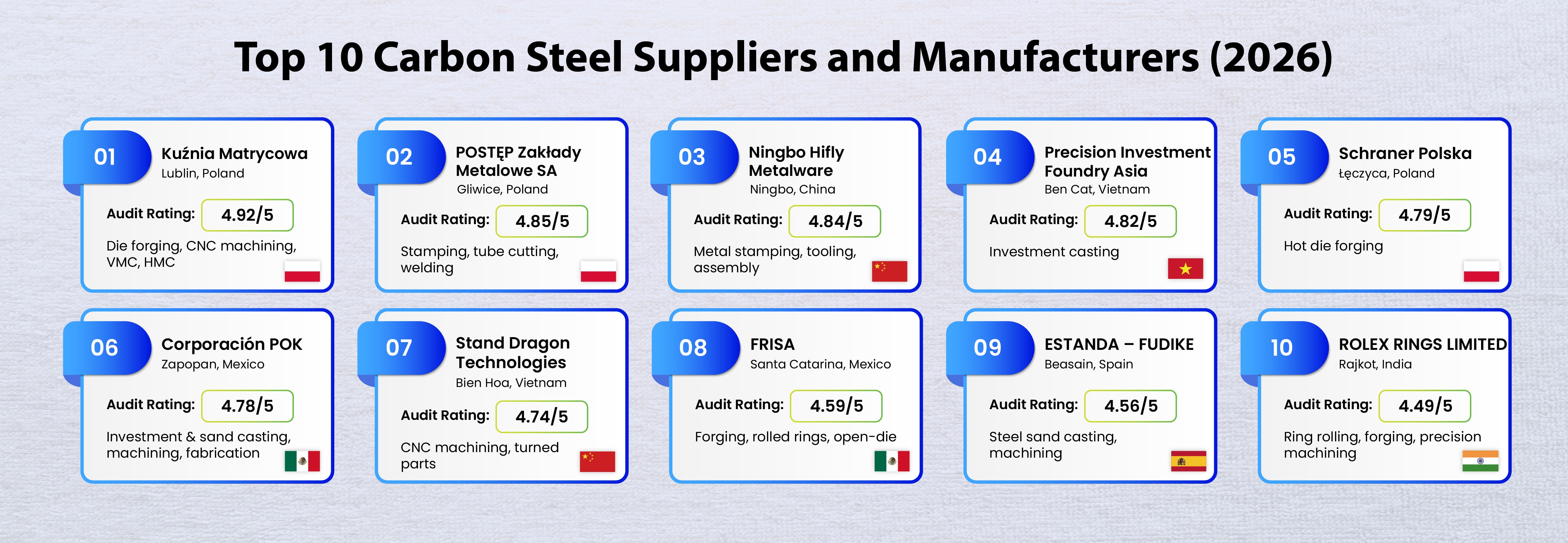
Top 10 Carbon Steel Suppliers at a Glance
# | Supplier | Location | Key processes | Certifications | MESH rating |
1 | Kuźnia Matrycowa | Lublin, Poland | Die forging, CNC machining, VMC, HMC | IATF 16949 | 4.92 |
2 | POSTĘP Zakłady Metalowe SA | Gliwice, Poland | Stamping, tube cutting, welding | — | 4.85 |
3 | Ningbo Hifly Metalware | Ningbo, China | Metal stamping, tooling, assembly | IATF 16949, ISO 14001 | 4.84 |
4 | Precision Investment Foundry Asia | Ben Cat, Vietnam | Investment casting | — | 4.82 |
5 | Schraner Polska | Łęczyca, Poland | Hot die forging | — | 4.79 |
6 | Corporación POK | Zapopan, Mexico | Investment & sand casting, machining, fabrication | — | 4.78 |
7 | Stand Dragon Technologies | Bien Hoa, Vietnam | CNC machining, turned parts | IATF 16949, ISO 9001/14001/45001 | 4.74 |
8 | FRISA | Santa Catarina, Mexico | Forging, rolled rings, open-die | — | 4.59 |
9 | ESTANDA – FUDIKE | Beasain, Spain | Steel sand casting, machining | EN 15085-2 CL1, DB HPQ, ISO 45001 | 4.56 |
10 | ROLEX RINGS LIMITED | Rajkot, India | Ring rolling, forging, precision machining | IATF 16949, ISO 9001/14001/45001 | 4.49 |
How this list was created. These suppliers were selected from the MESH Works network based on carbon steel capability, manufacturing processes, on-site audit findings and MESH supplier ratings. The MESH rating is a platform-level supplier indicator and is not an independent industry-wide ranking. Capability and certification data comes from MESH supplier profiles and audit records. Capabilities should be independently evaluated against your specific requirements before qualification or award.
1. Kuźnia Matrycowa — Lublin, Poland
Kuźnia Matrycowa is a manufacturing company based in Lublin, Poland, with a strong focus on forging and machined components.
Capabilities
Die forging with CNC, VMC and HMC machining
Carbon steel, stainless steel, steel
IATF 16949
Industries: automotive, agricultural machinery, heavy equipment, railways
Forging and machining under one roof matters where the forging tolerance won't hold a critical feature. It removes a handoff and a supplier from the qualification chain.
View Kuźnia Matrycowa on MESH Works →
2. POSTĘP Zakłady Metalowe SA — Gliwice, Poland
A high-volume stamping and tube fabrication business supplying major automotive customers in Poland and internationally, and part of the Luma Automation Group.
Capabilities
Stamping, tube cutting, welding, pipe machining, assembly
Steel sheet and strip from 0.5 to 5 mm, plus pipe
Car body shell elements, seat structure components, exhaust system components, DC motor elements
Approximately 330,000 parts per day — over 90 million a year
98.7% on-time delivery, shipping to 14 countries
Industries: automotive, appliances, electronics
The daily output figure is the reason to shortlist POSTĘP. Volume at that scale is a capability in its own right, and it was confirmed during the audit rather than claimed in a brochure.
View POSTĘP Zakłady Metalowe on MESH Works →
3. Ningbo Hifly Metalware Co., Ltd — Ningbo, China
A stamping specialist producing customised metal stamping parts, with tooling, automation planning and assembly in house.
Capabilities
Metal stamping with riveting, welding, cleaning and assembly
Stamping tools and dies, plus stamping automation planning
Material thickness 0.5 mm to 10.0 mm, tolerance capability to 0.02 mm
Press machines from 45 ton to 600 ton
Automated assembly lines
IATF 16949:2016, ISO 14001:2015
Applications: solar, telecommunications, construction, office equipment, automotive
The press range is the most useful number here — 45 to 600 ton covers most automotive and appliance stampings, and the stated 0.02 mm tolerance capability is tight for a stamping operation.
View Ningbo Hifly Metalware on MESH Works →
4. Precision Investment Foundry Asia Co., Ltd — Ben Cat, Vietnam
An investment casting foundry working in carbon steel and stainless alongside ductile and grey iron.
Capabilities
Investment casting
Carbon steel, stainless steel, ductile and grey iron
Industries: automotive, agricultural machinery, appliances, valves and instruments
Investment casting is the right process for complex carbon steel geometry that would be expensive to machine from bar — valve bodies, levers, brackets with integrated features. Vietnam is also worth considering where the alternative is a Chinese foundry and the tariff position matters.
View Precision Investment Foundry Asia on MESH Works →
5. Schraner Polska Sp. z o.o. — Łęczyca, Poland
A precision forging company specialising in hot die forging of steel, with aluminium, copper and titanium also in the portfolio.
Capabilities
Hot die forging producing shaped forgings
Carbon steel, aluminium, copper, titanium and other forgeable alloys
Industries: automotive, power tools, textile machinery
Supplies customers in Poland, wider Europe and North America
The existing North American customer base is worth noting if you are qualifying a European source and want a supplier already used to shipping, documenting and communicating to US requirements.
View Schraner Polska on MESH Works →
6. Corporación POK — Zapopan, Mexico
A fully integrated castings company and Tier 1 supplier, and a member of Nucor Corporation since November 2018 under its engineered bar group. Nucor is the largest steel producer in the United States.
Capabilities
Sand casting, investment casting and permanent mould in a wide range of alloys
Fabrication, welding, stamping
Heat treatment in house
More than 35 CNC machining centres for value-added finishing
Carbon steel, steel, bronze
Industries: automotive, aerospace, agricultural machinery, construction, lighting
POK is the strongest nearshore option on this list for US buyers. The Nucor relationship gives it a materials supply chain most independent foundries can't match, and 35 machining centres means castings ship finished rather than raw.
View Corporación POK on MESH Works →
7. Stand Dragon Technologies Co., Ltd — Bien Hoa, Vietnam
A precision machining and turned-parts manufacturer producing fasteners, lock parts and small hardware in steel, stainless, brass and aluminium.
Capabilities
CNC machining, turning, threading, drilling, grinding, hexagoning, sandblasting
Lock parts, fasteners, screws, rivets, nuts, pins, inserts, turned parts
Part sizes with an outside diameter range of 2 mm to 36 mm
In-house surface treatment: zinc plating, nickel plating, black oxidisation, anodising
Inspection including roughness, hardness, gear testing and concentricity
ISO 9001:2015, ISO 14001:2015, ISO 45001:2018, IATF 16949:2016
Industries: automotive, electronics, hand tools, energy equipment, medical instruments
Four certifications including IATF is the strongest documented quality position on this list. In-house plating also matters for small steel parts, where finishing is usually where the lead time goes.
View Stand Dragon Technologies on MESH Works →
8. FRISA — Santa Catarina, Mexico
A forging company with more than 50 years in the market, vertically integrated, and one of the significant global forgers of rolled rings and large forged components.
Capabilities
Rolled rings, contoured rings, bars, hollow bars, rollers and shafts, blocks and plates, discs
Pot die forgings (semi-closed forging), ingots, billets
Carbon steels, alloy steels, stainless steels, titanium, superalloys
Vertically integrated, from small specialised components to large finished items
Industries: aerospace, construction and mining, industrial machinery, oil and gas, power generation, wind power, semiconductors
FRISA is the list's answer for large-section carbon steel forgings — rings, shafts and discs where few suppliers have the press capacity. The wind power and oil and gas customer base is evidence of that scale.
9. ESTANDA – FUDIKE — Beasain, Spain
Founded in 1953 and vertically integrated, ESTANDA specialises in high-performance steel casting and machining across three production sites in the Basque Country — Beasain, Ibarra (Fudike) and Olaberria.
Capabilities
Steel casting on green sand and Pepset (chemical) moulding lines
Carbon, alloyed and heat-resistant steels
Machining and heat treatment following casting
EN 15085-2 classification level CL1 — welding of railway vehicles and components
Deutsche Bahn HPQ product qualification for railway brake discs and parts
ISO 9001, ISO 14001, ISO 45001, ISO 14064, IRIS
100% renewable energy in melting and machining; over 92% sand reclamation
Industries: railway, mining, cement, energy, marine and offshore, industrial equipment, automotive
The most heavily certified supplier on this list. The railway qualifications take years to obtain, and the sustainability figures are becoming a procurement requirement rather than a nice-to-have as scope 3 reporting spreads.
View ESTANDA – FUDIKE on MESH Works →
10. ROLEX RINGS LIMITED — Rajkot, India
A manufacturer of hot forged rolled rings and automotive components, serving multinational customers across fifteen countries including the USA, Mexico, Canada, Germany, France, Italy, Spain, Poland, Czech Republic, Portugal, China, Thailand, Brazil and South Africa.
Capabilities
Hot forging and ring rolling, followed by heat treatment
Machining including broaching, grinding, hobbing, shaving, spline rack rolling
Bearing rings; chassis components including wheel hubs, spindles and generation 3 bearing rings; powertrain components including CV joint parts, gear blanks and rings, bevel gears, ring gears, flanges and shafts; engine components including cam lobes, lock nuts and gears
In-house forging tool design and tool manufacturing, shortening development time
Carbon steel and aluminium
ISO 9001:2015, IATF 16949:2016, ISO 14001:2015, ISO 45001:2018 — certified by TÜV NORD
Industries: automotive, aerospace, agricultural machinery, construction, heavy equipment, recreational vehicles, valves and instruments
In-house tooling is the differentiator. For forged parts, tool lead time usually sets the program timeline, and a supplier that designs and cuts its own tools removes the longest dependency in a new part introduction.
View ROLEX RINGS on MESH Works →
Carbon Steel Grades and What They're Used For
Grade choice usually follows the process, and knowing which grade your part calls for narrows the supplier list faster than anything else.
Forging
1045 - medium carbon. The workhorse for shafts, levers and general forged components
4140 - chromium-molybdenum alloy. Higher strength and toughness; forged shafts, axles, heavy-duty parts
4340 - nickel-chromium-molybdenum. Aerospace and heavy equipment where fatigue strength matters
8620 - a carburising grade. Gears, bearing rings, anything case hardened after forging
Stamping and sheet fabrication
1008 / 1010 - low carbon, excellent formability. Deep drawn parts, brackets, housings
DC01–DC06 - cold rolled sheet grades; DC06 for the most demanding deep drawing
HSLA - high strength low alloy, where automotive body parts need strength at reduced thickness
Steel casting
WCB (ASTM A216) - the standard carbon steel casting grade for pressure-containing parts such as valve bodies
1030 / 8630 - general and higher-strength cast components
Machining from bar
1018 - low carbon, free machining, widely stocked. General turned parts and case-hardened components
12L14 - leaded free-machining steel for high-volume turned parts
1045 - where the machined part needs strength without heat treatment
Confirm grade equivalence in writing when sourcing across regions. A drawing calling for 4140 may be quoted as 42CrMo4 in Europe or SCM440 in Asia. The grades are close but not identical, and it should be an agreed deviation rather than a discovery at PPAP.
How to Choose a Carbon Steel Supplier
Piece price is the easiest thing to compare and the least useful on its own. Tooling, heat treatment, secondary operations, scrap rate and freight usually move landed cost more than the quoted part price.
1. Match the process to the part
Process | Best for | Watch for |
Die forging | Parts needing grain flow and fatigue strength — shafts, levers, gear blanks | Tooling cost and lead time; draft angles and flash |
Ring rolling | Bearing rings, flanges, large-diameter rings | Few suppliers have it; verify diameter range |
Open die forging | Large sections, low volume, custom geometry | Higher machining allowance, more material removal |
Stamping | Sheet parts at volume — brackets, housings, body components | Progressive die investment; springback on higher-strength grades |
Investment casting | Complex geometry with good surface finish, small to medium parts | Size limits; higher unit cost than sand casting |
Sand casting | Larger, heavier castings | Rougher surface, wider tolerances, more machining stock |
Machining from bar | Turned parts, prototypes, tight-tolerance features | Material removal cost at volume |
A supplier that lists "carbon steel" tells you nothing about which of these it can do well.
2. Check the size and tonnage envelope first
The fastest way to disqualify a supplier is dimensional. A stamper whose largest press is 600 ton cannot run a part needing 1,000 ton. A turned-parts shop working to 36 mm outside diameter cannot make your 60 mm flange. A ring roller has minimum and maximum diameters. Establish those numbers from the drawing before shortlisting on price.
3. Ask where heat treatment happens
Carbon and alloy steel parts usually need normalising, quench and temper, or case hardening. In house means one supplier and one set of process controls. Subcontracted means a second supply chain you haven't audited — frequently where lead time and quality variation originate. Ask directly, and for automotive programs ask whether the process is qualified to CQI-9.
4. Verify certification against the industry, not in general
ISO 9001 is the baseline. IATF 16949 is required for most automotive programs. EN 15085 applies to welded railway components and IRIS to the wider rail supply chain. ISO 45001 and ISO 14001 are increasingly required by customer codes of conduct. Certification confirms a system exists; it does not confirm equipment, capacity or delivery performance — which is what an on-site audit assesses.
5. Understand the tariff position before comparing landed cost
Section 232 duties on steel apply to the full customs value of covered products rather than only the metal content, and rates have been revised more than once during 2026. Whether a part is classified as a steel article or a derivative changes the rate materially, and USMCA-qualifying goods from Mexico are treated differently from Asian-origin parts. Confirm current classification against the relevant HTSUS annexes before committing — it is a significant part of why nearshore steel sourcing has become more competitive than piece price alone suggests.
6. Verify capacity rather than take it on trust
Published capacity is a claim until someone stands in the plant and counts the presses. The gap between what a supplier lists and what it actually runs is the most common finding in on-site audits, and it is why qualification takes months when it starts from a directory listing.
Why Carbon Steel Supplier Qualification Matters
Carbon steel is the default material for industrial components, which is exactly what makes it hard to source well. Thousands of manufacturers can credibly say they work in it. Very few can tell you, without a plant visit, what their press tonnage range is, whether heat treatment is in house, what their scrap rate looks like on comparable parts, or whether the certification on their website is current.
That gap is where qualification time goes. Not in the RFQ, and not in the commercial negotiation — in finding candidates and working out which of them are real.
MESH Works maintains a database of 19K+ manufacturing suppliers across 40+ countries, of which 4K+ have been audited in person at the factory against a 45-point evaluation. Suppliers are searchable by process, commodity, capacity, certification and location, so a requirement like forged carbon steel rings, IATF 16949, Mexico returns manufacturers whose capability has already been confirmed on site.
Search audited carbon steel suppliers → — free, no signup required.