Bronze refers to a family of copper alloys whose properties vary significantly with composition. For example, bearing bronze and aluminium bronze differ so much that they are often produced by different methods and sometimes by different suppliers.
That makes bronze sourcing a two-part question: which alloy, and which process. Get those right and the supplier shortlist narrows quickly. Get them wrong and you will collect quotes that cannot be compared.
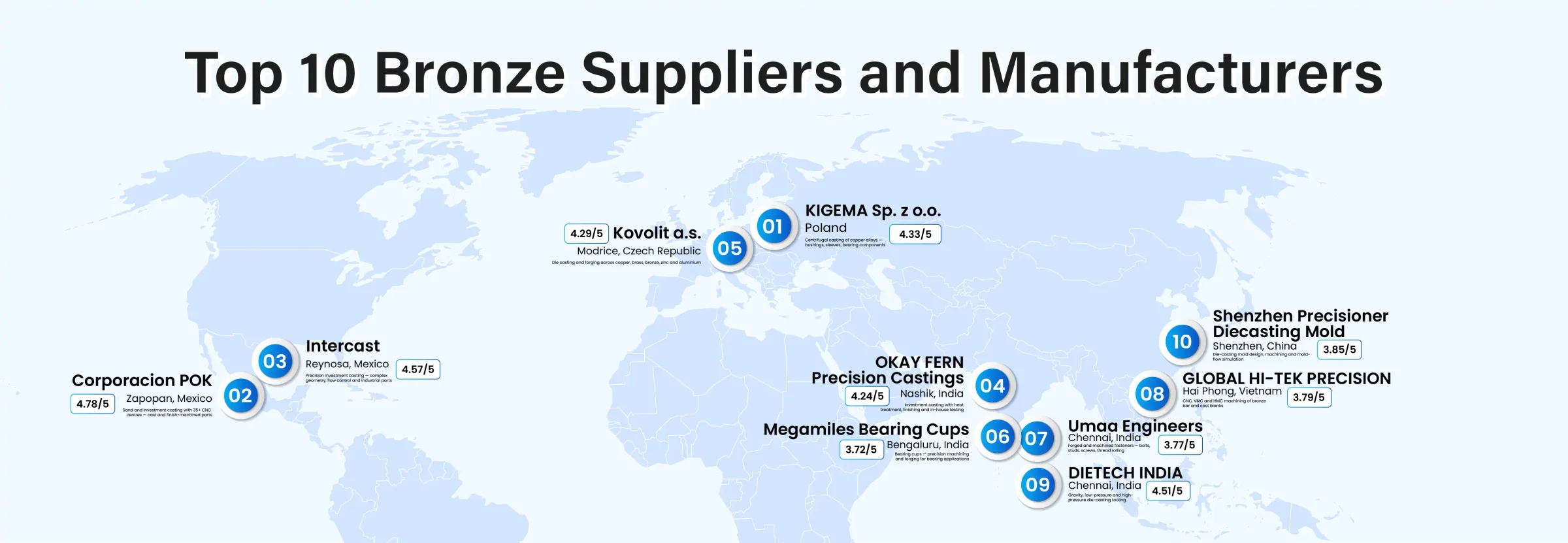
This guide begins by outlining alloys and processes, then profiles ten suppliers from the MESH Works database in Mexico, Europe, India, China, and Vietnam, highlighting the specific bronze requirements each supplier meets.
Quick Comparison
# | Supplier | Location | Rating | What it does for a bronze requirement |
1 | KIGEMA Sp. z o.o. | Europe | 4.33 | Centrifugal casting of copper alloys — bushings, sleeves, bearing components |
2 | Corporacion POK | Zapopan, Mexico | 4.78 | Sand and investment casting with 35+ CNC centres — cast and finish-machined parts |
3 | Intercast | Reynosa, Mexico | 4.57 | Precision investment casting — complex geometry, flow control and industrial parts |
4 | OKAY FERN Precision Castings | Nashik, India | 4.24 | Investment casting with heat treatment, finishing and in-house testing |
5 | Kovolit a.s. | Modrice, Czech Republic | 4.29 | Die casting and forging across copper, brass, bronze, zinc and aluminium |
6 | Megamiles Bearing Cups | Bengaluru, India | 3.72 | Bearing cups — precision machining and forging for bearing applications |
7 | Umaa Engineers | Chennai, India | 3.77 | Forged and machined fasteners — bolts, studs, screws, thread rolling |
8 | GLOBAL HI-TEK PRECISION | Hai Phong, Vietnam | 3.79 | CNC, VMC and HMC machining of bronze bar and cast blanks |
9 | DIETECH INDIA | Chennai, India | 4.51 | Gravity, low-pressure and high-pressure die-casting tooling |
10 | Shenzhen Precisioner Diecasting Mold | Shenzhen, China | 3.85 | Die-casting mold design, machining and mold-flow simulation |
First, Which Bronze?
"Bronze" on a drawing is not a specification. The alloy selected determines the casting process, machinability, mechanical properties, and a significant portion of the cost. Different alloy families also behave distinctly.
Family | Common grades | What it does | Typical parts |
Tin bronze / bearing bronze | C90300, C93200 (SAE 660), C93700 | Excellent bearing and wear properties, good machinability, tolerant of marginal lubrication. The default for plain bearings | Bushings, sleeve bearings, thrust washers, wear plates |
Phosphor bronze | C51000, C52100, C54400 | Phosphorus addition raises strength, fatigue resistance and spring quality. Good conductivity | Springs, electrical contacts, fasteners, small bushings |
Aluminium bronze | C95400, C95500, C95800 | The strongest bronze family — high strength, excellent seawater corrosion and erosion resistance. Tougher to machine | Marine fittings, pump and valve components, heavy-duty bearings, gears |
Manganese bronze / high-tensile brass | C86300, C86500 | Very high tensile strength. Strictly a high-strength brass, sold and specified as bronze | Gears, heavy structural bearings, machine components under load |
Silicon bronze | C87600, C65500 | Good corrosion resistance and weldability, excellent for forming and cold work | Fasteners, pump parts, architectural and marine hardware |
Leaded bronze | C93200, C93700, C93800 | Lead improves machinability and embedability. Check lead restrictions for potable water and RoHS applications | High-speed bearings, bushings, hydraulic components |
Along with the grade, specify the applicable standard (ASTM B505 for continuous cast, B584 for sand cast, B271 for centrifugal), required mechanical properties, hardness, machining allowance, and any lead content restrictions. Note that potable water and RoHS applications exclude several of the most machinable grades.
Which Process Makes Your Bronze Part
Bronze can be cast using several methods, with part geometry typically determining the best option. Sourcing issues often arise when the correct alloy is chosen but the process is not.
Process | When it is right | Suppliers here |
Centrifugal casting | Cylindrical and rotational parts. Molten bronze is spun in a rotating mold, which forces out gas and light inclusions and produces a dense, uniform structure at the bearing surface. The standard route for bushings and sleeves | 1 |
Sand casting | Larger parts, lower volumes, and complex external geometry. Cheapest tooling of any casting route, looser tolerance, more machining allowance | 2 |
Investment casting | Complex geometry, thin walls, fine detail and tight as-cast tolerance. Higher tooling and part cost, far less machining | 2, 3, 4 |
Gravity die casting (permanent mold) | Repeat production of medium-volume parts. Molten bronze is poured into a reusable steel or cast iron mold. Better surface and tolerance than sand, cheaper per part at volume | 5, 9 |
Forging | Parts needing maximum strength and fatigue life. Grain flow follows the geometry and there is no porosity | 5, 6, 7 |
Machining from bar or blank | Low volumes, tight tolerances, or finishing a cast part. Bronze machines well; leaded grades machine very well | 2, 6, 7, 8 |
It is important to note that conventional high-pressure die casting is suitable for aluminium, zinc, and magnesium, but not for bronze, as its melt temperature exceeds equipment limits. Bronze described as "die cast" is typically gravity or low-pressure cast in a permanent mold, which requires different tooling and processes.
The Suppliers
Bronze is rarely the only material a supplier offers. As a copper alloy, it is often processed alongside brass, aluminium, and steel in the same facility. Foundries that handle copper alloys typically list several materials. This is standard for the industry, so focus on whether the supplier’s processes and equipment meet your part’s requirements.
Each entry below states what the supplier does and which bronze requirement it fits.
1. KIGEMA Sp. z o.o.
Location: Poland
MESH Rating: 4.33
Processes: Centrifugal casting, turning, milling, drilling, cutting, grinding
Commodities: Bronze, brass
Certifications: ISO 9001, ISO 14001 and an occupational health and safety standard
Industries: Agricultural machinery, energy equipment, railway
KIGEMA is listed first because its core process is the primary method used to manufacture bronze parts.
Centrifugal casting spins molten metal inside a rotating mold, using centrifugal force to drive denser metal outward and push gas, slag, and light inclusions to the inner bore, which is then machined away. This process creates a dense, uniform structure ideal for bearings. For bronze bushings, sleeves, and bearing shells, it offers superior quality compared to sand casting and avoids the tooling costs of investment casting.
It is the only supplier listed whose commodities are exclusively copper alloys, specifically bronze and brass, with in-house machining to finish castings. Its industries include agricultural machinery, energy equipment, and railway, all of which require heavy bearing applications.
Fits: Bronze bushings, sleeve bearings, wear rings, cylindrical and rotational parts, and the first supplier to approach for any plain bearing requirement.
Supplier profile: KIGEMA Sp. z o.o.
2. Corporacion POK — Mexico
Location: Zapopan, Jalisco, Mexico
MESH Rating: 4.78
Processes: Sand casting, investment casting, CNC/VMC/HMC machining, heat treatment, fabrication and welding
Commodities: Bronze, carbon steel, steel
Industries: Automotive, aerospace, agricultural machinery, construction, lighting
Corporacion POK is the most broadly equipped supplier on this list and carries the highest MESH Rating.
It operates two casting routes: sand and investment, supported by over 35 CNC machining centres, as well as heat treatment, fabrication, and welding. This combination is especially important for bronze, as bronze castings typically require finish machining on bearing bores, sealing faces, and mounting features. A foundry with extensive machining capabilities can deliver a finished part, eliminating the need for a secondary supplier.
With both sand and investment casting in one facility, the process can be selected based on part requirements rather than equipment limitations. Sand casting suits larger or lower-volume work, while investment casting is ideal for fine detail and tight as-cast tolerances.
For North American buyers it is also the nearshore option: Jalisco sits inside Mexico's established manufacturing belt with USMCA treatment and short freight into the US.
Fits: Cast-and-machined bronze components, parts needing two casting routes evaluated, and buyers wanting casting and finish machining from one nearshore supplier.
Supplier profile: Corporacion POK — Mexico
3. Intercast — Mexico
Location: Reynosa, Tamaulipas, Mexico
MESH Rating: 4.57
Process: Precision investment casting, machining, surface finishing, heat treatment
Commodities: Bronze, stainless steel, carbon steel, steel, brass
Industries: Automotive, flow control, industrial equipment, transportation, security, industrial gas turbines, food processing
Intercast specializes in investment casting and offers the complete lost-wax process: pattern injection, wax assembly, ceramic shell investment, pouring, knockout, finishing, cleaning, heat treatment, machining, and inspection.
This capability is important for bronze parts with complex geometry or fine detail, such as impellers, valve internals, manifolds, and intricate marine hardware. Investment casting achieves tighter as-cast tolerances and better surface finishes than sand casting, reducing the need for machining expensive alloys like bronze.
The listed industries reflect this focus. Flow control, industrial gas turbines, and food processing equipment all require bronze and copper alloys for corrosion resistance and often involve complex geometries.
The inclusion of brass alongside bronze demonstrates Intercast’s broader copper-alloy expertise, rather than a single incidental capability.
Fits: Complex bronze geometry, valve and flow control internals, near-net-shape parts where machining an expensive alloy should be minimised.
Supplier profile: Intercast — Mexico
4. OKAY FERN Precision Castings — India
Location: Nashik, Maharashtra, India
MESH Rating: 4.24
Process: Investment casting, pattern and tooling, heat treatment, shot blasting, finishing, machining
Commodities: Bronze, iron, stainless steel, zinc, aluminium
Industries: Automotive, aerospace, construction, medical instruments, valves and instruments
OKAY FERN is the second investment casting option and offers the most comprehensive in-house process chain described: pattern and wax processing, shell preparation, melting and pouring, heat treatment, shot blasting, finishing, machining, and inspection and testing, including dimensional checks and material tests.
In-house inspection and material testing are important for bronze parts. Copper alloy chemistry directly affects mechanical and bearing performance. A foundry that verifies composition and properties internally provides a test certificate with the parts, rather than subcontracting this step. This is especially important for aerospace, medical, and valve applications, all of which are among its listed industries.
Nashik is located in Maharashtra's engineering belt and is within reach of Pune's supply chain for secondary operations.
Fits: Precision bronze castings needing a documented test package, valve and instrument components, aerospace and medical work where certification matters.
Supplier profile: OKAY FERN Precision Castings — India
5. Kovolit a.s. — Czech Republic
Location: Modrice, Czech Republic
MESH Rating: 4.29
Processes: Die casting, forging, CNC machining, heat treatment, finishing, dimensional measurement
Commodities: Bronze, copper, brass, zinc, aluminium
Industries: Automotive, agricultural machinery, construction, electronics, energy equipment, medical instruments, recreational vehicles, valves and instruments
Kovolit offers three copper alloys: bronze, copper, and brass, in addition to zinc and aluminium. This range indicates a facility designed for copper-alloy production, not just occasional quoting.
Kovolit is the only supplier listed that combines casting, forging, machining, heat treatment, and dimensional measurement in one facility. For bronze, this enables production of parts requiring maximum strength and fatigue life through forging, as grain flow follows the geometry and eliminates porosity. Access to both casting and forging from a single supplier allows direct comparison without issuing multiple RFQs.
Kovolit primarily performs die casting with aluminium. For bronze, gravity or low-pressure permanent mold casting and forging are the relevant processes, rather than high-pressure die casting.
Fits: Forged bronze components, higher-strength parts, European buyers wanting casting and forging quoted by the same supplier.
Supplier profile: Kovolit a.s. — Czech Republic
6. Megamiles Bearing Cups — India
Location: Bengaluru, Karnataka, India
MESH Rating: 3.72
Processes: Precision machining, forging, bearing cup manufacturing
Commodities: Bronze, stainless steel, aluminium, carbon steel, copper, brass
Industries: Automotive and non-automotive
Megamiles specializes in bearing components, aligning its expertise with the primary application of bronze.
Bronze is primarily used for bearing components. Tin and leaded bronzes are valued for their low friction against steel, tolerance for marginal lubrication, and ability to embed debris instead of damaging the shaft. Manufacturers producing bearing cups regularly have already addressed bore tolerance, concentricity, and surface finish challenges that general machine shops may encounter for the first time.
Megamiles works with bronze, copper, and brass, and offers both precision machining and forging, covering the typical manufacturing processes for finished bearing components.
Fits: Bronze bushings, bearing cups, sleeve bearings, thrust washers — bearing applications specifically.
Supplier profile: Megamiles Bearing Cups — India
7. Umaa Engineers — India
Location: Chennai, Tamil Nadu, India
MESH Rating: 3.77
Processes: Forging, thread rolling, precision machining, heat treatment, surface finishing, material testing
Commodities: Bronze, stainless steel, aluminium, carbon steel, copper, iron, brass
Certifications: ISO 9001:2015 and IATF 16949:2016
Industries: Automotive, heavy equipment, railways
Umaa manufactures high-tensile screws, bolts, studs, and machined components, including non-standard fasteners. This represents a more significant bronze capability than it may initially seem.
Bronze fasteners are a distinct category with consistent demand. Silicon bronze (C65500, C87600) is specified for marine and architectural applications due to its resistance to seawater corrosion and non-galling properties. Phosphor bronze is used when spring quality or electrical conductivity is required. Both types are typically produced by forging and thread rolling, as rolled threads are stronger and the material work-hardens effectively. These are the processes Umaa lists.
According to the supplier, Umaa also holds ISO 9001 and IATF 16949 certifications, and performs heat treatment, surface finishing, and material testing in-house.
Fits: Bronze fasteners, studs and bolts, non-standard threaded components, marine and architectural fastening.
Supplier profile: Umaa Engineers — India
8. GLOBAL HI-TEK PRECISION (VN) — Vietnam
Location: Hai Phong, Vietnam
MESH Rating: 3.79
Processes: CNC machining, VMC, HMC
Commodities: Bronze among listed commodities
Industries: Automotive, aerospace, agricultural machinery, appliances
GLOBAL HI-TEK is a machining house where bronze machining is a core capability, not just a finishing process.
Bronze, especially leaded grades like C93200, machines efficiently. For low and medium volumes, it is often more cost-effective to machine parts from continuous cast bar rather than invest in casting tooling. Bushings, spacers, wear strips, and small bearing components are commonly produced this way, eliminating pattern costs and tooling lead times.
The company operates CNC, vertical, and horizontal machining centers, serving customers in automotive, aerospace, agricultural machinery, and appliances. Its location in Hai Phong, Vietnam's northern port city, simplifies freight logistics for export programs.
Fits: Machined bronze parts from bar or cast blank, low-to-medium volume work, prototypes and bridge quantities where casting tooling is not justified.
Supplier profile: GLOBAL HI-TEK PRECISION (VN) — Vietnam
9. DIETECH INDIA (P) Limited — India
Location: Chennai, Tamil Nadu, India
MESH Rating: 4.51
Processes: Die-casting die design and manufacture including high-pressure, low-pressure, and gravity
Commodities: Bronze among listed commodities
Capabilities: CAD/CAM, die-flow simulation, die development, casting quality planning
Industries: Automotive, aerospace, agricultural machinery, appliances, construction, electronics, EV, heavy equipment, lighting
DIETECH is a tooling supplier, not a parts supplier, and is included here for a specific reason.
Its profile includes gravity and low-pressure die-casting tooling, in addition to high-pressure. Gravity die casting, also known as permanent mold casting, is a standard production method for bronze and brass. Components such as bushings, valve bodies, and fittings are commonly cast in reusable steel or cast iron molds, which provide better surface finish and tighter tolerances than sand casting, at a lower cost per part than investment casting.
If a bronze program is transitioning from sand casting to permanent mold for higher volumes, the die is the critical component. DIETECH designs and manufactures these dies using CAD/CAM, die-flow simulation, and casting quality planning.
DIETECH does not supply finished bronze components; contact them for tooling solutions.
Fits: Gravity and low-pressure die tooling for a bronze casting programme, die-flow simulation, tooling for a foundry transitioning to permanent mold.
Supplier profile: DIETECH INDIA (P) Limited — India
10. Shenzhen Precisioner Diecasting Mold — China
Location: Shenzhen / Dongguan, Guangdong, China
MESH Rating: 3.85
Processes: Die-casting mold design and manufacture, CNC and precision machining, polishing, assembly, mold inspection
Commodities: Bronze among listed commodities
Capabilities: CAD/CAE/CAM, mold-flow simulation
Industries: Automotive, aerospace, lighting, telecommunications, medical equipment
Shenzhen Precisioner is the second tooling supplier listed, providing die and mold design, manufacturing, polishing, assembly, and inspection, supported by CAD/CAE/CAM and mold-flow simulation.
The company’s mold work is described for aluminium, magnesium, and zinc die casting. While mold-making skills can transfer across materials, copper alloys require higher temperatures, different die steel selection, cooling design, and tool life considerations. Confirming copper-alloy application is essential.
Like DIETECH, Shenzhen Precisioner supplies tooling, not finished bronze parts.
Fits: Die and mold tooling, mold-flow simulation, precision mold machining.
Supplier profile: Shenzhen Precisioner Diecasting Mold — China
How to Choose a Bronze Supplier
Name the alloy, not the family. For example, C93200 and C95400 are both bronzes but differ significantly in strength, corrosion resistance, machinability, and price. Always reference the exact designation and applicable standard.
Match the process to the geometry. Use centrifugal casting for cylindrical or rotational parts. Choose investment casting for complex shapes. Sand casting is suitable for larger or lower-volume work. Permanent mold casting is ideal for repeat production. For low-volume parts requiring tight tolerances, machine from bar stock.
Check the lead restriction early. The most machinable bronzes contain lead, which is restricted in potable water, food contact, and RoHS applications. Identifying these requirements after production can be costly.
Ask who does the machining. Most bronze castings need finish machining on bores and faces. A foundry with machining in-house delivers a finished part; one without delivers a casting and a second supplier to manage.
Request the chemistry certificate. The composition of copper alloys directly affects bearing and corrosion performance. Confirm whether composition testing is performed in-house or subcontracted, and clarify what documentation is provided with the parts.
Compare total landed cost. Because bronze is expensive, machining allowance is especially important. A lower-cost casting that requires significant machining may result in higher overall costs.
Key Questions to Consider Before Submitting a Bronze RFQ
Which bronze alloys do you pour or machine routinely, and to which standard?
Which casting process would you propose for this geometry, and why?
What casting weight and envelope do you run day to day?
Is machining in-house, and who owns the finished dimensional result?
Is composition and mechanical testing in-house, and what certificates ship with the parts?
Can you supply lead-free grades if the application requires them?
What tooling is needed, who owns it, and what is the lead time?
What are your minimum order quantity and typical production lead time?
Which quality certifications are current, and do they cover this facility?
Can you provide first-article inspection and sample approval before production?
Find Bronze Suppliers with MESH Works
MESH Works gives sourcing teams more than 19,000 manufacturers across 40+ countries, searchable by commodity, process, certification and region — with 4,000+ audited in person at the factory.
Search Bronze Suppliers — filter by process, certification and country
Explore Global Sourcing — discovering and evaluating manufacturers across regions