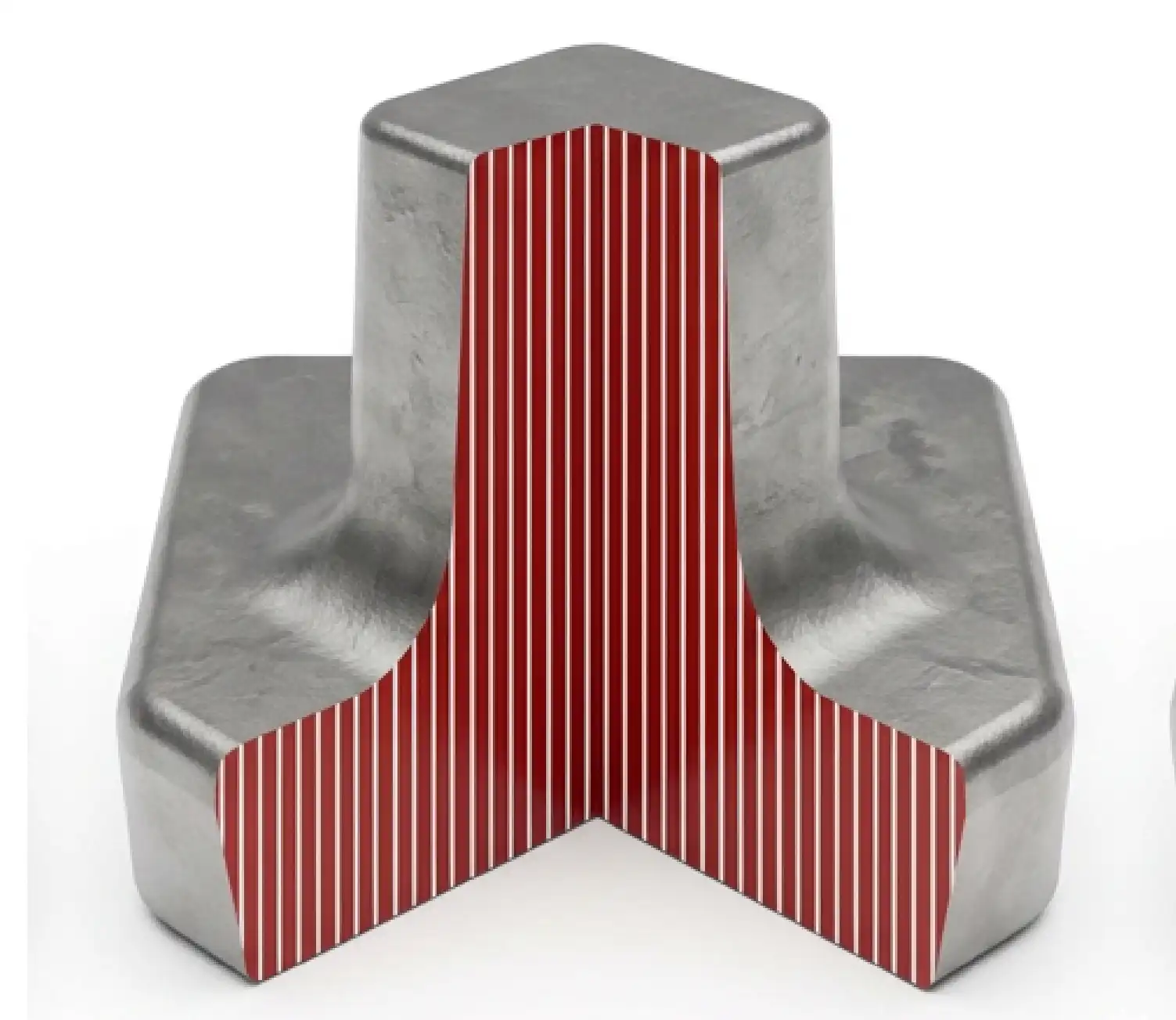
Machined from bar
Grain runs straight through
Wherever the contour crosses the bar, the grain is severed. The geometry is free, but strength does not follow the shape.
Weakest in fatigue · most material wasted
For parts that carry load. Compare Indian forgers on process route, press class, alloy and temper, heat treatment and machining — across automotive, EV, aerospace and industrial components.
Because of where the grain ends up. The same component made three ways has three different internal structures — and that, not the shape, is what you are paying for.
Why does grain flow matter in a forged part?
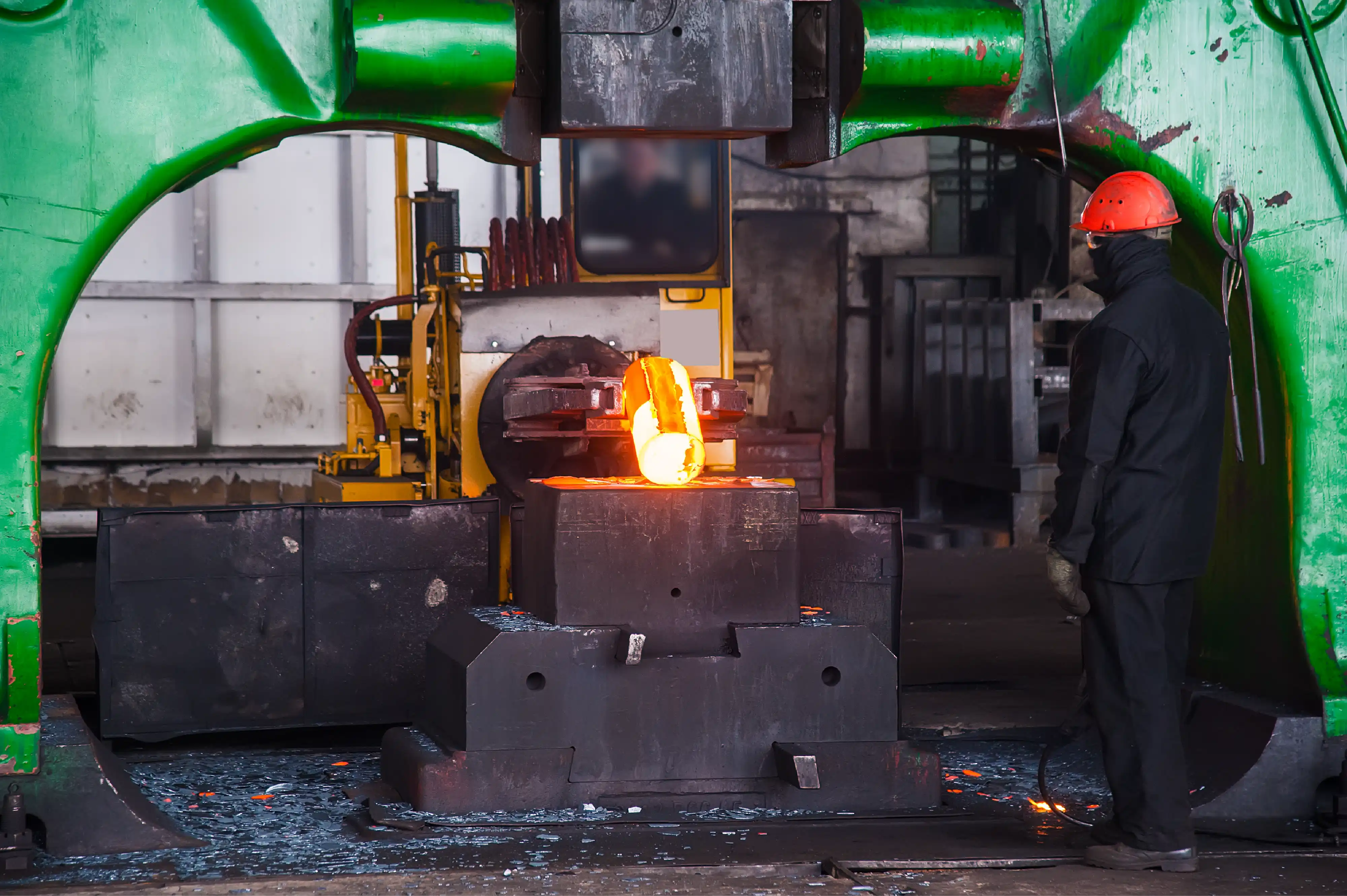
Forging deforms solid metal, so the grain follows the contour of the component and strength runs along the load path. Machining the same shape from bar cuts straight grain wherever the contour crosses it. A casting has no directional grain at all. For parts under cyclic load, that difference decides service life.
Machined from bar
Wherever the contour crosses the bar, the grain is severed. The geometry is free, but strength does not follow the shape.
Weakest in fatigue · most material wasted
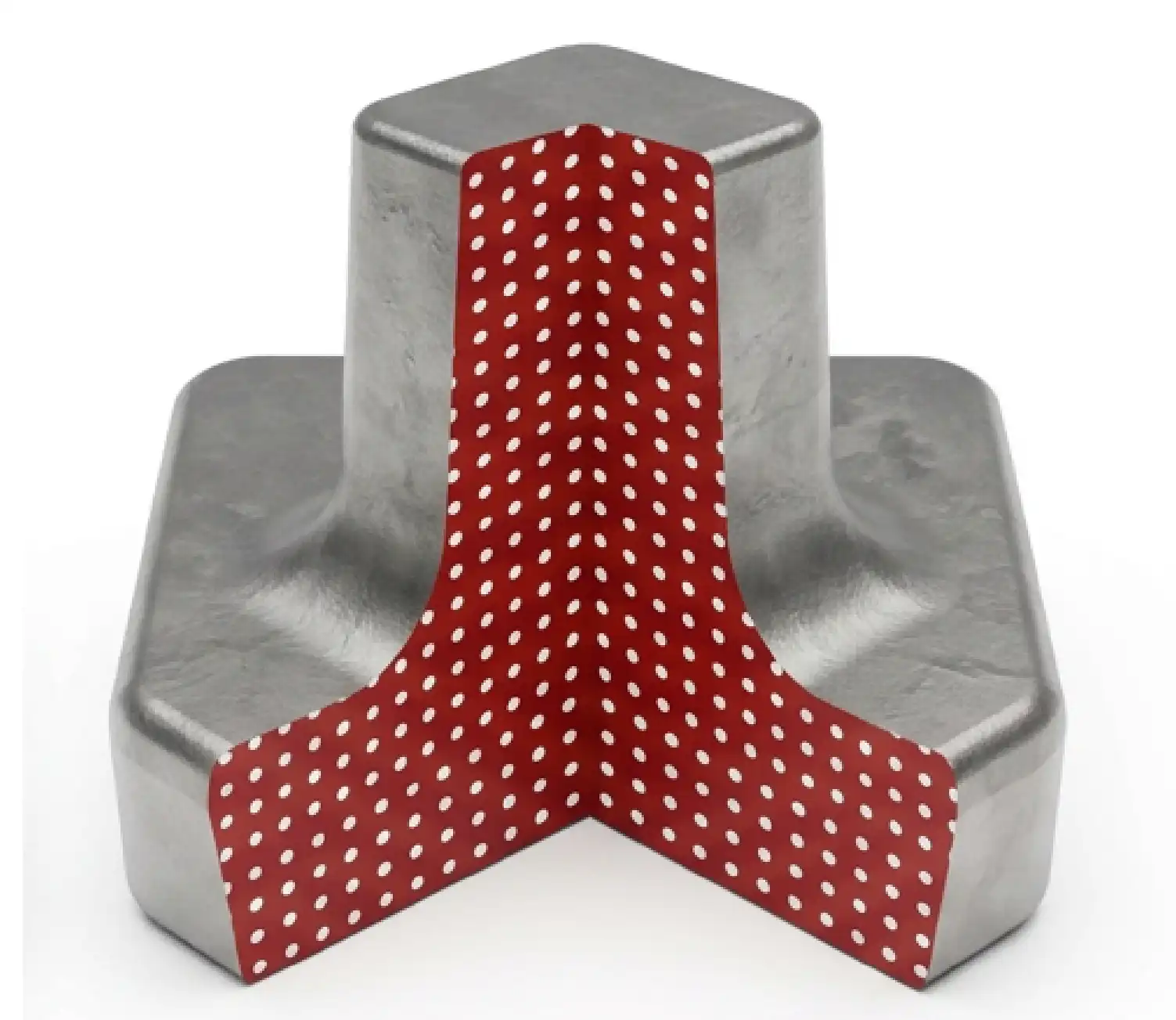
Cast
Solidified structure is uniform but undirected, and porosity is a live risk. Complex shapes are easy; load-bearing duty is not.
Lower strength · highest geometric freedom
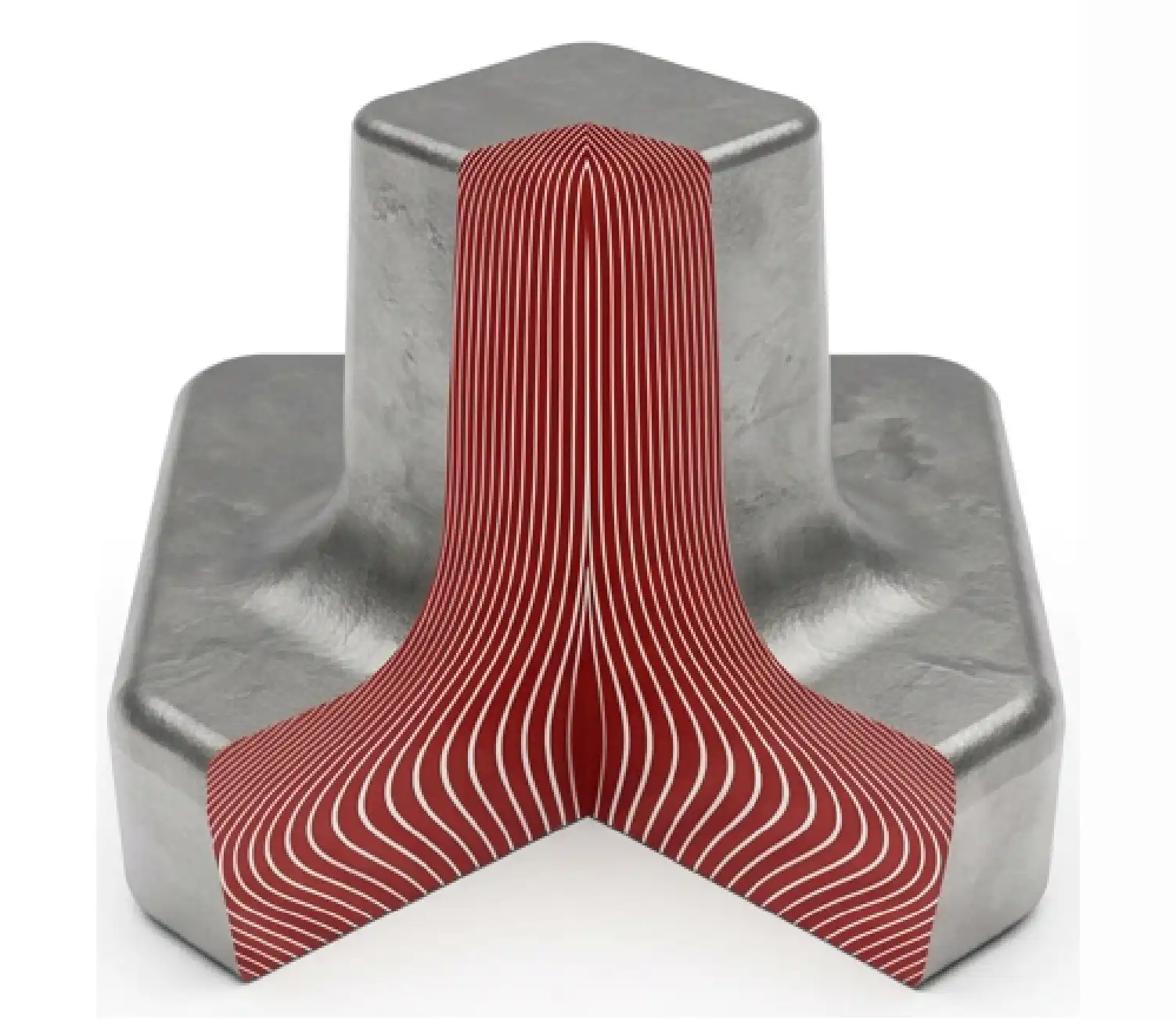
Forged
Deformation aligns the grain along the part, so strength sits where the load path needs it. This is the reason forging exists.
Highest fatigue strength · near-net material use
Choose on how the part is loaded, not on which quote arrives lowest.
| Factor | Forged | Machined from bar | Cast |
|---|---|---|---|
| Grain structure | Follows the contour of the part | Severed wherever the contour cuts the bar | No directional grain |
| Fatigue strength | Highest of the three | Reduced where grain is cut | Lower, and porosity-dependent |
| Material usage | Near-net, modest flash loss | High — most of the bar becomes swarf | Efficient, close to final shape |
| Geometric freedom | Moderate; draft and parting line constrain it | Very high | Highest — thin walls and complex cores |
| Tooling cost | Die cost up front | None beyond fixtures | Die cost up front |
| Best suited to | Load-bearing, fatigue-critical parts at volume | Prototypes, low volume, very complex machined features | Complex housings where strength is secondary |
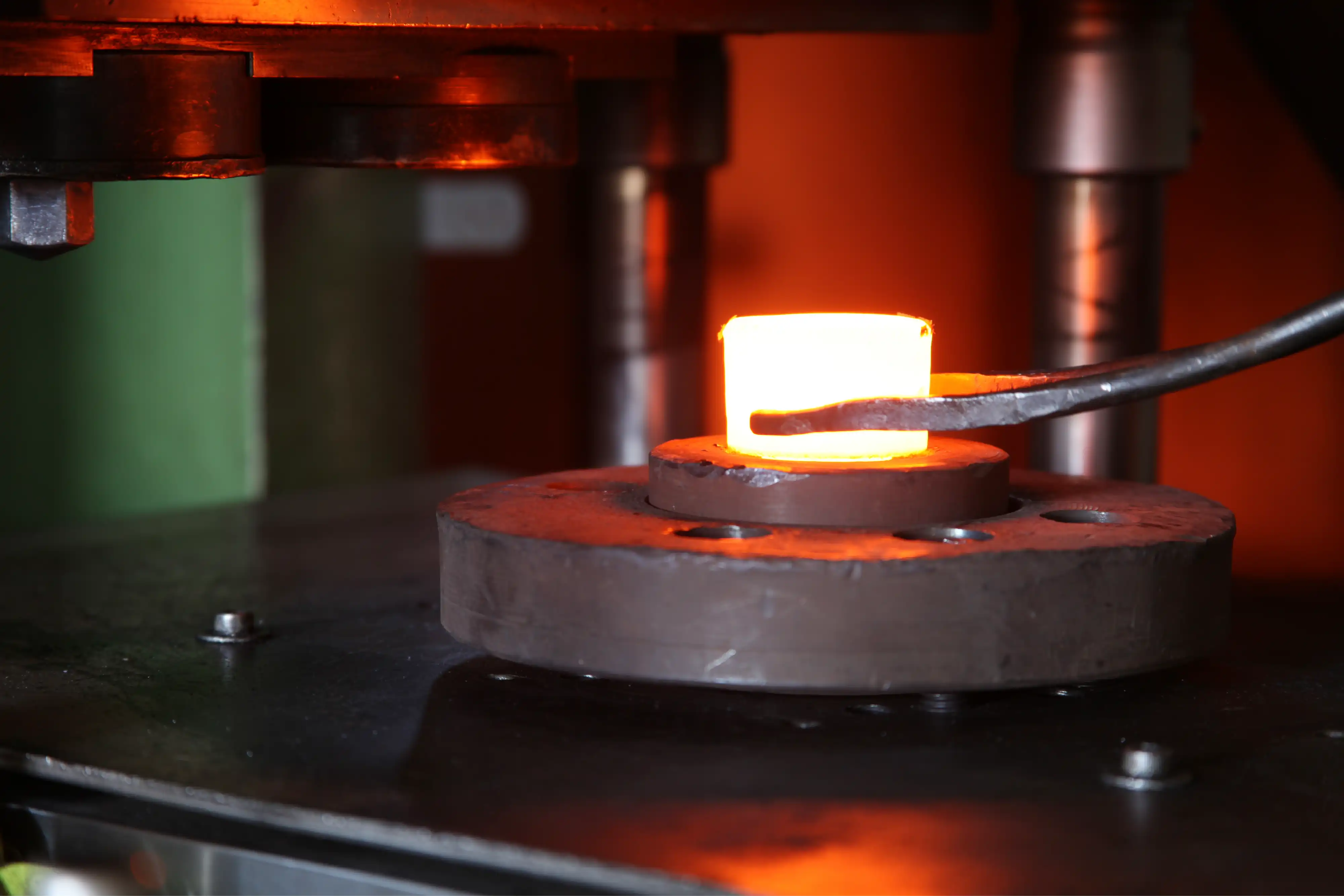
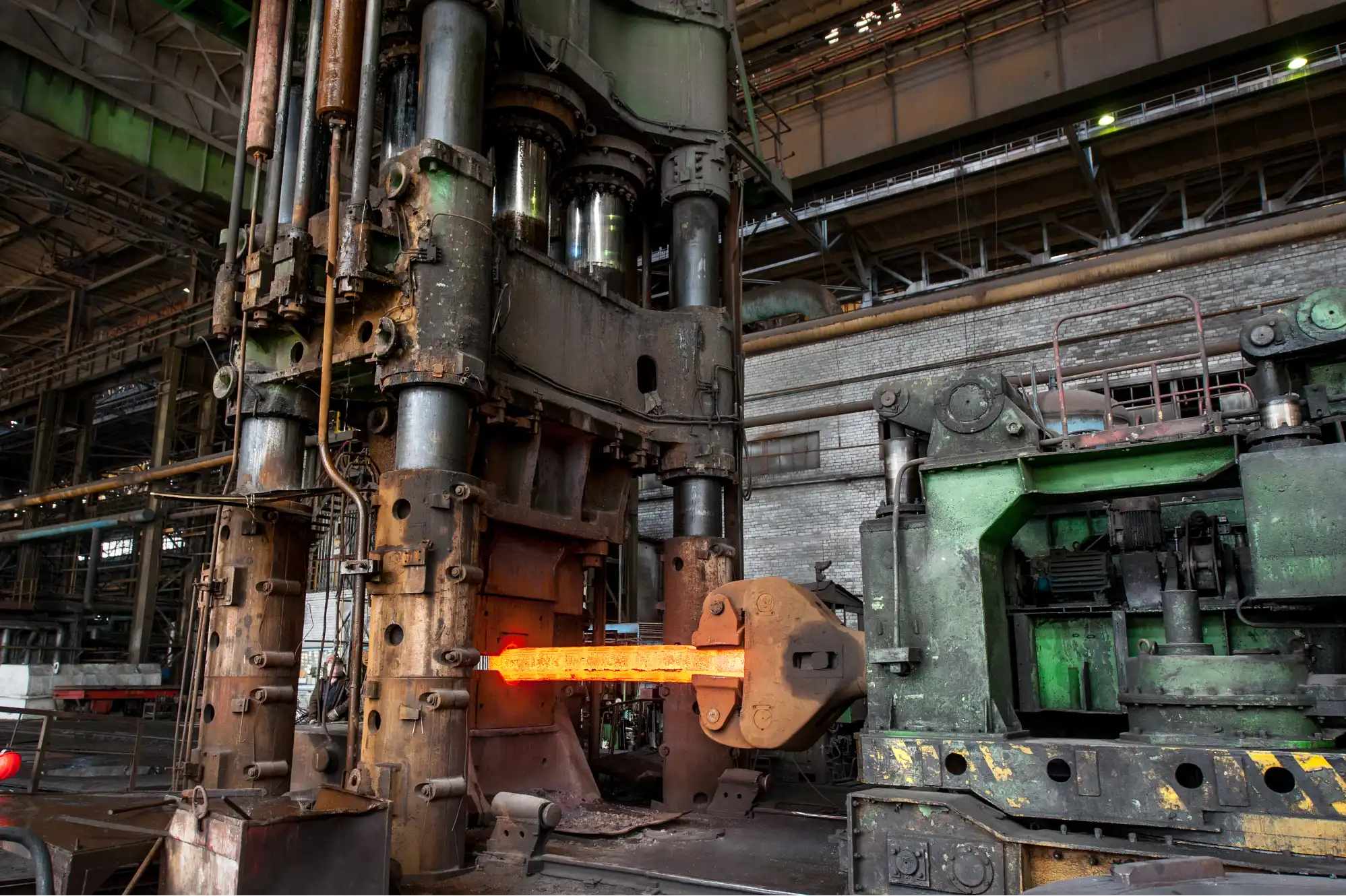
India is one of the largest forging economies in the world, built around the automotive corridors. Suppliers run from specialised forging shops to integrated manufacturers with tool rooms, heat-treatment furnaces, machining cells and inspection under one roof.
Capability is supplier-specific and the spread is wide — presses from a few hundred tonnes to 2,000 T and above, plus hammers. What matters is whether one supplier’s equipment, alloy handling, temper control and machining line up with your part.
Submit your componentDrawn from what Indian forging suppliers publicly document about their own equipment and processes. Every line below moves with the supplier, the press and the part.
| Capability | Commonly available | Available from selected suppliers |
|---|---|---|
| Forging process | Closed-die / impression-die, hot forging | Precision, near-net-shape, open-die and specialised forging |
| Forging equipment | Hydraulic and mechanical presses, forging hammers | High-tonnage presses, automated forging lines and specialised equipment |
| Component weight | Small to medium forged components | Larger rings, discs and specialised components, equipment depending |
| Common alloys | 6061, 6082, 6063 | 2014, 2219, 2618, 6351, 7075, 7050 and other application-specific grades |
| Heat treatment | T6 and alloy-specific treatment | T652, T852, T7352 and other controlled tempers where applicable |
| Tooling | Custom forging dies and trimming tools | In-house tool rooms, forging simulation and specialised tooling |
| Machining | CNC turning, milling, drilling and tapping | Complex multi-operation machining and precision finishing |
| Surface finishing | Shot blasting and standard finishing | Anodising, powder coating, painting and specialised treatments |
| Inspection | Dimensional inspection and material verification | CMM, hardness, ultrasonic, X-ray and other specialised testing |
| Production volume | Prototype, low and medium volume depending on supplier | High-volume OEM programmes and automated lines |
| Integrated manufacturing | Forging plus selected downstream operations | Forging, heat treatment, machining, finishing, testing and assembly |
Different routes suit different volumes, geometries and tolerance expectations.
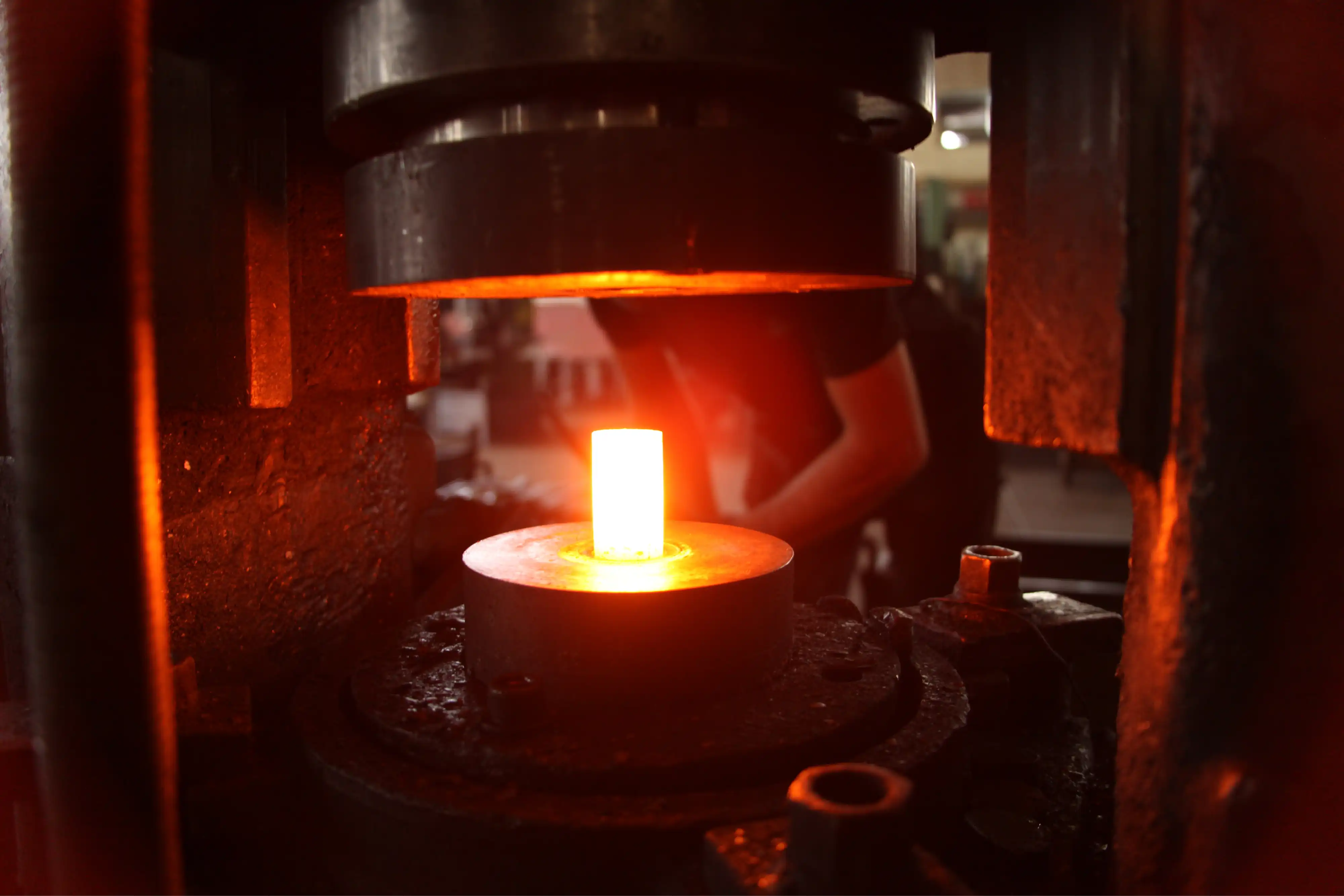

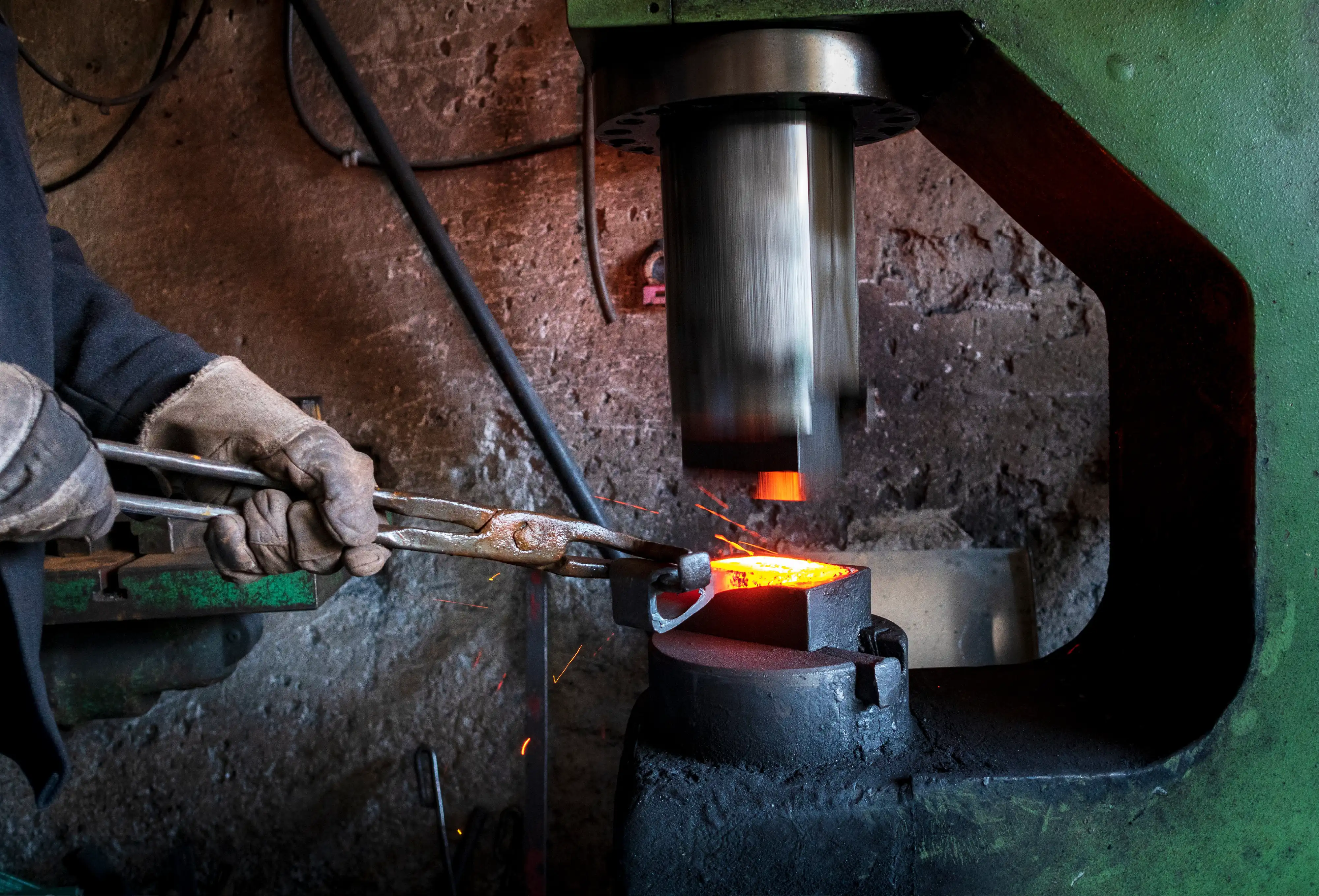
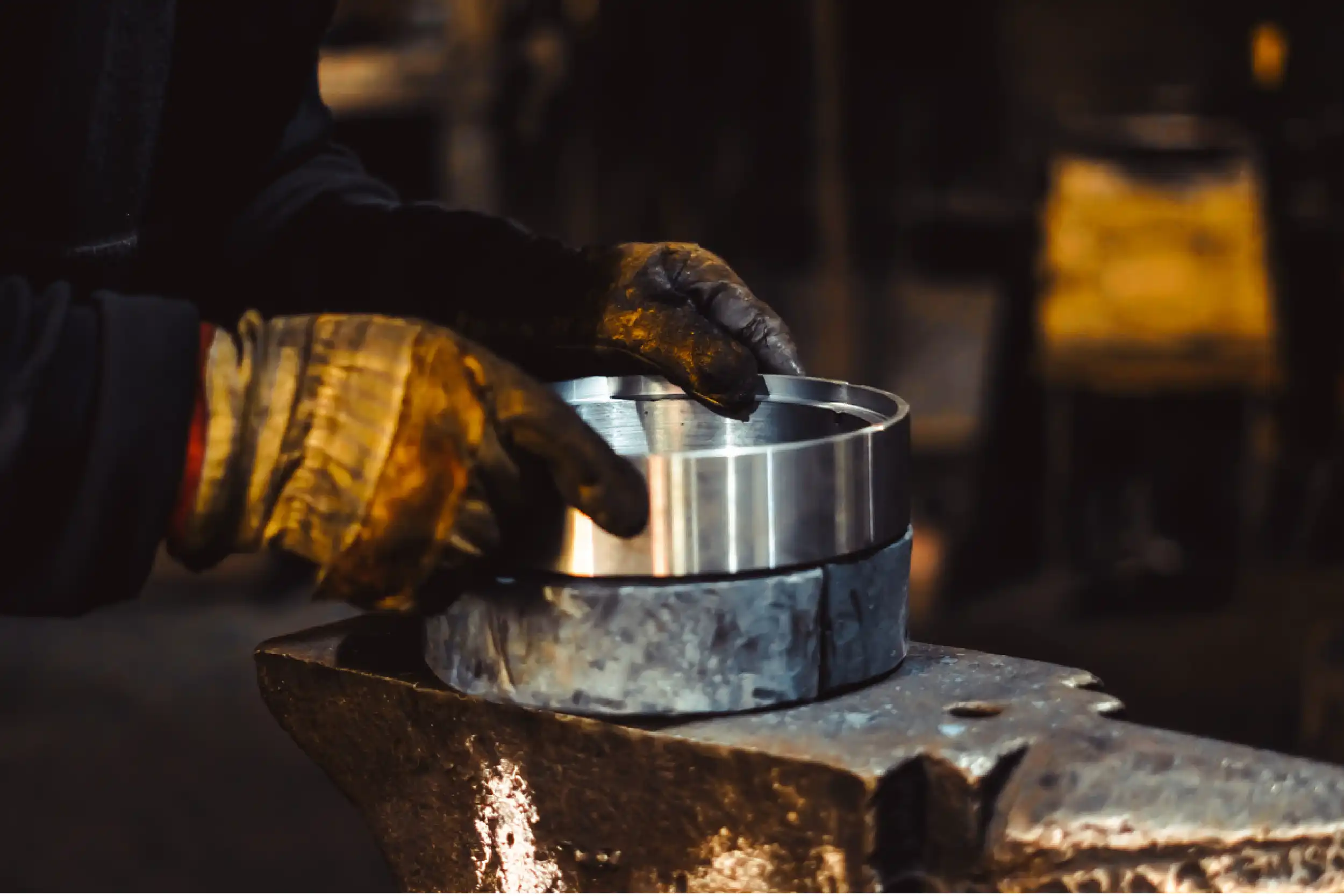
Selection follows strength, fatigue performance, corrosion exposure, machinability and service temperature.
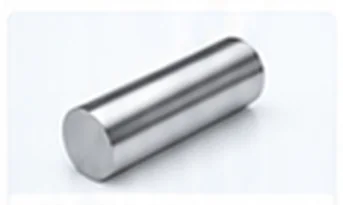
Workhorse grade
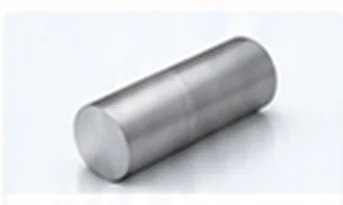
Structural 6000-series
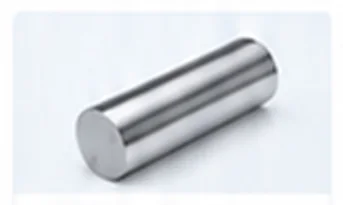
High strength-to-weight
High-strength 2000-series
Supplier dependent
Forging capacity grew up alongside the automotive belts, and still clusters there.
India’s largest forging belt; automotive and heavy forgings
Forging with machining depth; auto components
Auto components and engineered forgings
General engineering forgings, fasteners and auto parts
Engineering forgings and machined assemblies
Automotive forgings with export orientation
Pump bodies, motor parts and general engineering forgings
Automotive forging and machining base
Forging problems are expensive late: a worn die, a missed temper or an under-specified allowance all surface after tooling money is spent.
How do I evaluate an aluminium forging supplier in India?
Confirm the parting line and grain-flow direction, the specific press or hammer your part will run on, die ownership and expected die life, the heat-treatment route and its certification, billet source and chemistry, machining allowance per face, and the non-destructive testing plan.
Equipment list by tonnage, tool room, heat-treatment furnaces, NDT capability and certification scope — captured by a MESH audit before a forger reaches your shortlist.
See a sample auditFrom suspension arms to aerospace brackets, forged to drawing.
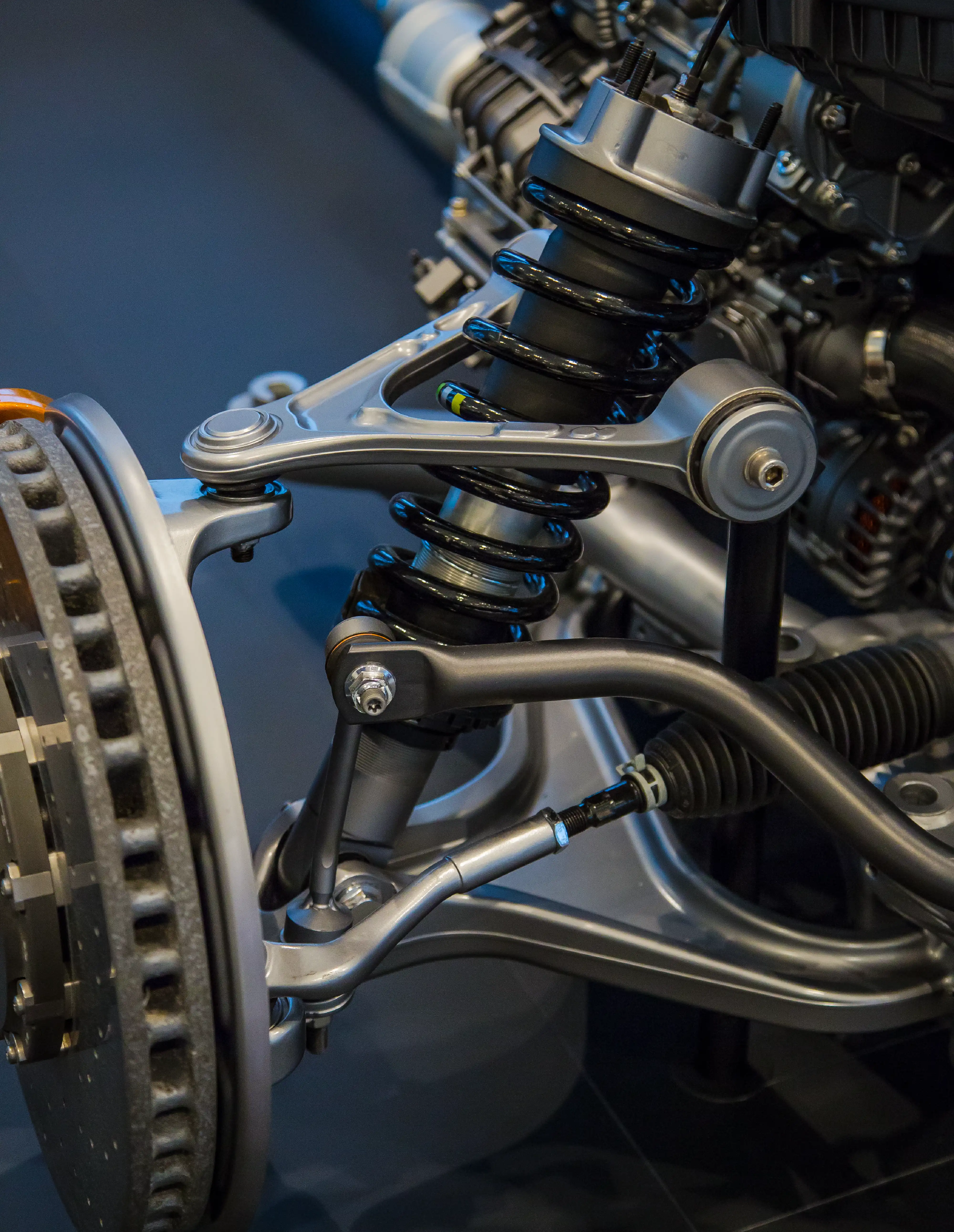
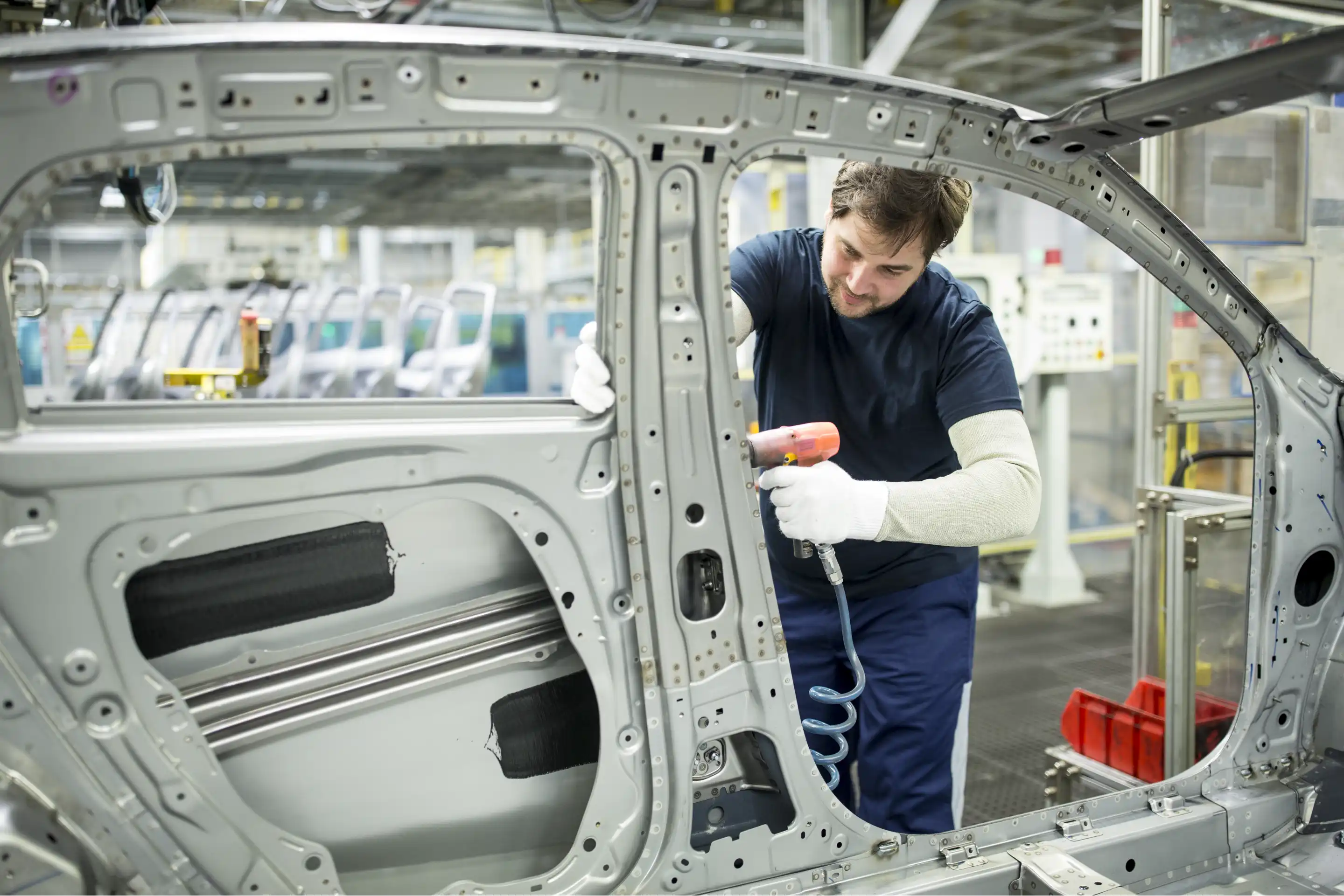
Suspension arms, steering parts, brackets and levers.
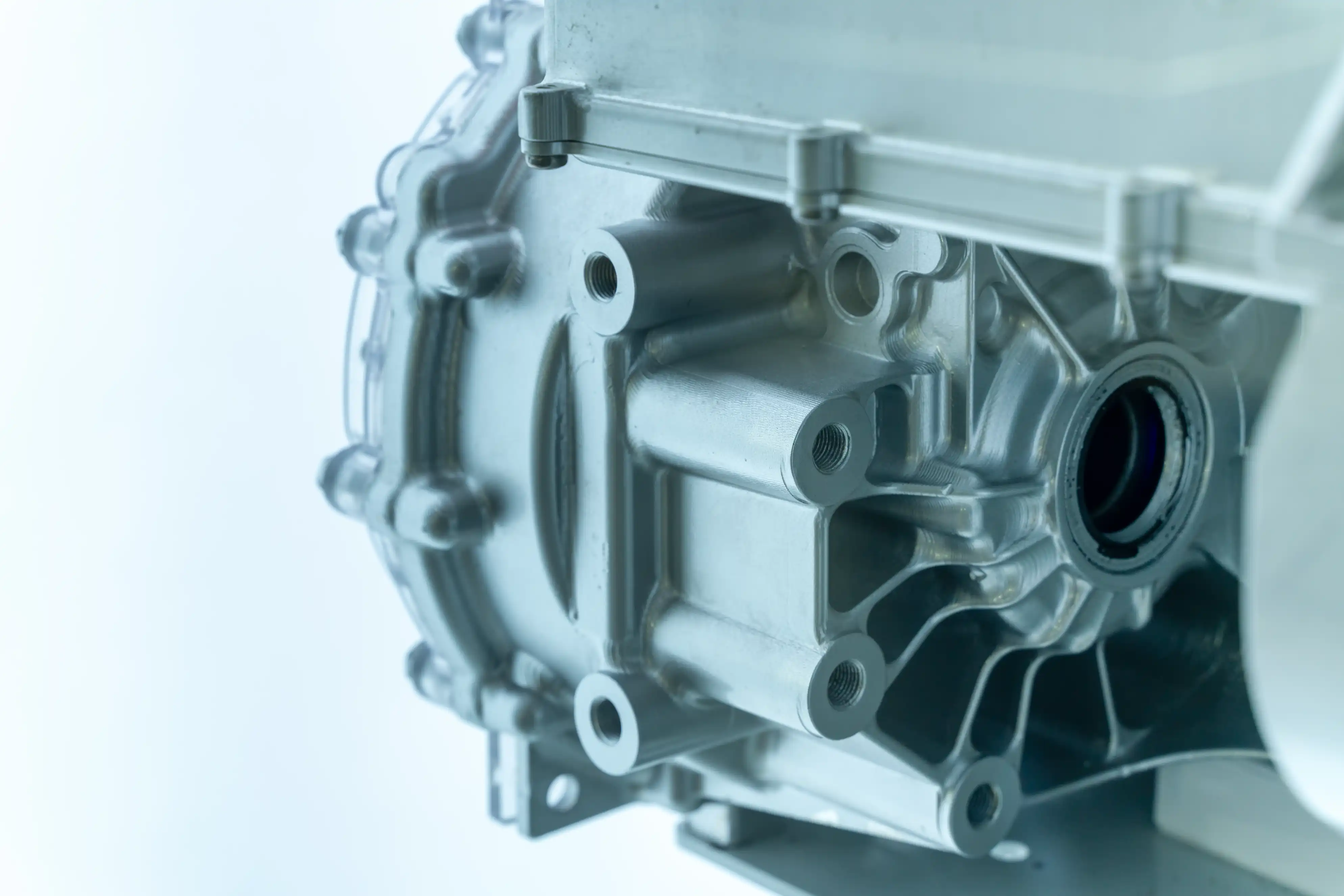
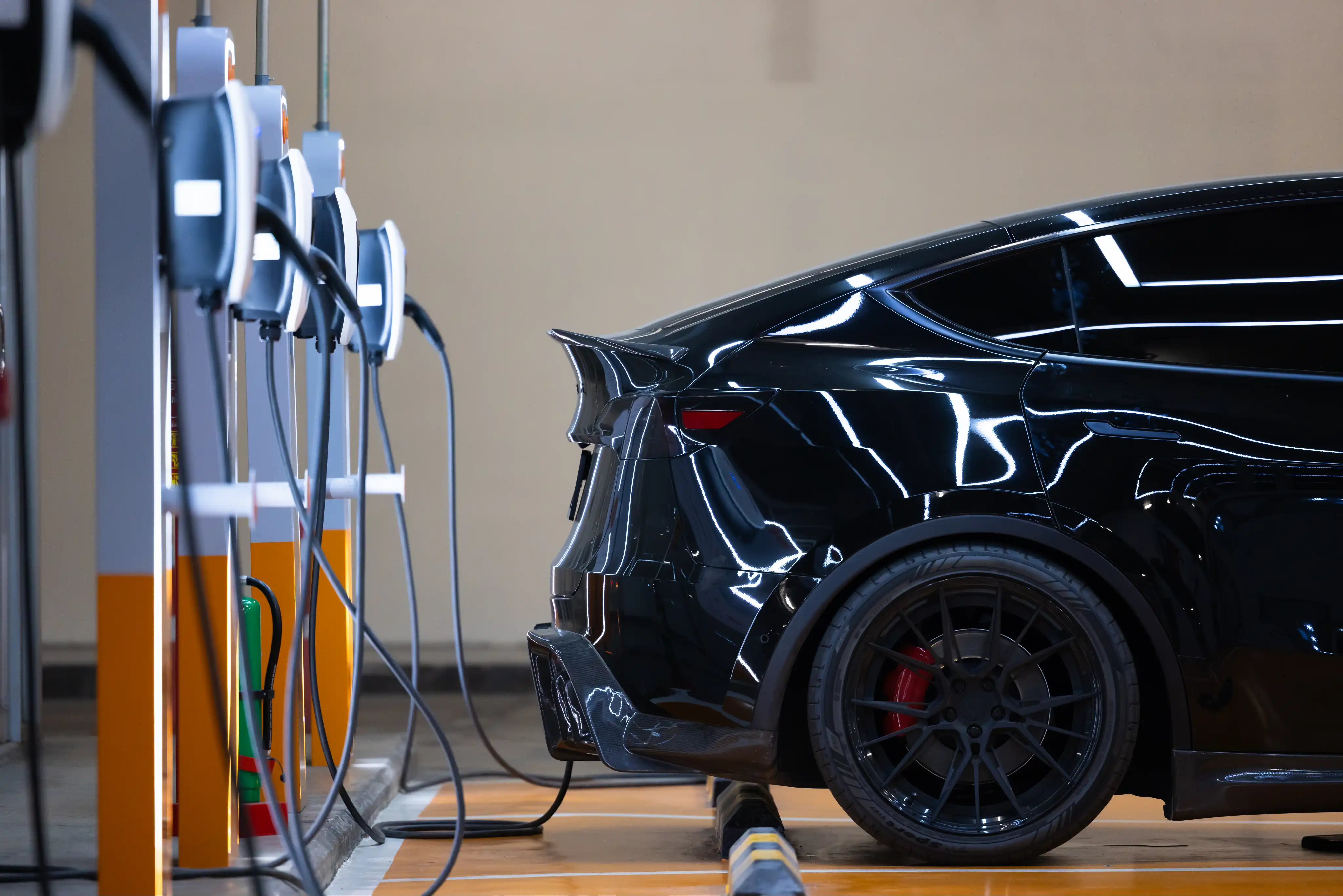
Motor housings, structural parts and battery-related components.
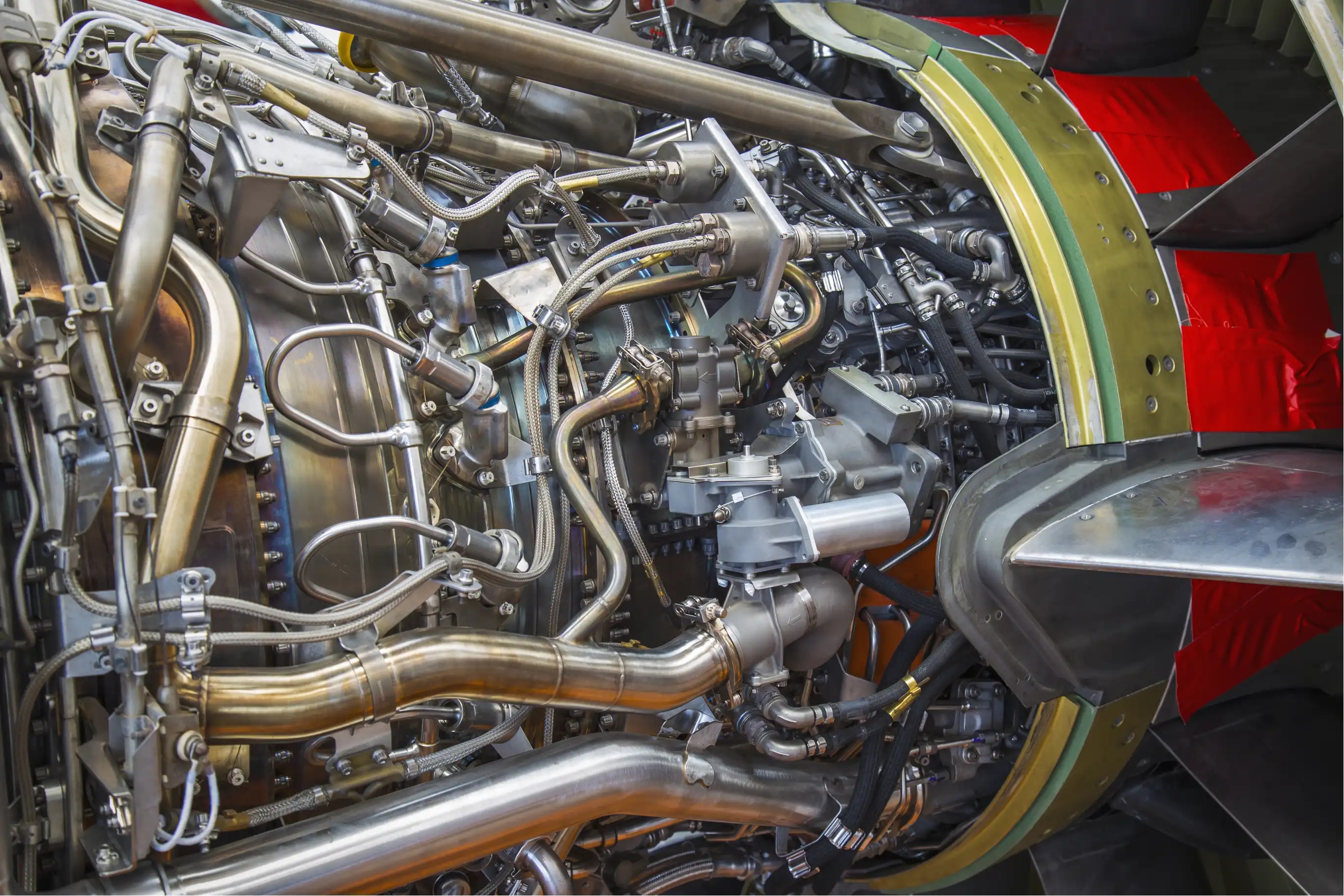
High-strength forged parts for aerospace and defence.
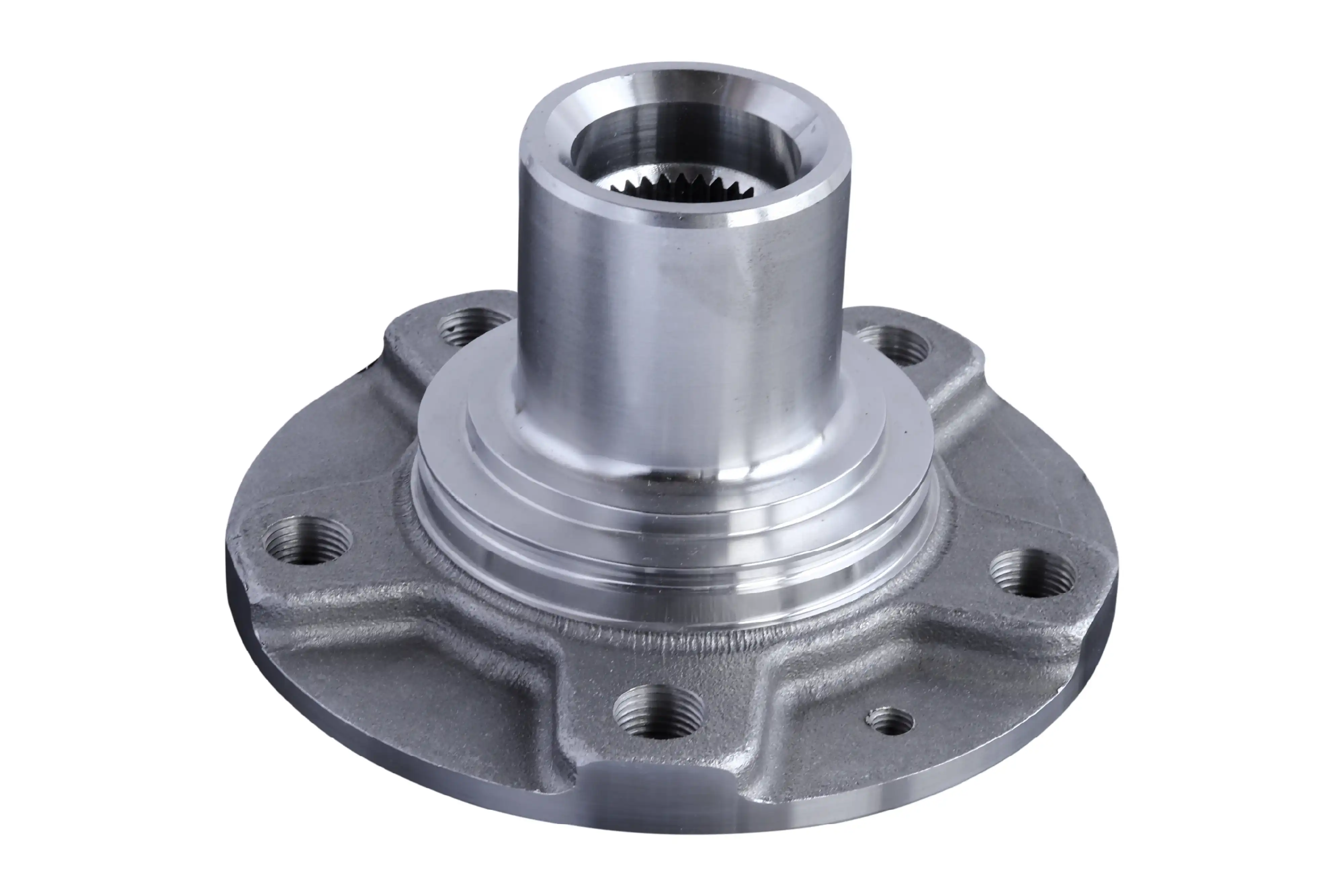
Shafts, hubs, flanges and machinery parts.
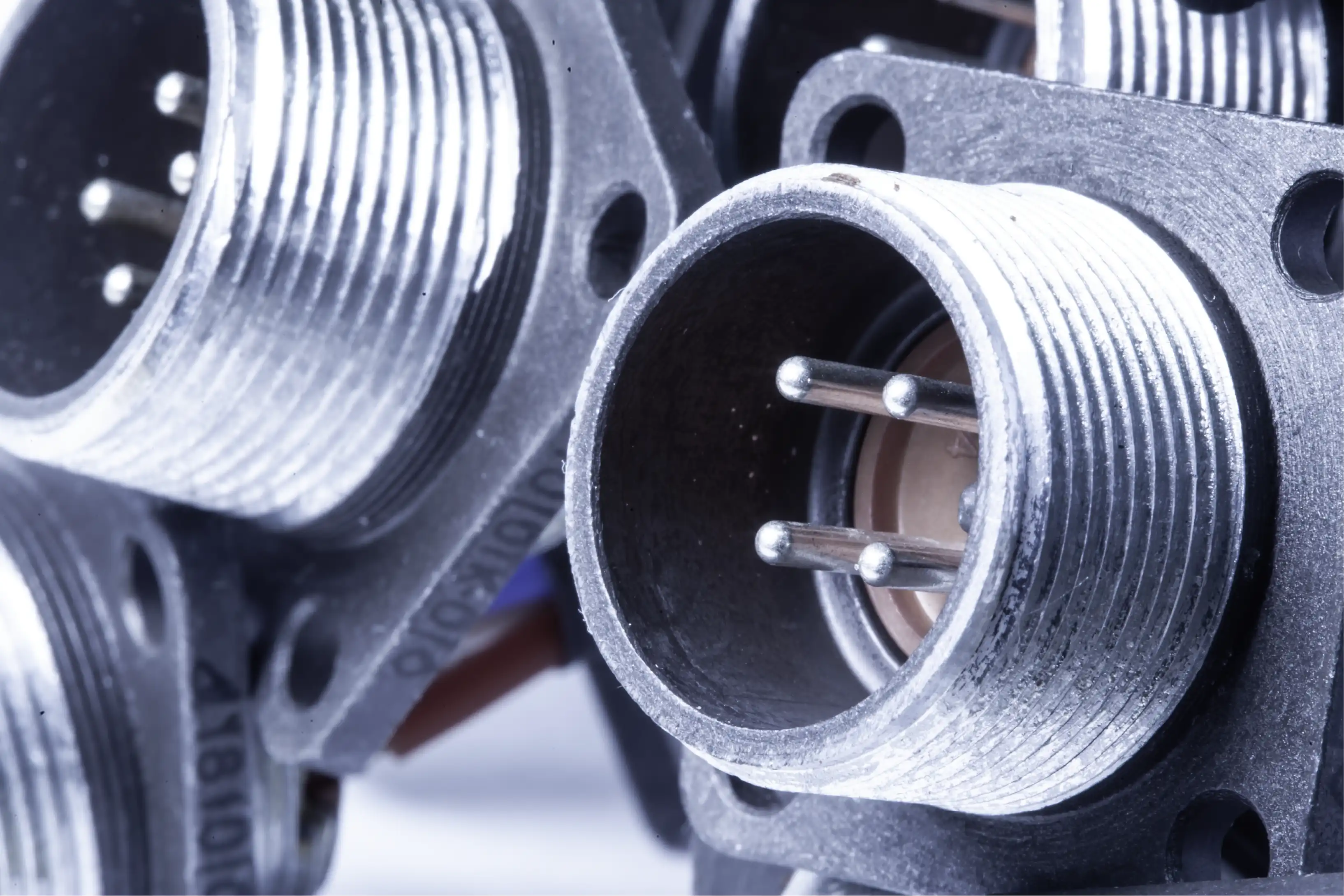
Conductive and structural forged aluminium parts.
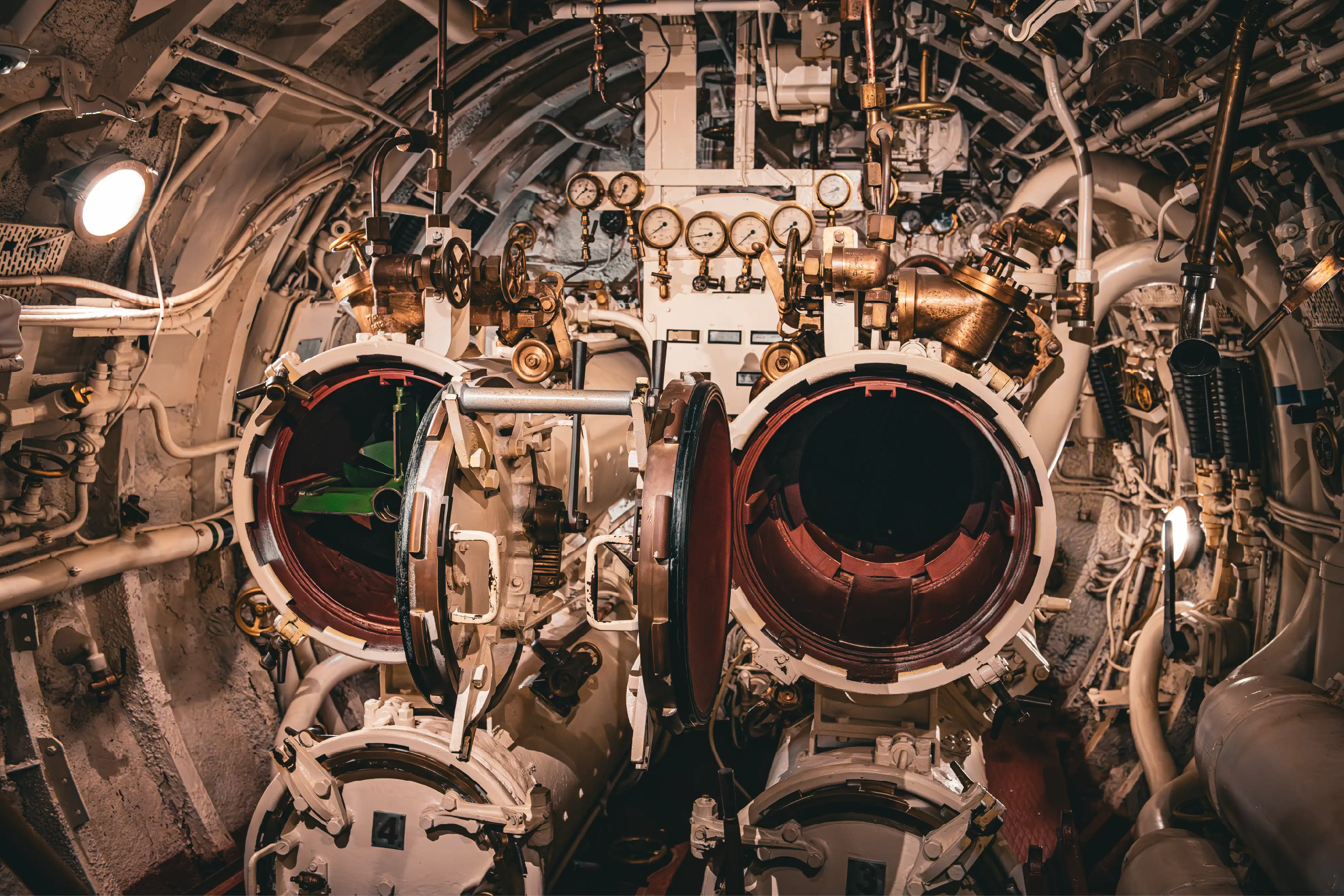
Corrosion-resistant, performance-critical components.
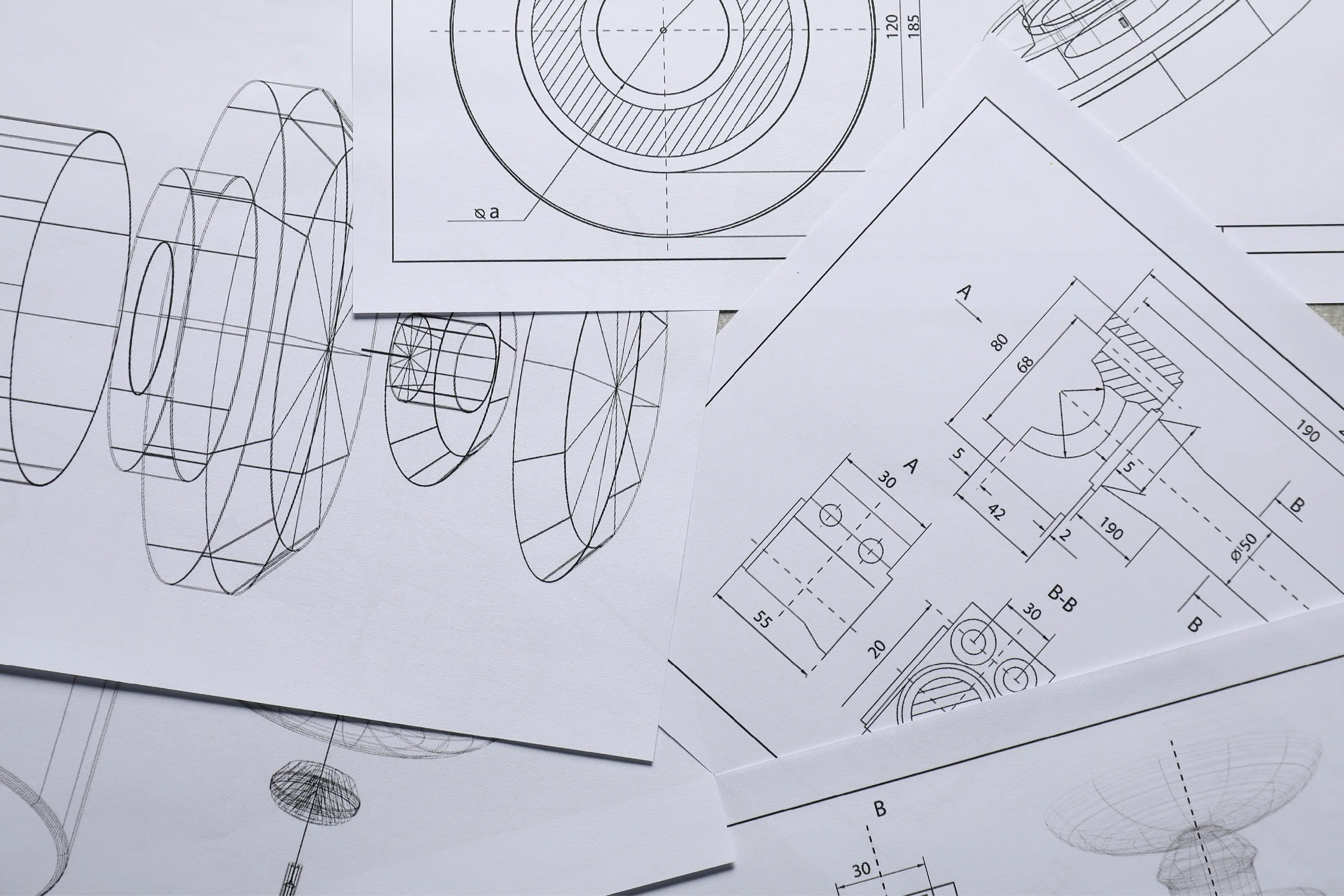
Forged to your 2D and 3D drawings and specifications.
Send the drawing, alloy, temper and annual volume. We match it to forgers with the right press, dies and heat treatment.
Find suppliersMost Indian forgers cover more of this route than buyers assume. What matters is which of those steps happen under their own roof.
Heat treatment sits in the middle of the chain, and it is where mechanical properties are actually created. When forging and heat treatment sit with one supplier, so does responsibility for the test certificate.
Whether heat treatment and NDT are in-house or subcontracted, and whether the special-process approval — NADCAP where relevant — covers the subcontractor too.
Where the work sits best depends on part size, alloy grade and destination market.
| Factor | India | China | Vietnam | Mexico | USA | Poland |
|---|---|---|---|---|---|---|
| Indicative cost position (ex-works) | Low–mid | Low–mid | Low | Mid | High | Mid |
| Forging supplier depth | Very deep — a major global forging base | Deep | Developing | Moderate | Deep | Moderate |
| Aerospace-grade capability | Present at selected suppliers | Present | Limited | Moderate | Strong | Strong |
| Integrated machining | Widely offered with forging | Widely offered | Often separate | Widely offered | Widely offered | Widely offered |
| US trade exposure | Section 232 on aluminium; verify HTS | Section 232 + China-specific measures | Section 232; origin scrutiny | USMCA treatment depends on origin rules | Domestic | Section 232 |
| US transit | ~25–40 days* | ~30–45 days* | ~28–40 days* | ~2–5 days* | Domestic | — |
| EU transit | ~20–30 days* | ~30–40 days* | ~30–40 days* | — | — | ~2–4 days* |
| Best fit | Fatigue-critical parts, mid-to-high volume, forging plus machining | Very high volume and large forgings | China+1 for simpler forged parts | US nearshoring for automotive | Aerospace and defence compliance | EU-destined production |
*Ocean leg only, port to port. Add inland movement at both ends, customs and any heat-treatment lead time before you compare delivery promises.
Where forged aluminium from India ends up.

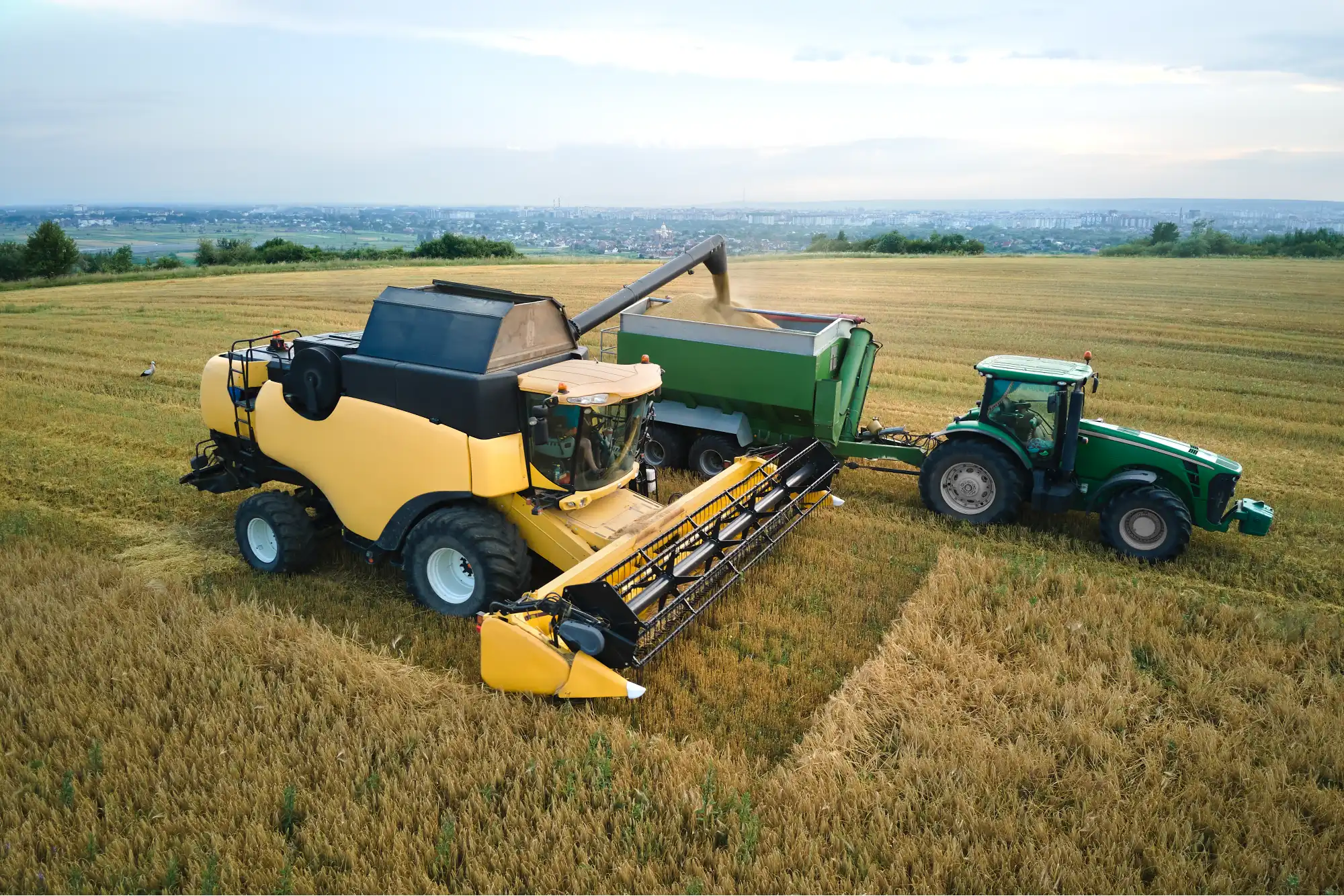
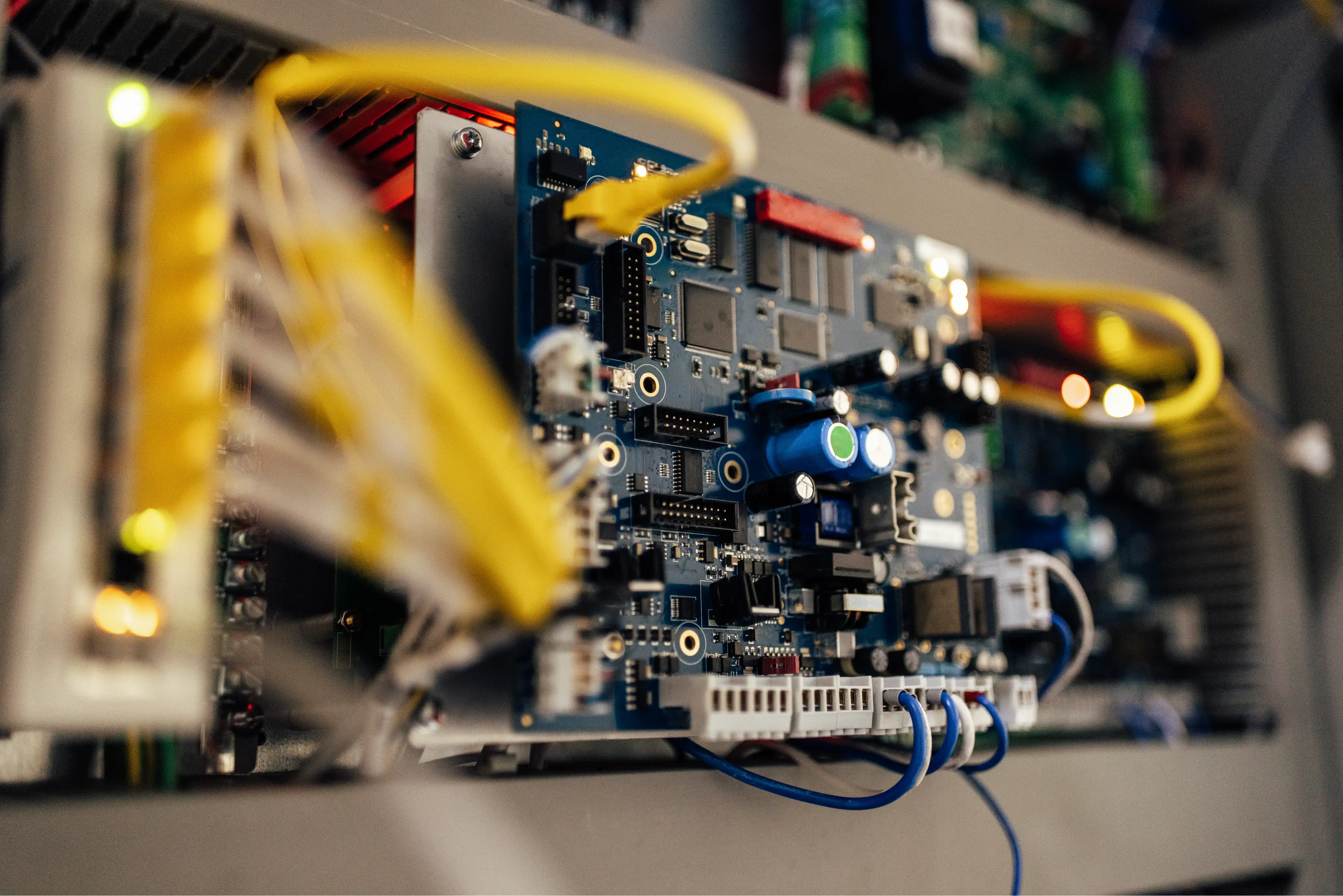
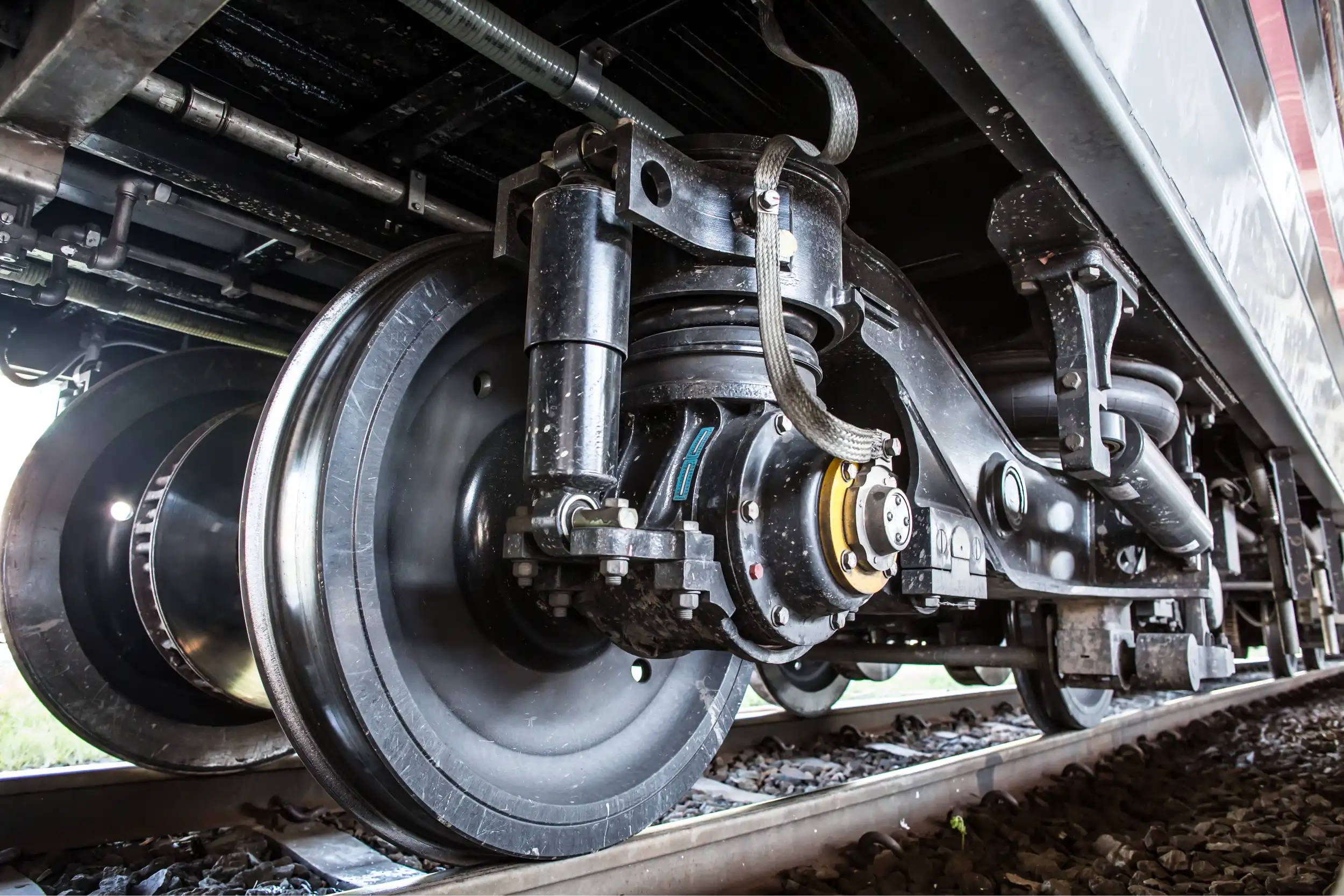
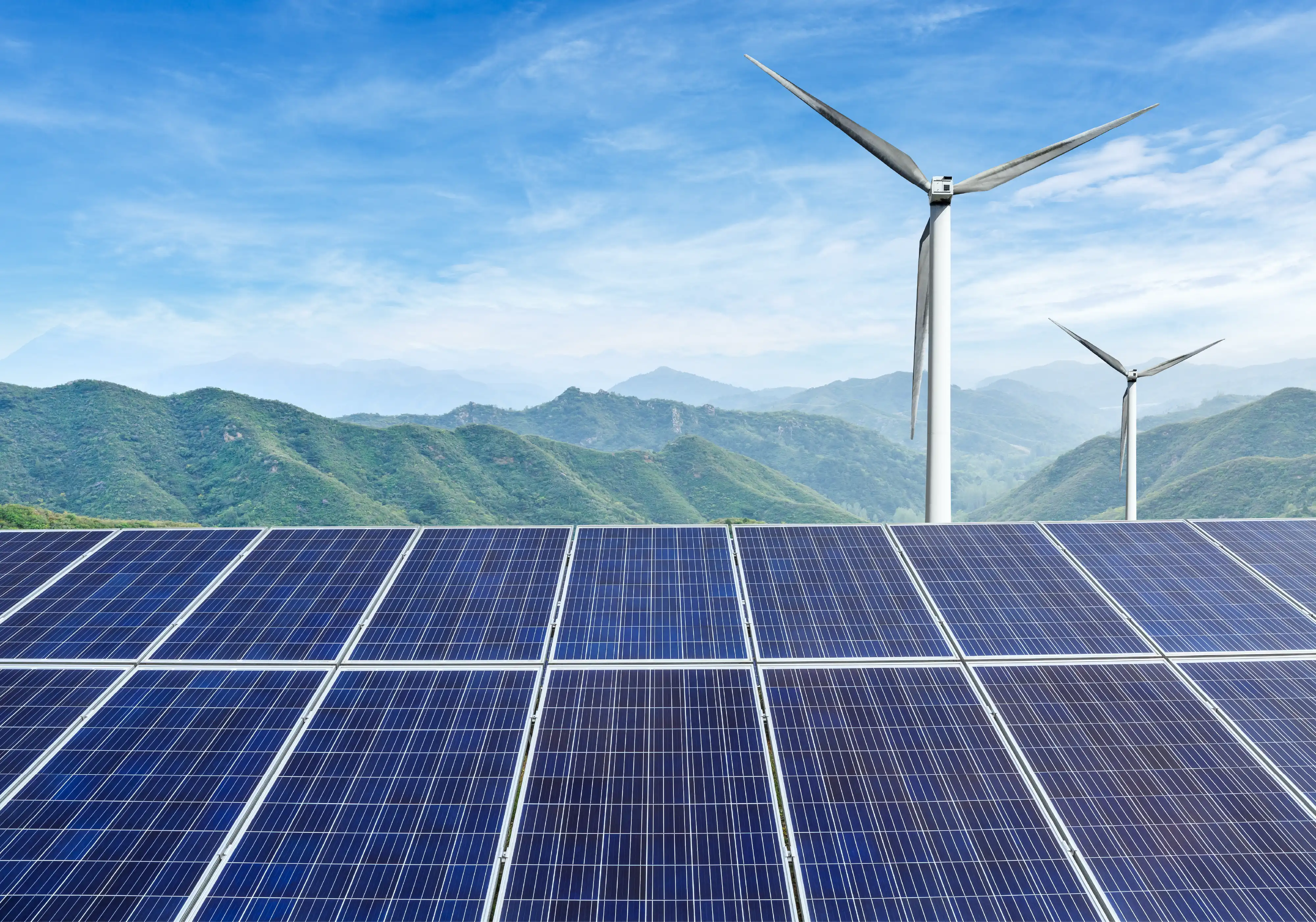
Any directory can give you a forging company in Pune. None of them can tell you whether the grain will run the right way.
Alloy without temper, or a drawing without machining scope, gets you a number that changes later.
From drawing to a shortlist of forgers, without leaving the platform.
Sign in with your company credentials.
Open Sourcing and begin a request.
Alloy, temper, part weight, volume and machining scope.
Shortlist forgers with the right press class and heat treatment.
Reach the shortlist directly and ask for prices.
Aluminium alloy is shaped under controlled pressure between dies, on a press or hammer, usually while hot. The point is not just the shape: deformation aligns the metal's grain with the contour of the part, which is why forgings outperform castings and machined bar in fatigue.
Send the part, the alloy and the temper. We come back with Indian forgers whose press class, heat treatment and machining fit the component.
Find forging suppliersForged, treated, verified.