Brass remains an important engineering material for components used across automotive, electrical, electronics, industrial equipment, valves, appliances, energy systems, and other manufacturing applications. Depending on the component and application, buyers may source brass parts through processes such as CNC machining, casting, stamping, injection moulding, forming, and other precision manufacturing methods.
Finding a supplier that lists brass as a commodity, however, is only the first step. Procurement teams also need to evaluate the supplier's manufacturing processes, equipment, quality systems, certifications, production capabilities, industry experience, and ability to meet the required specifications and volumes.
MESH Works' Supplier Discovery network includes 900+ brass suppliers, giving buyers access to manufacturers across different countries, processes, and industries.
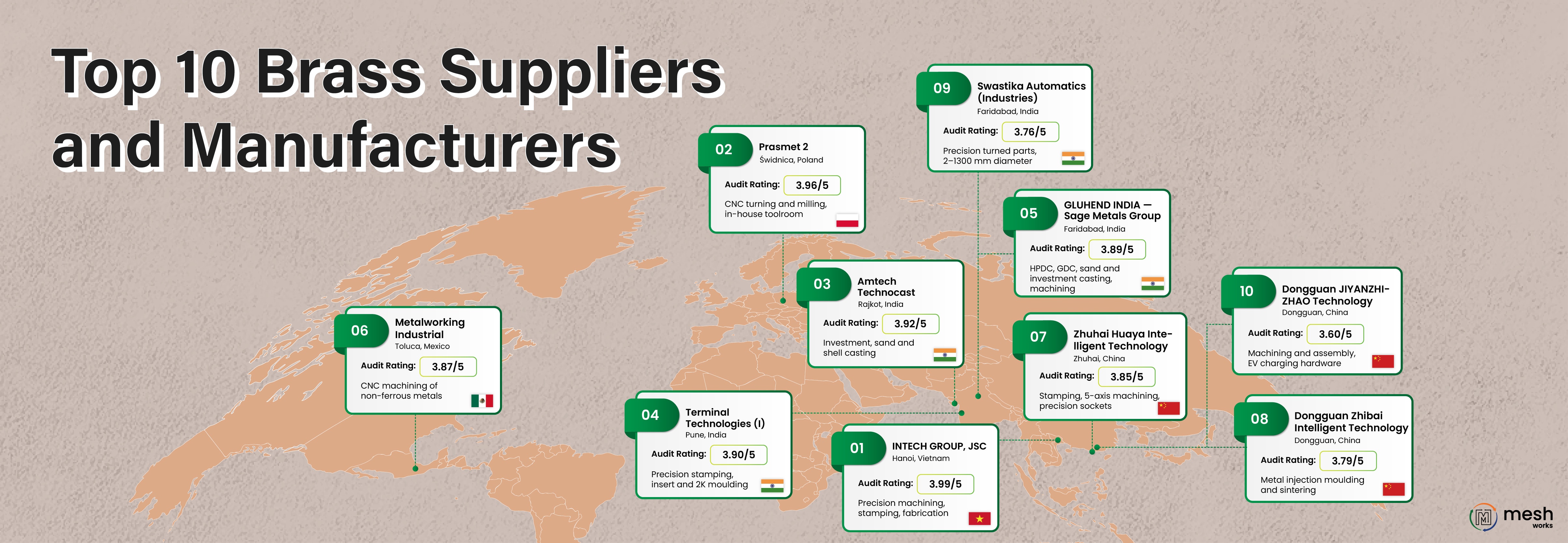
In this guide, we highlight 10 brass suppliers and manufacturers from the MESH Works network, covering manufacturing companies across India, China, Vietnam, Poland, and Mexico.
How We Selected These Suppliers
Every supplier on this list has been visited in person by a MESH Works engineer and assessed against 45 points covering manufacturing capability, equipment, quality systems, capacity, engineering support and logistics, documented with photographs and video from the factory floor.
The shortlist was built on:
Brass as a working material in the supplier's production
A process brass components are actually made by — machining, casting, stamping, forming, MIM
Current certification appropriate to the industries served
Demonstrated capacity, confirmed during the audit
Several suppliers here work across many commodities. Where that's the case, the entry focuses on the brass-relevant capability and the applications where brass is genuinely the material.
Top 10 Brass Suppliers at a Glance
# | Supplier | Location | Key brass capability | Certifications | MESH rating |
1 | INTECH GROUP, JSC | Hanoi, Vietnam | Precision machining, stamping, fabrication | ISO 9001 | 3.99 |
2 | Prasmet 2 | Świdnica, Poland | CNC turning and milling, in-house toolroom | ISO 9001 | 3.96 |
3 | Amtech Technocast | Rajkot, India | Investment, sand and shell casting | ISO 9001, PED 2014/68, AD 2000 | 3.92 |
4 | Terminal Technologies (I) | Pune, India | Precision stamping, insert and 2K moulding | IATF 16949, ISO 14001 | 3.90 |
5 | GLUHEND INDIA — Sage Metals Group | Faridabad, India | HPDC, GDC, sand and investment casting, machining | ISO 9001, ISO 14001, ISO 45001, IATF 16949 | 3.89 |
6 | Metalworking Industrial | Toluca, Mexico | CNC machining of non-ferrous metals | ISO 9001, IATF 16949 | 3.87 |
7 | Zhuhai Huaya Intelligent Technology | Zhuhai, China | Stamping, 5-axis machining, precision sockets | ISO 9001, ISO 13485, IATF 16949, ISO 45001 | 3.85 |
8 | Dongguan Zhibai Intelligent Technology | Dongguan, China | Metal injection moulding and sintering | ISO 9001, ISO 14001 | 3.79 |
9 | Swastika Automatics (Industries) | Faridabad, India | Precision turned parts, 2–1300 mm diameter | IATF 16949, ISO 9001 | 3.76 |
10 | Dongguan JIYANZHIZHAO Technology | Dongguan, China | Machining and assembly, EV charging hardware | ISO 9001, ISO 14001, ISO 45001 | 3.60 |
1. INTECH GROUP, JSC — Hanoi, Vietnam
Part of Intech Group and established in 2011, specialising in precision mechanical machining and sheet metal fabrication.
Capabilities
Precision CNC machining for complex 2D and 3D contours
CNC laser cutting, press braking, punching, semi-automatic welding
Jigs and tools, including assembly, welding and test jigs
Plastic, injection and stamping mould processing
ISO 9001:2015
Brass alongside stainless steel, aluminium, bronze and carbon steel
Industries: electronics, appliances, lighting, medical instruments, energy and heavy equipment
Intech's electronics work — jigs and tooling for printers, phones, televisions and LCD assembly — is where brass tends to appear, in contacts, bushings and fixture components that need machinability and wear resistance.
View INTECH GROUP on MESH Works →
2. Prasmet 2 Sp. z o.o. — Świdnica, Poland
A manufacturer of mechanical components and subassemblies whose commodity list is entirely non-ferrous — aluminium, copper and brass. That focus is unusual and makes it the most brass-oriented machining supplier on this list.
Capabilities
Turning, punching, threading and assembly
Hardening, sandblasting, washing and galvanising
In-house toolroom with die design, EDM, milling and grinding
PPAP documentation and a dedicated measurement laboratory
ISO 9001 certified, with IATF 16949 work underway
End-to-end support from design and prototyping through serial production, anti-corrosion coating and after-sales
Industries: energy equipment, automotive, lighting, home appliances
A dedicated measurement laboratory and PPAP capability are strong signals for brass parts going into regulated applications, where material certification and dimensional evidence matter as much as the part itself.
View Prasmet 2 on MESH Works →
3. Amtech Technocast — Rajkot, India
An investment, sand and shell casting foundry with an in-house machine shop, and the most heavily certified casting supplier on this list.
Capabilities
Investment casting, sand casting and shell casting
In-house machine shop for machined castings
Online molten metal checks on every heat
In-house mechanical testing, heat treatment and non-destructive testing
NDT by an ASNT Level II approved inspector — RT, UT, MPT and LPT
ISO 9001:2015, PED 2014/68/EU material manufacturer QA approval for investment castings, AD 2000-Merkblatt W0
Industries: industrial valves and pumps, gas turbines, oil field equipment, railway, aeronautical, orthopaedic implants, food and pharma machinery
PED and AD 2000 approvals are what European valve and pump OEMs require for pressure-bearing castings. Combined with Level II NDT in house, this is the supplier on the list best equipped for cast brass and bronze valve components.
View Amtech Technocast on MESH Works →
4. Terminal Technologies (I) Private Limited — Pune, India
A precision stamping and injection moulding manufacturer whose name describes its core product — terminals, where brass is the default material.
Capabilities
Advanced progressive stamping on high-speed machines
Tooling built in house, including stamping dies and plastic moulds
Wire-cut precision to 0.1 micron
Horizontal and vertical injection moulding, including insert moulding and 2K moulding
In-house post-stamping and moulding assembly
R&D prototyping: 3D printing, laser cutting, wire EDM, spark EDM, stage tooling
IATF 16949, ISO 14001
Industries: electrical switchgear, automotive, solar energy, power electronics, railways, telecommunication, fire alarm systems
Insert moulding is the capability to note. Brass terminals overmoulded into plastic housings — connectors, switchgear components, solar junction hardware — normally mean two suppliers and an assembly step. Terminal Technologies does both.
View Terminal Technologies on MESH Works →
5. GLUHEND INDIA PRIVATE LIMITED — Sage Metals Group — Faridabad, India
The broadest manufacturing footprint on this list, and the only supplier operating facilities in both India and the USA.
Capabilities
High-pressure die casting, gravity die casting, sand casting, investment casting
Stamping, forming, injection moulding, machining
Sheet metal fabrication, robotic MIG/TIG/resistance/spot welding, laser cutting
Surface treatment in house: zinc and tin plating, liquid painting, powder coating, chromating
In-house tooling and prototyping, integrated assembly
ISO 9001, ISO 14001, ISO 45001, IATF 16949
Industries: electrical wiring accessories, plumbing, power T&D, HVAC, telecommunication, CATV broadband, water solutions, oil and gas, marine, medical
Electrical wiring accessories and plumbing are the two largest brass end-markets in the world, and both are on this profile. Tin plating in house matters for brass electrical contacts, where bare brass tarnishes. The US facilities make it the shortest supply chain on this list for North American buyers.
View GLUHEND INDIA on MESH Works →
6. Metalworking Industrial — Toluca, Mexico
A machining house with 45 years in the metal parts sector, working almost entirely in non-ferrous metals — aluminium, bronze and brass alongside carbon steel.
Capabilities
CNC machining, VMC and HMC
Production machining, serial parts and manufacturing devices
Integrates raw material supply with machining to deliver a finished certified product
ISO 9001, IATF 16949
Industries: valves and instruments, automotive, energy equipment, medical instruments
Valves and instruments plus a non-ferrous machining focus is the clearest brass signal in the set. For US buyers, Metalworking Industrial is also the nearshore option — which matters more for brass than most commodities given the copper tariff position.
View Metalworking Industrial on MESH Works →
7. Zhuhai Huaya Intelligent Technology Co., Ltd — Zhuhai, China
An intelligent manufacturing and automation provider founded in 2007, with branches in Dongguan, Suzhou and Wuhan.
Capabilities
4- and 5-axis precision machining
Stamping, laser cutting, assembly
Automated assembly and testing equipment design
FCT, ICT and aging tests; visual inspection
Precision sockets among its named product areas
ISO 9001, ISO 13485, IATF 16949, ISO 45001
Industries: automotive electronics, medical OEM/ODM, 3C and smart wearables, precision optics, new energy
Precision sockets and test contacts are brass or beryllium copper almost without exception. The ISO 13485 medical certification alongside IATF is an unusual combination and a strong quality signal.
View Zhuhai Huaya Intelligent Technology on MESH Works →
8. Dongguan Zhibai Intelligent Technology Co., Ltd — Dongguan, China
A metal injection moulding specialist — the one genuinely different manufacturing route on this list.
Capabilities
MIM: feedstock mixing and granulation, injection moulding, catalytic debinding, vacuum sintering
Post-processing: CNC machining, heat treatment, assembly
Surface treatment including polishing, plating and PVD
ISO 9001:2015, ISO 14001:2015 with annual surveillance audits
Materials: brass, copper, titanium, tungsten alloy, aluminium, steel
Industries: medical devices, consumer electronics, aerospace, automotive power transmission
MIM is worth considering for small, complex brass parts produced in high volume — the geometries that would be expensive to machine and too intricate to cast. Worth evaluating against part size, tolerance and annual volume before assuming machining is the only route.
View Dongguan Zhibai Intelligent Technology on MESH Works →
9. SWASTIKA AUTOMATICS (INDUSTRIES) — Faridabad, India
Established in 1984 and IATF 16949:2016 certified, specialising in precision turned parts — and its own profile lists brass first among the materials it machines.
Capabilities
Precision turned components from 2 mm to 1300 mm diameter
Machines brass, stainless steel, 12L14, aluminium, copper and alloy steels
Procures castings and forgings from partners and machines to customer requirement
Die casting
IATF 16949, ISO 9001
Applications: automotive CNG regulators, manifolds, chiller industry, air-conditioning, appliances
CNG regulators, manifolds and chiller components are classic brass parts — pressure-containing, machined from bar, requiring leak tightness. The 2 mm to 1300 mm range is unusually wide for a turning operation.
View Swastika Automatics on MESH Works →
10. Dongguan JIYANZHIZHAO Technology Co., Ltd — Dongguan, China
An industrial design and one-stop R&D and production provider, combining design services with manufacturing.
Capabilities
CNC machining, VMC and HMC, assembly
Industrial design, structural design, embedded development and app integration
Patent-focused technology conversion including utility model and design patents
ISO 9001, ISO 14001, ISO 45001
Products: personal care devices, smart home devices, and AC and DC EV charging piles — portable and centralised systems
Materials include brass, copper, zinc and aluminium
EV charging hardware is a growing brass application — connector contacts, terminals and grounding components all need conductivity with mechanical durability. Relevant where you need a partner who can take a product from design through to production rather than quoting from a finished drawing.
View Dongguan JIYANZHIZHAO Technology on MESH Works →
Brass Grades: What to Specify
Free-machining
C36000 (CW603N) — free-cutting brass, the machinability benchmark against which all other alloys are rated. Fittings, valves, turned components. Contains lead
C37700 (CW617N) — hot stamping and forging brass. Forged fittings and valve bodies
Forming and drawing
C26000 (CW505L) — cartridge brass, 70/30. Excellent cold formability. Deep drawn parts, stamped terminals, housings
C27200 — yellow brass, general purpose forming
Corrosion resistant
C46400 — naval brass, tin added for seawater resistance. Marine hardware
CW602N (DZR) — dezincification resistant, arsenic added. Potable water fittings
Low and lead-free
C69300 / C87850 and similar silicon brasses — developed to meet the 0.25% potable water requirement. Machinability is lower than C36000 and pricing differs; confirm the supplier has run them
Plumbing
C23000 — red brass, 85/15. Higher copper content, better corrosion resistance
Confirm the designation system when sourcing across regions. A drawing calling for C36000 may be quoted as CW603N in Europe or CuZn39Pb3 by composition. They're equivalent, but it should be agreed rather than discovered at PPAP.
How to Choose a Brass Supplier
1. Match the process to the part
Process | Best for | Watch for |
CNC turning from bar | Fittings, valves, connectors, inserts | Alloy choice drives cost more than cycle time |
Hot stamping / forging | Valve bodies, heavy fittings | Narrow temperature window; tooling cost |
Investment casting | Complex valve and pump geometry | Porosity in pressure parts — ask about NDT |
Die casting | Higher volume, thinner wall components | Alloy selection differs from gravity casting |
Stamping | Terminals, contacts, clips | Progressive tooling investment; springback |
Metal injection moulding | Small, complex, high-volume parts | Size limits; tooling cost needs volume to justify |
2. Settle the lead question before you quote
See the section above. The alloy drives the price, the machinability, the lead time and whether the part is legal in the destination market. It is the single most consequential line on a brass drawing.
3. Ask about plating and surface finish
Bare brass tarnishes. Electrical contacts are typically plated with tin, nickel, or silver, while decorative parts are chrome plated or lacquered. Confirm whether plating is performed in house; for example, GLUHEND and Dongguan Zhibai manage this internally. Using a subcontracted plater introduces an unaudited supply chain and often causes lead time delays.
4. Check stress-corrosion risk on formed parts
Cold-worked brass under residual stress can crack when exposed to ammonia or amines, a phenomenon historically known as season cracking. For drawn or heavily formed parts, confirm whether stress-relief annealing is performed and request the relevant specification.
5. Price metal separately from conversion
Brass is a copper alloy, and copper is exchange traded. Metal typically represents the majority of a brass part's cost. Request quotes that separate metal and conversion costs, with a clear pricing basis. This approach allows you to assess whether machining is competitive or if price changes are due to market fluctuations.
6. Understand the tariff position
Brass is a copper alloy and is subject to US Section 232 copper measures, which, as of April 2026, apply to the full customs value of covered products rather than only the metal content. Classification depends on the product form and whether it is considered a semi-finished copper product or a derivative. Confirm the classification before comparing landed costs.
7. Verify capacity rather than take it on trust
Published capacity figures are only claims until verified. Discrepancies between listed and actual operating equipment are the most common findings during on-site audits.
Why Brass Supplier Qualification Matters
It is easy to find a manufacturer that lists brass. However, identifying one with experience in your specific alloy, the required certifications, in-house plating, and verifiable credentials is more challenging. Most of this information is not visible in a standard supplier profile.
Brass is a commodity where sourcing mistakes often become apparent late in the process. Lead content issues may arise at import, dezincification can occur after a year in service, and stress corrosion cracking may develop in the field. These problems are not detected during incoming inspection.
MESH Works maintains a database of 19K+ manufacturing suppliers across 40+ countries, of which 4K+ have been audited in person against a 45-point evaluation. Suppliers are searchable by process, commodity, capacity, certification and location.
Search audited brass suppliers → — free, no signup required.