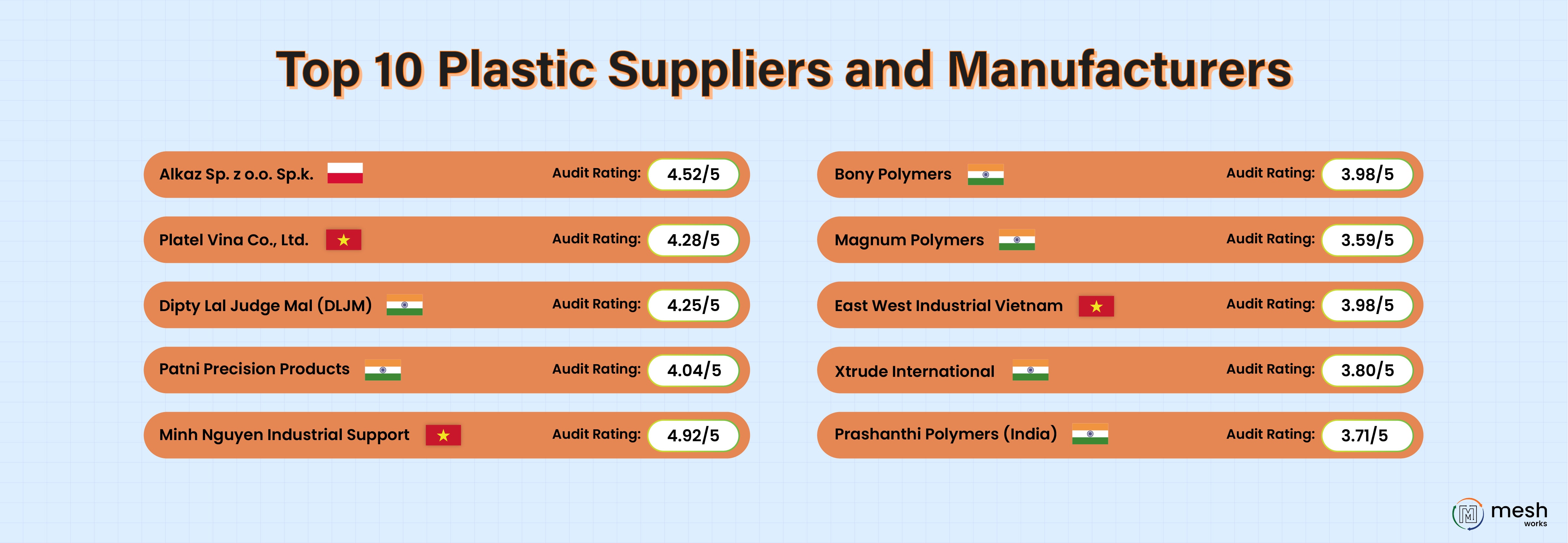
MESH Works lists more than 19,000 manufacturing suppliers across 40+ countries. The ten plastic manufacturers highlighted here were chosen for their plastics capabilities, certifications, and process coverage, including injection molding, extrusion, blow molding, insert molding, and in-house tooling in India, Vietnam, and Poland.
Choosing a plastic manufacturer is not a quotation comparison. Even if a supplier has injection molding machines, they may not meet your requirements due to factors such as unsuitable clamping force, incompatible resin, insufficient process tolerance, or limited certification scope. This page provides verified information on each supplier, including certifications, processes, materials, and available capacity, to help you create a shortlist based on capability rather than company descriptions.
Quick Answer: Which Plastic Manufacturers Should You Consider?
# | Supplier | Country | Primary process | Key certifications |
1 | Alkaz Sp. z o.o. Sp.k. | Poland | Injection molding | ISO 9001 |
2 | Platel Vina Co., Ltd. | Vietnam | Plastics manufacturing | IATF 16949, ISO 9001, 14001, 45001, UL, RBA |
3 | Dipty Lal Judge Mal (DLJM) | India | Injection molding | IATF 16949, ISO 9001 |
4 | Patni Precision Products | India | Injection molding | ISO 9001, ISO 14001, OHSAS 18001 |
5 | Minh Nguyen Industrial Support | Vietnam | Injection molding + mold making | ISO 9001 |
6 | Bony Polymers | India | Injection molding | IATF 16949, ISO 14001, ISO 45001, TÜV SÜD |
7 | Magnum Polymers | India | Insert, injection & blow molding | IATF 16949, ISO 14001 |
8 | East West Industrial Vietnam | Vietnam | Injection molding | ISO 9001, ISO 13485, ISO 14001 |
9 | Xtrude International | India | Extrusion | IATF 16949, ISO 9001 |
10 | Prashanthi Polymers (India) | India | Blow molding + injection | ISO 15378, cGMP |
How We Selected These Plastic Manufacturers
Four criteria, applied in order:
Plastics as the listed commodity. Suppliers whose MESH profile lists plastics as a primary commodity, not as one material among several. This removed several well-rated suppliers who are mold-makers or contract manufacturers serving plastics among other materials.
Documented certification. Each supplier holds at least one current, named quality certification relevant to industrial manufacturing — IATF 16949, ISO 9001, ISO 13485 or ISO 15378.
Process coverage across the list. Injection molding dominates plastics sourcing, but extrusion and blow molding are different businesses with different suppliers. The list covers all three plus insert molding and in-house tooling.
Published capability detail. Suppliers who specify details such as machine tonnage, resin range, or tooling capacity in their profiles are ranked higher than those who list only the process.
1. Alkaz Sp. z o.o. Sp.k. — Poland
Location: Olsztyn, Warmińsko-Mazurskie, Poland
Process: Injection molding, mold design and construction
Certification: ISO 9001
Industries: Automotive, construction, electronics, lighting, medical instruments
Alkaz is a full-service injection molding company operating more than 50 injection molding machines with clamping force up to 1,600 tons.
That capacity figure is the reason it leads this list. It is the only supplier on this list that publishes both machine count and clamping-force range, allowing buyers to quickly determine fit for their parts. A 1,600-ton press covers most automotive interior and structural components, large appliance housings and sizeable industrial enclosures.
Alkaz also handles mold design and construction in-house with mold flow analysis, so tooling and production sit with one supplier. For buyers requiring a European molder due to freight, lead time, or EU program requirements, Alkaz is the strongest option on this list.
Best fit for: Automotive and lighting components, large-part molding, EU-based programs needing tooling and production from one source.
Supplier profile: Alkaz Sp. z o.o. Sp.k.
2. Platel Vina Co., Ltd. — Vietnam
Location: Thu Duc City, Ho Chi Minh City, Vietnam
Process: Plastics manufacturing, injection molding, assembly
Certifications: IATF 16949, ISO 9001, ISO 14001, ISO 45001, UL product certification, RBA 6.0 CSR audit
Industries: Appliances, electronics, power and energy
Platel Vina holds the broadest certification stack of any supplier on this list. This includes IATF 16949 for automotive, ISO 9001, ISO 14001, and ISO 45001 for quality, environmental, and occupational health standards, UL product safety certification, and an RBA 6.0 social compliance audit.
The RBA 6.0 audit is particularly significant. Many large OEMs require suppliers to demonstrate CSR and responsible sourcing compliance before onboarding, often referencing the RBA standard. Suppliers who have already passed this audit can expedite the onboarding process by eliminating a potentially lengthy step.
The company operates two factories in Vietnam, producing components for appliances, consumer electronics, and power equipment. Assembly operations are integrated with molding processes.
Best fit for: Appliance and electronics components, automotive programs requiring IATF certification, and buyers with CSR or responsible sourcing requirements.
Supplier profile: Platel Vina Co., Ltd.
3. Dipty Lal Judge Mal Private Limited (DLJM) — India
Location: Noida, Uttar Pradesh, India
Process: Injection molding, tooling
Certifications: IATF 16949, ISO 9001
Industries: Automotive, appliances, electronics, EV, earthmovers
DLJM has manufactured plastic molded components and tooling since 1984. Four decades of experience is especially valuable in automotive plastics, where expertise in failure modes is developed through practice rather than specification.
DLJM holds IATF 16949, the automotive quality standard, and ISO 9001. The company serves EV, earthmovers, and conventional automotive sectors. Its combined molding and tooling capabilities allow customers to manage tool development and part production with a single supplier.
For buyers sourcing automotive or off-highway plastic components from India, DLJM offers both an extensive production history and up-to-date automotive certifications, a combination that is rare in the market.
Best fit for: Automotive and EV plastic components, off-highway and earthmoving equipment parts, and programs requiring both tooling and production.
Supplier profile: Dipty Lal Judge Mal Private Limited
4. Patni Precision Products Pvt. Ltd. — India
Location: Mumbai, Maharashtra, India
Process: Injection molding, tool room, pad printing, hot foiling, sub-assembly
Certifications: ISO 9001:2015, ISO 14001:2015, OHSAS 18001:2007
Industries: Automotive, appliances, lighting, medical instruments, recreational vehicles, valves and instruments, oil and gas, power and energy, defense
Patni offers the broadest resin range among the listed suppliers, making it especially valuable for buyers with specific material requirements.
Family | Grades listed |
Commodity | PP, LDPE, HDPE, rigid and soft PVC |
Styrenics | ABS, HIPS, GPPS, SAN, ASA |
Engineering | PA6, PA66, PA46, PA12, POM, PBT, PC, acrylic |
Elastomers | TPU, TPR, TPV, TPE |
Packaging | PET, PET-G |
High-performance | PPS, PPO, PES, LCP, PVDF, PEEK |
That bottom row is the differentiator. PEEK, PVDF, LCP and PPS are high-temperature, chemically resistant engineering grades used in oil and gas, defense, electrical and medical applications. Most molders do not process these materials due to the need for specialized equipment and strict process control. A supplier offering these resins demonstrates advanced capabilities and process discipline.
Patni’s quality scope covers the manufacture of injection molded plastic parts, serving industries including defense, oil and gas, medical instruments, and recreational vehicles.
Note that plating and metallizing, screen and laser printing, ultrasonic welding, prototyping, and 3D printing are outsourced. Pad printing, hot foiling, shrink wrapping, and sub-assembly are performed in-house. If your part requires welding or metallizing, confirm which party is responsible for execution and quality.
Best fit for: High-temperature and chemically resistant components, oil and gas, defence, electrical, medical instruments, any part with a demanding resin specification.
Supplier profile: Patni Precision Products Pvt. Ltd.
5. Minh Nguyen Industrial Support JSC — Vietnam
Location: Ho Chi Minh City, Vietnam
Process: Injection molding, precision mold making, machining, EDM, printing, assembly
Industries: Household appliances, electrical accessories, automotive
Minh Nguyen is an integrated supplier offering product design, precision mold making, injection molding, printing and assembly under one roof, with machining and EDM capability in the mold workshop and measuring and testing equipment supporting quality control.
This integration eliminates gaps between toolmaking and molding, reducing the risk of issues and disputes over responsibility. For new parts requiring tool development, having a single point of accountability can provide significant value.
Documented applications include household appliances, electrical accessories, and automotive components.
Before shortlisting: confirm the current ISO 9001 certification revision directly with the supplier. The profile references an older revision of the standard, and the company reports ISO 14001 and ISO 13485 certification as in progress.
Best fit for: New parts requiring tool development, appliance and electrical components, buyers wanting tooling and molding from a single supplier.
Supplier profile: Minh Nguyen Industrial Support JSC
6. Bony Polymers Private Limited — India
Location: Faridabad, Haryana, India
Commodities: Plastics, rubber
Process: Injection molding, rubber molding, extrusion, co-extrusion
Certifications: IATF 16949:2016, ISO 14001:2015, ISO 45001, TÜV SÜD management system certification
Industries: Automotive, agricultural machinery, appliances, EV
Bony Polymers specializes in both plastics and rubber, making it an ideal supplier for components that require both materials, such as rigid plastic carriers with bonded elastomer seals, hoses with molded end fittings, and grommet or bush assemblies.
Its TÜV SÜD certification scope is specific and worth reading: it covers extrusion profiles, hoses, tubes and hose assemblies for automotive use. This targeted scope provides clear information about the product families assessed under the quality system.
With IATF 16949, ISO 14001, and ISO 45001 certifications, and experience in automotive, agricultural machinery, and EV sectors, Bony Polymers is well positioned for vehicle and machinery programs requiring sealing, fluid transfer, or vibration components.
Best fit for: Plastic-and-rubber assemblies, hoses and hose assemblies, sealing and vibration components, automotive and agricultural machinery.
Supplier profile: Bony Polymers Private Limited
7. Magnum Polymers — India
Location: Faridabad, Haryana, India
Process: Insert molding, injection molding, blow molding, in-house tooling design and manufacturing
Certifications: IATF 16949, ISO 14001
Founded: 1995
Industries: Automotive, appliances, electronics, EV, lighting
Magnum offers the broadest range of processes among single suppliers on this list, including insert molding, injection molding, and blow molding, with in-house tooling design and manufacturing.
Insert molding is a key capability. By molding plastic around a metal insert such as a threaded boss, terminal, bearing, or stamped bracket, Magnum eliminates downstream assembly steps and creates stronger joints than press-fitting or ultrasonic insertion. This process is standard in automotive electrical components, switchgear, and appliance assemblies, and is a specialized skill not offered by all molders.
The company’s tooling operation produces molds for injection molding machines ranging from 250 to 2,500 tons, reflecting its broad size capabilities. With IATF 16949 certification and experience in automotive, EV, electronics, and lighting, Magnum is well-suited for projects that require integration of plastic and metal components.
Best fit for: Insert-molded components, plastic-metal assemblies, automotive electrical and switchgear parts, and projects requiring tooling and multiple molding processes from a single supplier.
Supplier profile: Magnum Polymers
8. East West Industrial Vietnam Co., Ltd. — Vietnam
Location: Binh Duong, Vietnam
Process: Injection molding
Certifications: ISO 9001:2015, ISO 13485:2016, ISO 14001
Industries: Automotive, agricultural machinery, appliances, electronics, energy equipment, heavy equipment, lighting, medical instruments, recreational vehicles
ISO 13485 is the reason this supplier is on the list. This quality management standard for medical devices is significantly more demanding than ISO 9001. It requires design controls, risk management to ISO 14971, process validation, traceability and documented change control, all maintained under regulatory scrutiny.
Only two suppliers on this page hold a medical-grade standard, and East West is the one holding ISO 13485 specifically. For a buyer sourcing plastic components for a medical device, instrument housing or diagnostic consumable, that certification is usually the first filter applied and most molders fail it.
The company serves an unusually broad range of industries, from automotive and heavy equipment to energy and recreational vehicles, in addition to holding ISO 9001:2015 and ISO 14001 certifications.
Best fit for: Medical device and instrument components, diagnostic housings, any program where ISO 13485 is a prerequisite.
Supplier profile: East West Industrial Vietnam Co., Ltd.
9. Xtrude International — India
Location: Noida, Uttar Pradesh, India
Commodities: Plastics, PVC
Process: Plastic extrusion, die design and tooling
Certifications: IATF 16949, ISO 9001
Industries: Automotive, appliances, construction, electronics, EV, lighting, HVAC, furniture, retail display
Xtrude is the only extrusion specialist on this list. Extrusion differs significantly from molding, producing continuous profiles instead of discrete parts, using die tooling rather than molds, and relying on a distinct supplier base.
Xtrude’s key capability is co-extrusion of up to three materials with different hardness levels in a single profile. This is valuable for sealing and trim applications, where a window or door seal may require a rigid carrier, a flexible sealing lip, and a low-friction or soft-touch surface. All components are produced in one continuous extrusion, eliminating the need for assembly. Tri-durometer co-extrusion is an uncommon capability.
Die design and tooling are managed in-house and supported by CAD. Secondary operations include cutting to length, punching, notching, scoring, slitting, buffing, thermoforming, thermal welding, and assembly. Achieving IATF 16949 certification for extruded profiles is a notable distinction.
Best fit for: Sealing and trim profiles, gaskets, PVC and rigid profiles, HVAC and construction sections, automotive weatherstrip, and any continuous-profile requirements.
Supplier profile: Xtrude International
10. Prashanthi Polymers (India) Pvt. Ltd. — India
Location: Bangalore, Karnataka, India
Process: Blow molding, injection molding, pad printing, in-house tool room
Certification: ISO 15378:2017, cGMP
Founded: 1978
Industries: Pharmaceutical, FMCG, appliances, medical instruments
Prashanthi is the only blow molding supplier on this list and the only one with a Class D clean room.
ISO 15378 is the key certification in this context. It covers Good Manufacturing Practice for primary packaging materials for medicinal products. This standard applies ISO 9001 and GMP principles specifically to packaging that comes into direct contact with drug products. If you are sourcing bottles, containers, closures, or droppers for pharmaceutical or healthcare use, this certification is typically required, and few molders hold it.
The clean room enables controlled-environment manufacturing. Since 1978, the company has operated fully automatic injection and blow molding machines, pad printing, and an in-house tool room.
Blow molding is the preferred process for hollow parts such as bottles, containers, tanks, and ducting, where injection molding cannot achieve the required geometry. If your component is hollow, this supplier is the recommended starting point.
Best fit for: Pharmaceutical and healthcare primary packaging, bottles and containers, hollow components, cleanroom-manufactured parts, FMCG packaging.
Supplier profile: Prashanthi Polymers (India) Pvt. Ltd.
Which Plastic Process Does Your Part Need?
The process is determined by the part, not by the supplier. Get this wrong and the quote comparison is meaningless, because you'll be comparing suppliers who can't make the same thing.
Process | Produces | Typical parts | Tooling cost | Suppliers on this list |
Injection molding | Discrete solid parts, complex geometry | Housings, brackets, covers, connectors, clips | High | 1, 2, 3, 4, 5, 6, 7, 8, 10 |
Extrusion | Continuous profile, fixed cross-section | Seals, trim, tubing, channels, weatherstrip | Low to moderate | 9 |
Blow molding | Hollow parts | Bottles, containers, tanks, ducting | Moderate | 7, 10 |
Insert molding | Plastic molded around a metal insert | Threaded bosses, terminals, bearing housings | High | 7 |
Injection molding
Molten resin is injected under pressure into a closed mold, then cooled and ejected. This process enables complex geometries with high repeatability, making it the leading method for industrial plastics. Tooling represents the primary investment and the main contributor to lead time.
Evaluate: clamping force against your shot size and projected area, resin compatibility, cycle time, cavitation, tolerance capability, tooling cost and tool life.
Extrusion
Material is pushed continuously through a die to form a fixed cross-section, then cut to length. Tooling consists of a die rather than a mold, making it significantly less expensive and faster than injection tooling, and often requiring a different supplier base.
Evaluate: profile dimensional tolerance, die design, co-extrusion requirements if the profile needs more than one material or hardness, surface finish, downstream operations.
Blow molding
Heated plastic is expanded against the inside of a mold by air pressure to form a hollow part. This is the only practical process for producing closed hollow geometries at scale.
Evaluate: wall thickness distribution, container volume and neck finish, leak and burst testing, material compatibility with the contents, regulatory requirements for food or pharmaceutical contact.
Insert molding
Plastic is molded directly around a pre-placed metal component, bonding the two in one operation and removing a downstream assembly step. The joint is stronger than press-fitting or heat staking.
Evaluate: insert tolerance and presentation, automation of insert loading, pull-out and torque-out strength requirements, thermal expansion mismatch between the plastic and the metal.
Resin Selection: What to Specify Before You Quote
If the resin is not specified, quotes cannot be accurately compared. The chosen material affects tooling design, cycle time, shrinkage, machine selection, and a significant portion of the piece price.
Family | Grades | Typical use | Notes |
Commodity | PP, HDPE, LDPE, PVC | Housings, containers, profiles, general industrial | Lowest cost, widest supplier base |
Styrenics | ABS, HIPS, SAN, ASA | Appliance and consumer housings, trim | ASA for UV and outdoor exposure |
Engineering | PA6, PA66, POM, PBT, PC | Structural parts, gears, connectors, housings | Glass fill changes tooling and machine requirements — specify the percentage |
Elastomers | TPE, TPU, TPV | Seals, grips, overmolded surfaces | Common in two-shot and co-extrusion |
High-performance | PPS, PEEK, PVDF, LCP, PPO | High temperature, chemical exposure, electrical | Few molders run these — supplier 4 on this list does |
In addition to the grade, specify the operating temperature range, chemical and UV exposure, impact and flame-retardancy requirements (including UL 94 rating if applicable), color, and any required regulatory compliance such as FDA, RoHS, REACH, or ISO 10993 for medical applications.
How to Choose a Plastic Manufacturer
Certification and process listings confirm a supplier’s industry credentials, but do not guarantee they can produce your specific part. Address this before issuing an RFQ.
1. Define the material
Specify the polymer family, grade, and any fillers. Terms like "plastic" or "nylon" are insufficient; for example, PA66 with 30% glass differs significantly from unfilled PA6.
2. Issue complete technical data
Provide 2D drawings, 3D CAD files, tolerances, surface finish, color, and identify critical dimensions. Clarify if the supplier should offer design-for-manufacture input or follow the supplied design exactly.
3. State the volume realistically
Annual volume determines tooling class, cavitation and machine selection. Separate prototype, pilot, steady-state and peak demand. A tool built for 50,000 parts a year is the wrong tool at 500,000, and the wrong tool at 5,000.
4. Settle tooling before you compare prices
Tooling often causes commercial issues in molding programs. Confirm the following in writing:
Who designs the tool and who manufactures it
Who owns it — and what happens to it if you change supplier
Expected tool life in shots, and what happens when it's reached
Who maintains and repairs it, and who pays
Tooling lead time
Cost of engineering changes after the tool is cut
5. Check certification scope, not just the certificate
A certificate includes a scope statement specifying the processes and site it covers. A corporate ISO 9001 does not automatically apply to the plant producing your part. Verify the issuing body, validity date, named facility, and scope.
6. Match machine capacity to the part
Request information on clamping force range, number of machines in that range, shot capacity, shift patterns, and current utilization. Suppliers operating at 95% capacity present a delivery risk that quality systems cannot mitigate.
7. Compare total landed cost
Consider tooling amortization, piece price, freight, packaging, duties, payment terms, minimum order quantities, inventory carrying costs, and the expense of qualifying a replacement if needed. Piece price is rarely the largest cost factor.
8. Plan the second source from the start
For any component critical to production, identify an alternate supplier in advance. Qualifying a second plastics supplier under pressure takes months and is more costly than proactive planning.
Why Supplier Qualification Decides the Outcome
A molded part may appear simple, but its quality depends on the interaction of resin, mold design, machine, process parameters, and quality control. A supplier skilled in one type of part may not be suitable for another.
A common mistake is assuming that equipment alone indicates capability. A supplier with injection molding machines may not have experience with your resin, required tolerances, or production volume. Each of these factors should be addressed directly.
A structured qualification normally covers:
Documented capability and certification scope for the specific process
Confirmation of the resin and process against the actual part
Tooling plan, ownership and capacity
Quality documentation, inspection method and traceability
Samples or first-article inspection
Commercial terms, lead time and continuity
On-site assessment of the facility
That last step is the one most buyers can't resource. Sending a supplier quality engineer to a facility is costly and time-consuming, which limits how many new suppliers companies can qualify each year. MESH Works addresses this by providing supplier capability and factory-level assessment data through the platform, allowing companies to narrow their shortlist before arranging site visits.
Plastic Manufacturing by Country
Country | Suppliers here | What the region is strong at |
India | 6 — DLJM, Patni, Bony, Magnum, Xtrude, Prashanthi | Deepest base on this list. Strong automotive certification (IATF 16949 across four of the six), broad resin capability, extrusion and blow molding alongside injection. Noida–Faridabad and Pune are the main industrial clusters; Bangalore for regulated and precision work |
Vietnam | 3 — Platel Vina, Minh Nguyen, East West | Electronics and appliance manufacturing base with growing automotive and medical capability. Integrated tooling-plus-molding is common. Increasingly used as a China alternative |
Poland | 1 — Alkaz | EU-based, shortest lead times into Western Europe, no customs exposure for EU buyers. Largest published machine capacity on this list |
Country is a logistics and risk decision, not a capability one. The comparison that matters is between specific factories, not between places.
Find Plastic Manufacturers with MESH Works
MESH Works provides sourcing teams with access to over 19,000 manufacturers in more than 40 countries, consolidating capability, certification, and factory assessment data in one platform. This streamlines the shortlisting process before initial contact.
Search Plastic Suppliers — filter by process, certification, capacity and country
Explore MESH Audits — how factory-level assessment supports supplier qualification
Explore Global Sourcing — discovering and evaluating manufacturing suppliers across regions