Copper is essential for applications where high conductivity is required, such as motor windings, magnet wire, busbars, terminals, connectors, and cables. In the past eighteen months, sourcing copper has changed significantly. US tariffs on semi-finished copper now apply to the full customs value of imported goods, not just their copper content.
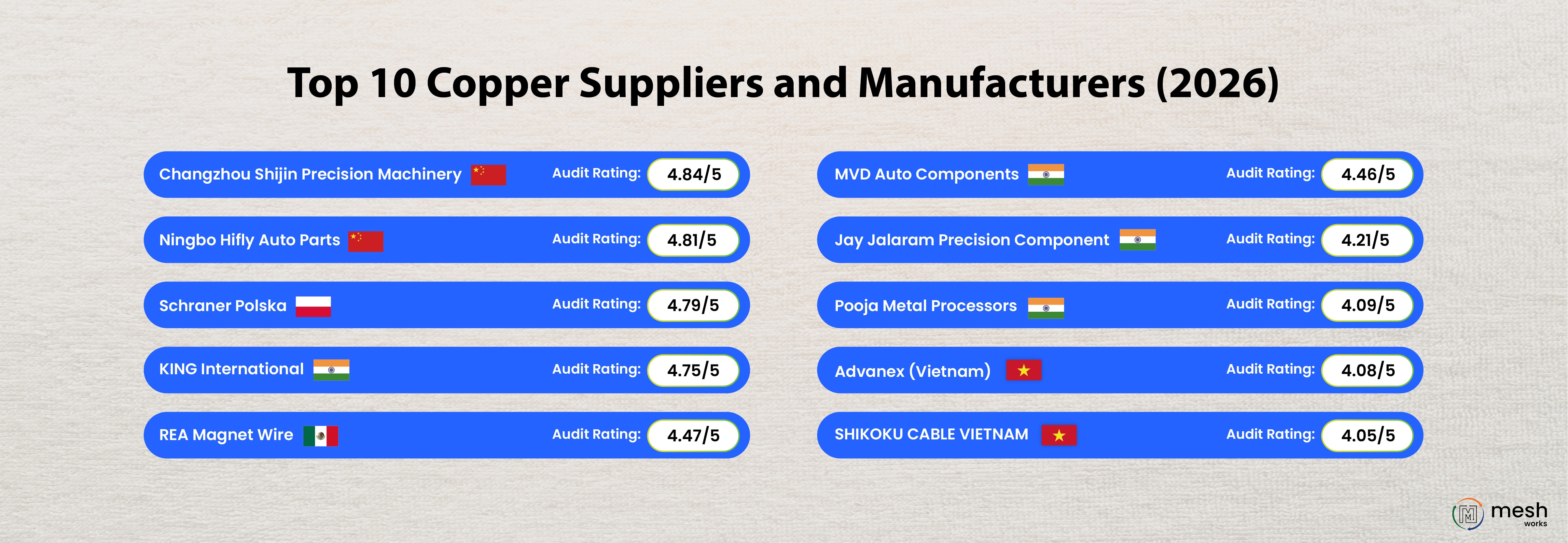
MESH Works lists 800+ copper suppliers across its network in 40+ countries. The ten below cover wire and cable, magnet wire, motor and stator components, springs and wire forming, electrical assemblies, precision machining, stamping and forging, across China, India, Poland, Mexico and Vietnam.
It is important to clarify that these are manufacturers who process copper by machining, forming, winding, stamping, or drawing it into components. This list does not include copper miners, smelters, refiners, or raw material traders. If you are purchasing cathode or rod, you will need to consult different suppliers.
How We Selected These Suppliers
Every supplier on this list has been visited in person by a MESH Works engineer and assessed against 45 points covering manufacturing capability, equipment, quality systems, capacity, engineering support and logistics, documented with photographs and video from the factory floor.
The shortlist was built on:
Copper as a working material in the supplier's production
The specific processes used to manufacture copper components, such as wire drawing, winding, wire forming, stamping, machining, and forging.
Current certification appropriate to the industries served
Demonstrated capacity, confirmed during the audit
Copper covers a broader range of part types than most commodities. For example, both a magnet wire producer and a precision machining shop supply copper, but they are not interchangeable. Several suppliers listed work with multiple commodities; in these cases, we highlight their copper-specific capabilities.
Top 10 Copper Suppliers at a Glance
# | Supplier | Location | Copper capability | Certifications | MESH rating |
1 | Changzhou Shijin Precision Machinery | Changzhou, China | CNC, VMC and HMC machining | IATF 16949 | 4.84 |
2 | Ningbo Hifly Auto Parts | Ningbo, China | Stamping, hydraulic press production | IATF 16949, ISO 14001 | 4.81 |
3 | Schraner Polska | Łęczyca, Poland | Hot die forging in copper | — | 4.79 |
4 | KING International | Ludhiana, India | Multi-process: forging, machining, stamping, fabrication | IATF 16949, ISO 14001, ISO 45001 | 4.75 |
5 | REA Magnet Wire | Nuevo León, Mexico | Magnet wire and copper wire | ISO 9001 | 4.47 |
6 | MVD Auto Components | Noida, India | Coils, solenoids, sensors, electrical assemblies | IATF 16949, ISO 14001 | 4.46 |
7 | Jay Jalaram Precision Component | Rajkot, India | CNC turning and machining | IATF 16949, ISO 9001 | 4.21 |
8 | Pooja Metal Processors | Faridabad, India | Stator and rotor components, stator winding | ISO 45001, ISO 14001 | 4.09 |
9 | Advanex (Vietnam) | Bac Ninh, Vietnam | Precision springs and wire forming | IATF 16949, ISO 9001, ISO 14001 | 4.08 |
10 | SHIKOKU CABLE VIETNAM | Ha Nam, Vietnam | Coaxial cable and cable assemblies | IATF 16949, ISO 14001 | 4.05 |
How this list was created. This list includes suppliers from the MESH Works network, selected for their copper capabilities, manufacturing processes, on-site audit results, and supplier profiles. The MESH rating serves as a platform-level indicator and does not represent an independent industry ranking or audit score. Please verify each supplier’s capabilities, copper grades, and capacity to ensure they meet your specific requirements before qualification or award.
1. Changzhou Shijin Precision Machinery Co., Ltd — Changzhou, China
A high-precision machining specialist operating from a facility of more than 15,000 square metres, with copper among its supported commodities alongside aluminum, brass and bronze.
Copper-relevant capability
CNC machining, VMC and HMC
IATF 16949
Industries: automotive, aerospace, electronics, energy equipment, medical instruments, high-speed railway and subway, valves and instruments
Machined copper components such as busbar terminations, electrode holders, fittings, are less common than machined steel or aluminum, and harder. Pure copper is gummy: it tears rather than chips cleanly, builds up on the tool edge and fights surface finish. A shop with medical and rail work is one used to holding finish on difficult materials.
View Changzhou Shijin Precision Machinery on MESH Works →
2. Ningbo Hifly Auto Parts Co., Ltd — Ningbo, China
An automotive stamping manufacturer specializing in body parts, chassis components, battery-box related parts, reinforcement brackets, HVAC panels and wheel covers.
Copper-relevant capability
Metal stamping on hydraulic presses with transfer systems
Copper listed alongside stainless steel, aluminum and carbon steel
IATF 16949, ISO 14001
The relevance here is EV-adjacent: battery-box components and HVAC assemblies increasingly combine stamped steel structure with copper conductive elements. Most useful where copper parts form part of a wider stamped-component program rather than a standalone copper requirement.
View Ningbo Hifly Auto Parts on MESH Works →
3. Schraner Polska Sp. z o.o. — Łęczyca, Poland
A precision forging company specializing in hot die forging, offering copper, steel, aluminum, and titanium in its material portfolio.
Copper-relevant capability
Hot die forging of copper and copper alloys
Industries: automotive, power tools, textile machinery
Serves customers in Poland, across Europe, and in North America.
Forged copper is a more specialized category than machined or stamped copper, used when both conductivity and mechanical strength are required, such as in switchgear contacts, heavy terminals, and electrode components. Because copper's forging temperature window is narrower than that of steel, working with a dedicated forging house is especially important.
View Schraner Polska on MESH Works →
4. KING INTERNATIONAL (A King Group Company) — Ludhiana, India
A TÜV-certified contract manufacturer, KING partners with OEM clients to produce forged, stamped, precision-machined, welded, and thread-rolled parts. Copper is included among its listed commodities.
Copper-relevant capability
Forging, stamping, precision machining, thread rolling
Extrusion, fabrication, welding, assembly, surface treatment
IATF 16949, ISO 14001, ISO 45001
Industries: automotive, agricultural machinery
KING offers integrated multi-process solutions for copper components requiring forming, machining, plating, or assembly, all managed under a single quality system. As copper is one of eleven commodities in its portfolio, please confirm grade experience and production volumes for your specific requirements.
View KING International on MESH Works →
5. REA Magnet Wire — Nuevo León, Mexico
REA is the most copper-focused supplier on this list. The company produces magnet wire, copper wire, and aluminum wire, with copper as its primary product.
Copper-relevant capability
Magnet wire and copper wire
Applications: transformers, motors, generators, electric vehicles, industrial machinery, energy systems, appliances
ISO 9001
Magnet wire is its own sourcing category, specified by conductor diameter, insulation class and thermal rating rather than by part geometry. REA also offers a nearshore option for US buyers, which is especially important for copper due to current tariff levels.
View REA Magnet Wire on MESH Works →
6. MVD Auto Components Private Limited — Noida, India
A manufacturer of automotive electrical and electronic components including switches, solenoids, sensors, coils, heaters, relays, buzzers and radiator caps.
Copper-relevant capability
Expertise in electrical and electromechanical assembly
Specialization in coil winding, solenoids, sensors, and relays
IATF 16949, ISO 14001
Industries served: automotive and appliances
MVD operates at the finished-component stage of copper sourcing. While solenoids and coils are essentially copper products, they are purchased as assemblies with specific electrical requirements rather than as copper components based on technical drawings.
View MVD Auto Components on MESH Works →
7. Jay Jalaram Precision Component LLP — Rajkot, India
A manufacturer and exporter of precision components, operating an integrated facility that processes copper, brass, bronze, aluminum, nickel, titanium, and various steels.
Copper-relevant capability
CNC turning and machining, VMC, HMC
Thread rolling, cylindrical grinding
· Provide in-house heat treatment and surface finishing.
IATF 16949, ISO 9001
Industries: automotive, aerospace, medical instruments, oil and gas, valves and instruments, energy
Their extensive experience with copper alloys is a key advantage. Brass and bronze require different machining approaches than pure copper, and their facility is equipped to handle all three efficiently. In-house surface finishing is especially important for copper parts that require tin or silver plating.
View Jay Jalaram Precision Component on MESH Works →
8. Pooja Metal Processors Private Limited — Faridabad, India
A manufacturer of stator and rotor components and ceiling fan products, including BLDC and induction fan solutions.
Copper-relevant capability
Stator winding processes include 100% electrical testing to ensure quality.
Comprehensive press shop operations and stamping services
Capabilities include die casting, CNC machining, and an in-house tool room.
ISO 45001, ISO 14001
Applications: motors, fans, electrical equipment
Stator winding is a highly copper-intensive and challenging manufacturing process. Winding quality directly affects motor efficiency and reliability. Their in-house tool room, combined with 100% electrical testing, provides a reliable solution for sourcing motor components.
View Pooja Metal Processors on MESH Works →
9. Advanex (Vietnam) Co., Ltd — Bac Ninh, Vietnam
A precision spring and wire-forming manufacturer producing compression, extension and torsion springs, wire-formed parts and flat spring products, with copper and stainless steel among its commodities.
Copper-relevant capability
Wire forming and multi-forming
Spring manufacturing, flat spring production
Stamping, heat treatment, shot peening, end grinding
IATF 16949, ISO 9001, ISO 14001
Industries: automotive, electronics, medical, office equipment
Copper alloy springs and formed wire parts, such as contacts, clips, terminals, and grounding springs, require both spring temper and electrical conductivity. These properties are typically achieved using phosphor bronze or beryllium copper, rather than pure copper. A specialized spring manufacturer with experience serving electronics customers is best suited to supply these components.
View Advanex Vietnam on MESH Works →
10. SHIKOKU CABLE VIETNAM LIMITED — Ha Nam, Vietnam
A manufacturer of coaxial cables and cable assemblies, with wire and cable as its process and copper as its commodity.
Copper-relevant capability
Coaxial cable manufacturing
Cable assemblies
IATF 16949, ISO 14001
Industries: automotive, aerospace, agricultural machinery, appliances, construction, energy equipment, heavy equipment, lighting
Cable represents copper sourcing in its purest commercial form. Copper content determines most of the price, so conductor specifications and metal pass-through terms are more significant than conversion costs. Cables and connectors are classified as copper-intensive derivatives for US tariff purposes.
View SHIKOKU CABLE VIETNAM on MESH Works →
US Copper Tariffs: What Changed and Why It Matters
Copper sourcing economics changed significantly between 2025 and 2026, more so than for steel or aluminum. If you source copper components for the United States, prioritize these changes in your quote comparisons before considering piece price.
On August 1, 2025, a 50% Section 232 tariff was implemented on semi-finished copper products (pipes, wire, rod, sheet, tube) and copper-intensive derivatives (fittings, cables, connectors, electrical components). The tariff was calculated based solely on copper content value.
On April 6, 2026, the tariff calculation shifted to the full customs value of the imported article, rather than just its copper content. Semi-finished copper products are now subject to a 50% tariff, while copper-intensive derivatives are subject to 25%. A reduced rate applies if the metal content is predominantly US-sourced.
On June 8, 2026, the US-origin metal threshold was lowered from 95% to 85%, with temporary rate structures in effect through December 31, 2027.
Still excluded: copper ores, concentrates, mattes, cathodes, anodes and scrap. Products where copper, steel and aluminum together make up less than 15% of total customs value fall outside the scope.
On the horizon: a phased tariff on refined copper has been announced: 15% in 2027 and 30% in 2028, along with domestic sales requirements for copper input materials. These measures are expected to increase upstream costs across related products.
What this means in practice. The shift from copper-content to full-customs-value calculation is often underestimated by buyers. For example, a cable assembly previously tariffed on 40% copper content is now tariffed on the entire article. Nearshore sourcing from Mexico and suppliers who can document US-origin metal content have become significantly more competitive than piece price alone indicates.
Copper Grades: What to Specify
"Copper" alone on a drawing is not a specification. Conductivity, machinability, and strength vary significantly across copper grades.
High-conductivity coppers
C11000 (ETP) is electrolytic tough pitch copper, the general-purpose conductor grade used for busbars, wire, and terminals. It offers approximately 100% IACS conductivity.
C10100 and C10200 (OFE / OFHC) are oxygen-free coppers, specified to avoid hydrogen embrittlement during brazing or welding, and for use in vacuum or high-reliability electronics.
Machinable coppers
C14500 (tellurium copper) addresses the machinability limitations of pure copper. It offers approximately 80–90% of the machinability of free-cutting brass while maintaining about 90% IACS conductivity. For high-volume copper machining, this is typically the preferred grade.
C18150 (chromium zirconium copper) is heat treatable and retains strength at elevated temperatures. Common applications include resistance welding electrodes and switchgear.
High-strength copper alloys
C17200 (beryllium copper) is the highest-strength copper alloy, used for connectors, springs, and contacts. Please observe all handling requirements for beryllium-containing materials.
C51000 (phosphor bronze) offers a spring temper with good conductivity, suitable for contacts, clips, and formed springs.
Brasses and bronzes
C26000 (cartridge brass) is used for deep drawing and forming applications.
C36000 (free-cutting brass) is considered the benchmark for machinability.
C93200 (bearing bronze) is commonly used for bushings and bearings.
Magnet wire requires a different specification, including conductor diameter (AWG or metric), insulation type, thermal class, and build, typically following NEMA MW 1000 or IEC 60317 standards.
Always specify the alloy designation, temper, applicable standard, and conductivity requirement in %IACS when relevant. If a supplier quotes C11000 for a drawing that requires C14500, the material cost may be lower, but machining costs will be significantly higher.
How to Choose a Copper Supplier
1. Match the supplier to the part type
Copper covers more distinct supplier types than most commodities, and they're not interchangeable:
Part type | Supplier type | What to check |
Magnet wire, winding wire | Wire producer | Conductor diameter range, insulation class, thermal rating |
Cable and harness | Cable manufacturer | Conductor spec, insulation, testing, assembly capability |
Motor and stator components | Motor component manufacturer | Winding capability, electrical testing, lamination sourcing |
Machined components | Precision machine shop | Grade experience — C14500 vs C11000 — tooling, surface finish |
Stamped contacts and terminals | Stamper | Press tonnage, progressive tooling, plating |
Springs, clips, formed wire | Spring and wire former | Alloy temper, forming equipment, conductivity after forming |
Forged components | Forging house | Copper forging temperature control, die design |
A magnet wire producer is not a fallback for a machined copper fitting.
2. Separate metal cost from conversion cost
Copper sourcing differs significantly from steel or aluminum because copper is an exchange-traded commodity with transparent daily pricing, and metal typically accounts for most of a copper part's cost. When quotes combine metal and conversion costs into a single price, it becomes difficult to determine if you are negotiating fabrication efficiency or simply absorbing metal price fluctuations.
Request quotes that separate metal cost from conversion cost, and ensure the pricing basis and adjustment mechanism are clearly stated. This approach allows for direct comparison across suppliers and regions and is the only way to accurately assess the competitiveness of a supplier's conversion cost.
3. Specify conductivity, not just the alloy
When electrical performance is critical, specify the required conductivity in %IACS and request verification methods. Note that cold working, plating, and joining processes can reduce conductivity. A part may meet dimensional specifications but still fail to satisfy electrical requirements.
4. Ask about plating and surface treatment
Copper oxidizes, and its oxide is a poor conductor. Most copper contacts and terminals are plated with tin, silver, or nickel. Confirm whether plating is performed in-house or subcontracted. If outsourced, this introduces an additional supply chain that may not have been audited and is often a source of lead time and quality variation.
5. Check machinability expectations against the grade
Pure copper is difficult to machine due to its ductility and tendency to adhere to tools, resulting in poor surface quality. For high-volume machining, and where permitted by the drawing, C14500 tellurium copper can improve efficiency and offset costs through reduced cycle time. Address this during the RFQ process, as suppliers quoting C11000 may include additional costs for machining challenges that could be avoided through design choices.
6. Price the tariff position into landed cost
Refer to the tariff section above. For copper parts shipped to the US, tariff costs often exceed the price differences between suppliers.
7. Verify capacity rather than take it on trust
Published capacity figures should be verified through on-site visits. Discrepancies between listed and actual production capacity are frequently identified during audits.
Why Copper Supplier Qualification Matters
Many manufacturers list copper among their capabilities, often alongside several other commodities. However, verifying that a supplier actively produces copper, meets your required grade, manages conductivity, and oversees plating requires further diligence.
Supplier differences are often not apparent in profiles. Winding quality affects motor efficiency, plating impacts contact life, and conductivity determines part functionality.
MESH Works maintains a database of 19K+ manufacturing suppliers across 40+ countries, of which 4K+ have been audited in person against a 45-point evaluation. Suppliers are searchable by process, commodity, capacity, certification and location, so a requirement like copper wire and cable, IATF 16949, Mexico returns manufacturers whose capability has already been confirmed on site.
Search audited copper suppliers → — free, no signup required.