A supplier clears onboarding in March. The PO goes out in April. By August they're missing PPAP dates and the program is three weeks behind.
Every transaction was recorded correctly. The decision behind them was never really made.
Over the past decade, manufacturing platforms have changed quickly. They started as systems to digitize transactions like RFQs, quotes, orders, and documents. Now, they have become a crowded ecosystem of tools promising speed and efficiency.
Still, many procurement, sourcing, and engineering teams struggle with the same core problems: slow decisions, teams not working together, and unexpected issues late in the process.
The issue is not a lack of platforms.
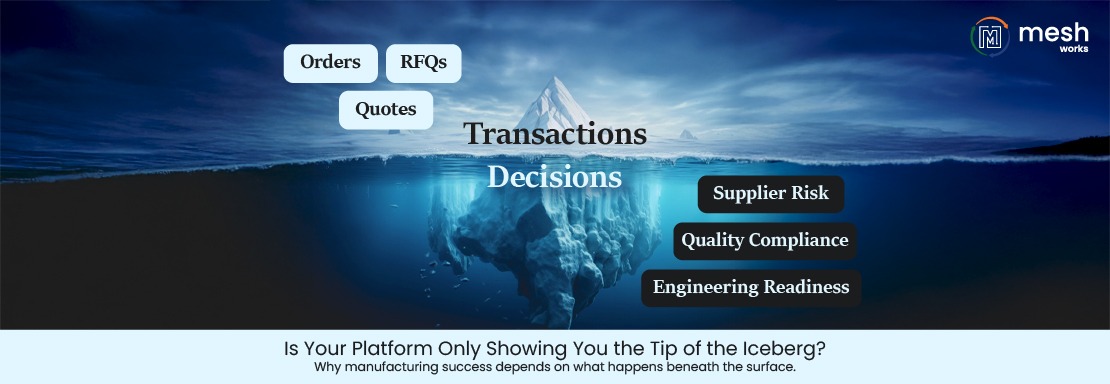
The real problem is that most platforms are designed to handle transactions, not to help people make better decisions.
The Problem with Transactional Systems in Manufacturing
Transactional platforms are designed to answer questions like:
Was the RFQ sent?
Was the quote received?
Was the order placed?
Was the document uploaded?
These systems do a good job of tracking activity. However, they often fail to help teams answer the questions that really matter:
What risks exist before we award the business?
Are suppliers truly ready from an engineering and quality standpoint?
What commitments were made, and are they being met?
When platforms focus only on transactions, decision-making stays manual, subjective, and fragmented.
Transactional platform | Decision-support platform |
Answers "Did this happen?" | Answers "Is this the right decision?" |
Records that the RFQ was sent | Shows which supplier fits, not just who's cheapest |
Confirms the quote was received | Compares suppliers on the same criteria every time |
Logs the award | Surfaces risk before the award |
Stores documents | Connects sourcing data to engineering and quality readiness |
Tracks the contract | Tracks commitments after the contract is signed |
Reports what happened | Informs what happens next |
See what a decision-support platform actually looks like.
MESH Works connects sourcing, quality, and engineering data into one decision record — so risk surfaces before the award, not after.
→ Book a Demo
Why Decisions Are Still Made Outside the Platform
In many organizations, the most important sourcing and supplier decisions are still made in a few familiar ways:
In spreadsheets
In offline meetings
Through individual judgment rather than shared visibility
This leads to three main problems:
1. Fragmented Context
Procurement, engineering, and quality teams often use different data sets. There isn’t a single system that provides a full view of supplier capability, readiness, risk, and commitments.
2. Inconsistent Decision Criteria
When there is no structured evaluation or shared visibility, different stakeholders assess suppliers in different ways. This causes rework, delays, and internal friction.
3. Late Risk Discovery
If platforms only track transactions, risks often show up after the award, such as during APQP, production, or delivery. At that point, fixing problems is costly and disruptive.
Manufacturing Risk Comes From the Decisions We Make
In manufacturing, risk usually doesn’t come from just one transaction. It builds up through a series of decisions:
Who is shortlisted
How suppliers are evaluated
What assumptions go unchallenged
Platforms that only track transactions show what happened after decisions are made, not during the decision process.
This difference is important.
What Decision-Support Platforms Do Differently
Platforms designed to support decisions help teams:
Compare suppliers against the same standards every time
Connect sourcing data with engineering and quality checks
Track commitments even after contracts are awarded
Bring stakeholders together before making final decisions
Reduce reliance on individual judgment
Rather than just asking, “Did this happen?”, these platforms help teams consider:
“Is this the right decision?”
This change turns these platforms from simple tools into valuable strategic resources.
The Cost of Staying Transaction-Focused
If manufacturing platforms focus only on transactions, organizations often face the following problems:
Sourcing cycles slow down, even when digital tools are in place.
There are weak transitions between sourcing, engineering, and quality teams.
It becomes hard to explain or repeat decisions.
In today’s unpredictable global market, where supply chains deal with policy changes, cost pressures, and limited capacity, these problems can get worse very quickly.
Where Manufacturing Platforms Are Headed
Leading manufacturers are shifting to platforms that:
Bring together sourcing, supplier evaluation, quality, and execution
Give a clear view of the entire supplier lifecycle
Help teams make decisions faster and with more confidence
Lower risks later by making things clearer earlier in the process
This isn’t just about adding more features.
It’s about changing what platforms do, moving from simply keeping records to actually helping people make decisions.
What This Means for MESH Works
MESH Works is built to support this change.
Instead of just handling transactions, the platform helps buyers, suppliers, and engineering teams make better decisions throughout sourcing, evaluation, and execution. By combining structure, visibility, and accountability in one place, MESH Works helps teams reduce risk before it becomes a problem.
The goal is not only to move faster, but also to move forward with confidence.
Final Thought
Transactions show what has already happened.
Decisions shape what comes next.
In manufacturing, platforms that help with decisions, not just transactions, are the ones that build long-term value.
Curious about how decision-driven manufacturing platforms work in real situations?
MESH Works helps procurement, engineering, and quality teams go beyond transactions by offering structured workflows, shared visibility, and accountability throughout the sourcing process.
Book a demo to see how MESH Works can help you make better sourcing and supplier decisions.