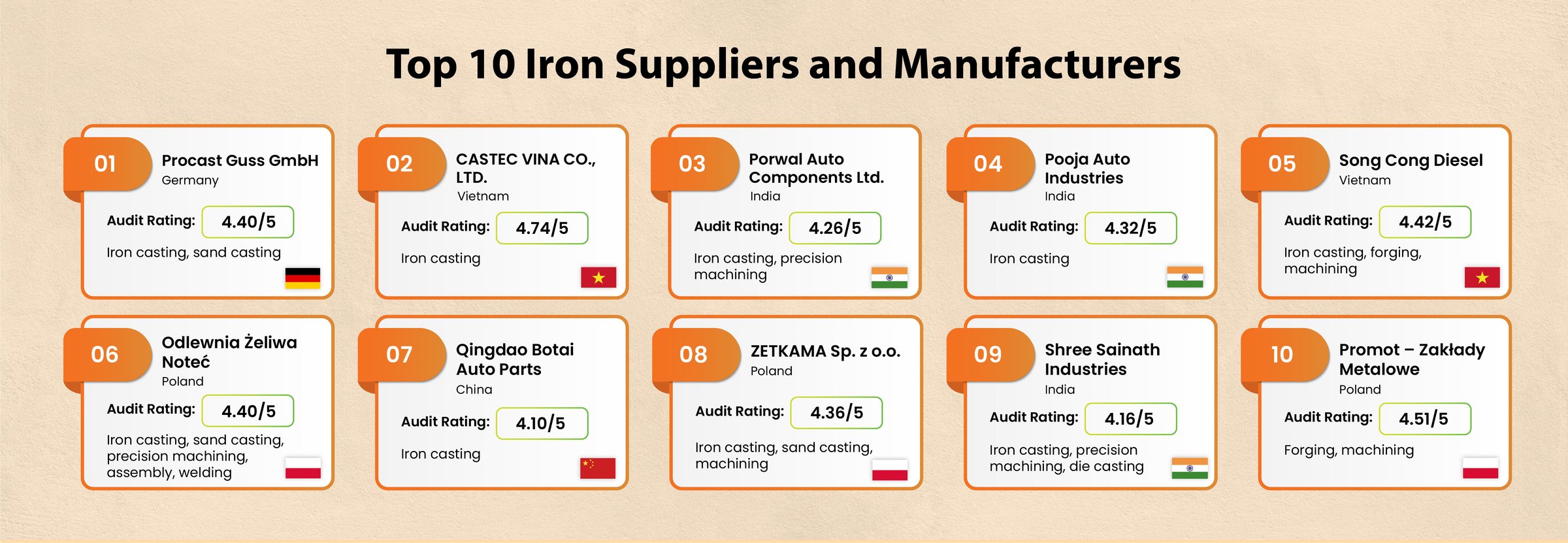
MESH Works lists more than 19,000 manufacturing suppliers across 40+ countries. The ten iron manufacturers below were selected by iron casting capability, documented certification and published capacity. Their expertise covers grey iron, ductile iron, ADI, SiMo, and Ni-Resist, with operations in Germany, Vietnam, India, Poland, and China.
Selecting an iron foundry involves more than comparing quotes. The grade affects part durability, the molding method impacts achievable tolerances, and the casting weight range determines if the foundry can produce your part. A foundry skilled in 5 kg automotive brackets may not be equipped for a 200 kg pump housing. This page provides published information on each supplier, including grades, processes, certifications, and capacity where available, to ensure the shortlist is based on capability rather than company descriptions.
Quick Answer: Which Iron Suppliers Should You Consider in 2026?
# | Supplier | Country | MESH Rating | Listed processes | Certifications |
1 | Procast Guss GmbH | Germany | 4.40 | Iron casting, sand casting | ISO 9001, ISO 14001, ISO 50001 |
2 | CASTEC VINA CO., LTD. | Vietnam | 4.74 | Iron casting | IATF 16949, ISO 14001 |
3 | Porwal Auto Components Ltd. | India | 4.26 | Iron casting, precision machining | ISO 9001:2015, IATF 16949:2016, IRIS ISO/TS 22163:2017, RDSO Class-A |
4 | Pooja Auto Industries | India | 4.32 | Iron casting | ISO 9001:2015, IATF 16949:2016 (TÜV SÜD), FM, UL |
5 | Song Cong Diesel (DISOCO) | Vietnam | 4.42 | Iron casting, forging, machining | ISO 9001:2015, ISO 14001:2015, ISO 50001:2018, IATF 16949:2016 |
6 | Odlewnia Żeliwa Noteć | Poland | 4.40 | Iron casting, sand casting, machining, precision machining, assembly, welding | ISO 9001:2015, ISO 14001:2019 |
7 | Qingdao Botai Auto Parts | China | 4.10 | Iron casting | IATF 16949:2016, 3C |
8 | ZETKAMA Sp. z o.o. | Poland | 4.36 | Iron casting, sand casting, machining | Products to ISO, ANSI, PN, ASME |
9 | Shree Sainath Industries | India | 4.16 | Iron casting, precision machining, die casting | ISO 9001:2015, IATF 16949 |
10 | Promot – Zakłady Metalowe | Poland | 4.51 | Forging, machining | ISO 9001, IATF 16949, PSC |
How We Selected These Iron Suppliers
Four criteria, applied in order:
1. Iron as the listed commodity. Every supplier here carries iron in the MESH commodity field, under the specific categories Iron – Ductile, Iron – Grey or ADI and alloy steel casting.
2. Documented certification. Every supplier on this list holds at least one named quality certification — ISO 9001, IATF 16949, IRIS, or a product approval such as FM, UL or RDSO.
3. Published capability detail. Suppliers who state something concrete — annual tonnage, casting weight range, named grades, molding equipment, OEM customers — rank above those listing only the process.
4. Process and regional coverage. The list covers iron casting, sand casting, high-pressure machine molding, lost foam and forging, across five countries with EU and Asian options.
1. Procast Guss GmbH — Germany
Location: Gütersloh, Germany
MESH Rating: 4.40
Processes: Iron casting, sand casting
Certifications: ISO 9001, ISO 14001, ISO 50001
Founded: 1982
Capacity: approximately 40,000 tonnes of cast product per year
Industries: Agricultural machinery, construction, hydraulic and off-road, valves and instruments, medical instruments
Procast Guss is the strongest profile on this list, and the only supplier here publishing both an annual tonnage and a full grade range.
40,000 tonnes a year is a serious machine-molding operation — enough to carry a high-volume automotive or agricultural programme without the capacity conversation becoming the sticking point. And its grade range goes well beyond the standard two: grey cast iron, ductile cast iron, high-silicon ductile iron, ADI, high-temperature-resistant SiMo, and selected austenitic and wear-resistant alloyed irons.
That ADI and SiMo capability is what sets it apart. Most foundries pour grey and ductile and stop there. ADI competes with forged steel on strength, and SiMo is what exhaust manifolds and turbocharger housings are made from — both are grades a buyer has to go looking for.
Best fit for: ADI and SiMo castings, high-temperature components, hydraulic and off-road equipment, EU-based programmes needing volume with a documented energy and environmental management system.
Supplier profile: Procast Guss GmbH
2. CASTEC VINA CO., LTD. — Vietnam
Location: Thoi Hoa Ward, Ho Chi Minh, Vietnam
MESH Rating: 4.74
Process: Iron casting, with machining
Commodities: Iron – Ductile, Iron – Grey
Certifications: IATF 16949:2016 (scoped to turbocharger component manufacturing), ISO 14001:2015 (casting and machining of cast irons)
Equipment: Induction melting, DISA Matic and Sinto molding lines
Industries: Automotive, EV, agricultural machinery, appliances, construction, electronics, energy equipment, heavy equipment, medical instruments, valves and instruments
CASTEC VINA has the most demanding customer list of any foundry here: BorgWarner, Garrett (by Honeywell), Haldex and Hyundai Mobis.
BorgWarner and Garrett are the two largest turbocharger manufacturers in the world, and turbo castings are among the hardest iron parts to make. A turbine housing runs at exhaust-gas temperature through thousands of thermal cycles while holding dimensional stability on the bore that carries the rotor. Being an approved supplier to both is a stronger statement about process control than any certificate — and its IATF 16949 scope is written specifically around turbocharger component manufacturing, which is unusually precise.
Its product range reflects that: turbocharger bearing and turbine housings, brake caliper knuckles, calipers, carriers and rotor discs, air-conditioning and refrigeration compressor parts, and hydraulic components. Safety-critical and pressure-containing work, not general castings.
The equipment is worth noticing. It runs DISA Matic and Sinto molding lines — high-pressure automatic systems that are effectively the industry standard for dimensional repeatability at volume. A foundry on hand molding cannot hold what these lines hold, and the presence of both suggests capacity across more than one part family. Melting is by induction furnace, which gives tighter temperature and chemistry control than a cupola.
Best fit for: Turbocharger housings, brake components, compressor and hydraulic parts, safety-critical automotive castings, high-volume programmes needing tight dimensional repeatability.
Turbine housings are normally poured in SiMo or another high-temperature ductile iron. The grade is not named on the profile, so confirm the specific grades and heat-treatment capability directly if you need high-temperature material.
Supplier profile: CASTEC VINA CO., LTD.
3. Porwal Auto Components Limited — India
Location: Indore, Madhya Pradesh, India
MESH Rating: 4.26
Processes: Iron casting, precision machining
Commodities: Iron – Ductile, Iron – Grey, ADI & Alloy Steel Casting, stainless steel, steel
Certifications: ISO 9001:2015, IATF 16949:2016, IRIS ISO/TS 22163:2017, RDSO Class-A
Melting: Induction and arc furnace
Molding: High-pressure molding lines, vacuum-assisted lost foam
Industries: Automotive, railways, agricultural machinery, construction, heavy equipment; also commercial vehicles, rail coach and locomotive, defence
Porwal has the broadest grade range of any foundry on this list, and it is the only one carrying ADI as a listed commodity rather than a mention in prose.
It pours ductile iron, grey iron, ADI, alloy steel castings and Ni-Resist — austenitic nickel cast iron, a specialty grade used where corrosion resistance, thermal stability and non-magnetic properties are all required at once, typically in pumps, turbochargers, exhaust components and marine equipment. Very few foundries pour it, and almost none list it alongside ADI.
Its railway credentials are the differentiator. Porwal holds IRIS (ISO/TS 22163) — the International Railway Industry Standard, which layers rail-specific requirements for project management, configuration control and first-article inspection on top of a quality system — and RDSO Class-A approval, the top supplier category awarded by Indian Railways' Research Designs and Standards Organisation. Together with IATF 16949 for automotive, that is an unusually wide approval base for a single foundry, and it means the plant has been audited repeatedly by customers with very different and very demanding requirements.
The supporting infrastructure matches. Induction and arc furnace melting gives flexibility across iron and steel chemistries. High-pressure molding lines deliver volume repeatability, while vacuum-assisted lost foam handles complex internal geometry. And it runs chemical, metallurgical, dimensional and non-destructive testing in-house — which matters for railway and defence work, where the test certificate package is as much a deliverable as the casting.
Best fit for: ADI and Ni-Resist castings, railway and rolling-stock components, defence and commercial vehicle parts, machined cast assemblies, and any programme where the documentation package is part of the requirement.
Supplier profile: Porwal Auto Components Limited
4. Pooja Auto Industries — India
Location: Rajkot, Gujarat, India
MESH Rating: 4.32
Process: Iron casting
Certifications: ISO 9001:2015 and IATF 16949:2016, both certified by TÜV SÜD; FM approval; UL listing
Casting weight: 1 kg to 250 kg per piece, machine molded
Industries: Automotive, agricultural machinery, construction, heavy equipment, valves and instruments
Pooja Auto holds the only product approvals on this list, as distinct from quality-system certificates: FM approval and UL listing, alongside IATF 16949 and ISO 9001 both certified by TÜV SÜD.
That distinction matters. FM approval and UL listing apply to products used in fire protection and electrical safety systems — sprinkler components, fittings, valve bodies — and they mean the castings themselves have been tested and listed by a third party. A QMS certificate says the process is controlled; a product listing says the part passed.
The 1 kg to 250 kg range is also the widest stated here, covering everything from small automotive brackets to substantial pump and valve bodies in one facility. Its listed applications run across tractors, earthmovers, railway, elevators, pipe fittings, pumps, cranes, gears, textile machinery and marine engineering.
It also sits in Rajkot, one of India's two major foundry clusters — several hundred foundries with a dense local supply chain for pattern making, machining, heat treatment and testing, which shortens lead times on secondary operations.
Best fit for: Fire-protection and valve components requiring FM or UL, automotive and off-highway castings, parts anywhere in the 1–250 kg band.
Supplier profile: Pooja Auto Industries
5. Song Cong Diesel Limited Company (DISOCO) — Vietnam
Location: Song Cong, Thai Nguyen, Vietnam
MESH Rating: 4.42
Processes: Iron casting, forging, machining (CNC, VMC, HMC)
Certifications: ISO 9001:2015, ISO 14001:2015, ISO 50001:2018, IATF 16949:2016
Casting methods: Greensand automatic molding and pouring, lost foam, semi-automatic casting
Industries: Automotive, agricultural machinery, appliances, construction, electronics, energy equipment, heavy equipment, lighting, medical instruments, valves and instruments
DISOCO holds four certifications — ISO 9001, ISO 14001, ISO 50001 and IATF 16949 — the deepest quality-system stack on this page. Its customers include Honda Vietnam, Ford Vietnam, Piaggio Vietnam, Dorman and CAB in the USA, Toshiba Japan and Shimizu Gokin.
Two things make it distinctive.
It runs both casting and forging in one plant, with heat treatment, assembly, machining and in-house mold and die design alongside. For a buyer weighing a cast part against a forged one, that means one supplier can quote both routes without the comparison turning into a negotiation between two vendors with opposing interests.
It offers lost-foam casting, which few foundries do. A polystyrene pattern is coated, packed in unbonded sand and vaporised by the incoming metal — leaving no parting line, no draft requirement and no cores. It produces complex internal passages in one piece that would otherwise need assembly or extensive machining, which is why it is used for engine manifolds, water jackets and cylinder heads.
DISOCO makes mechanical parts and diesel engines, including automobile, motorbike and engine components. Note that iron is two of ten listed commodities — it also carries stainless, aluminium, bronze, carbon steel, copper, brass and the steel grades 40X and 42CrMo — so confirm iron-specific capacity for your part rather than assuming the whole plant is a foundry.
Best fit for: Engine and powertrain castings, parts with complex internal passages suiting lost foam, programmes where a single supplier should quote both cast and forged routes, buyers needing ISO 50001 energy management in the supply chain.
Supplier profile: Song Cong Diesel Limited Company (DISOCO)
6. Odlewnia Żeliwa Noteć — Poland
Location: Pakość, Kujawsko-Pomorskie, Poland
MESH Rating: 4.40
Processes: Iron casting, sand casting, machining (CNC, VMC, HMC), precision machining, assembly, welding
Certifications: ISO 9001:2015, ISO 14001:2019
Founded: 1956
Industries: Appliances, energy equipment; also paper, chemical, mining, automotive and agriculture
Noteć has been running a foundry since 1956 — the longest history on this list — and it is the most vertically integrated supplier here.
Where most foundries on this page pour and finish, Noteć's listed processes run from iron and sand casting through CNC machining, precision machining, assembly and welding, with model making, in-house painting and a measurement laboratory alongside. For a buyer, that means a raw casting can leave as a finished, painted, assembled component from one supplier — removing the second vendor, the second inbound shipment, and the argument about who caused a dimensional problem.
It casts grey and spheroidal (ductile) iron, works from customer documentation or from a sample part, and is certified to both ISO 9001:2015 and ISO 14001:2019.
Best fit for: Machined and finished castings, assembled cast components, parts needing paint or coating, buyers consolidating casting and machining with one supplier.
Supplier profile: Odlewnia Żeliwa Noteć
7. Qingdao Botai Auto Parts Co., Ltd. — China
Location: Qingdao, Shandong, China
MESH Rating: 4.10
Process: Iron casting
Certifications: IATF 16949:2016, 3C certification, high-tech enterprise recognition
Founded: 2002
Industries: Automotive, agricultural machinery, energy equipment
Qingdao Botai specialises in heavy commercial vehicle work. Its named customers are FAW Jiefang, Sinotruk and FAW-Volkswagen, and it exports engineering machinery parts to Terex and Vermeer.
That matters because a commercial vehicle OEM's supplier approval is itself a qualification process — PPAP submission, process audit, capability studies, sustained delivery performance. A foundry supplying FAW and Sinotruk on truck chassis castings has been through it repeatedly, and exporting to Terex and Vermeer means the same for North American equipment OEMs.
Its work is structural: balance suspension assemblies, cast beams and related truck chassis castings, with CNC turning and machining centres alongside iron-mold sand casting.
Best fit for: Commercial vehicle and truck chassis castings, suspension components, construction and agricultural equipment parts, high-volume automotive programmes needing IATF 16949.
Supplier profile: Qingdao Botai Auto Parts Co., Ltd.
8. ZETKAMA Sp. z o.o. — Poland
Location: Ścinawka Średnia, Lower Silesia, Poland
MESH Rating: 4.36
Processes: Iron casting, sand casting, machining (CNC, VMC, HMC)
Standards: Products manufactured to ISO, ANSI, PN and ASME standards
Experience: 80 years
Industries: Agricultural machinery, construction, industrial automation; also energy, chemical, HVAC, water and sewage, pharmaceutical
ZETKAMA is different from the rest of this list: it is not a jobbing foundry, it is a valve and fittings manufacturer that owns its own iron foundry.
Its product range is finished flow-control equipment — shut-off valves, regulating valves, check and safety valves, butterfly valves, gate valves, mesh filters, strainers, balancing valves, compensators and sight flow indicators — manufactured to ISO, ANSI, PN and ASME standards.
For a buyer that means two quite different conversations. If you need a finished valve to a recognised standard, ZETKAMA is a product supplier with 80 years in the category. If you need a cast valve body to your own drawing, the relevant question is whether its foundry takes external casting work, because the profile is built around its own products. Worth establishing which of the two you are asking for at first contact.
Best fit for: Finished industrial valves and fittings to ISO, ANSI, PN or ASME; water, HVAC, energy and chemical process applications; cast valve bodies subject to confirming external foundry capacity.
Supplier profile: ZETKAMA Sp. z o.o.
9. Shree Sainath Industries — India
Location: Ahmedabad, Gujarat, India
MESH Rating: 4.16
Processes: Iron casting, precision machining, die casting
Commodities: Iron – Ductile, Iron – Grey, stainless steel, aluminium, carbon steel, steel
Certifications: ISO 9001:2015, IATF 16949
Industries: Automotive
Shree Sainath is the most narrowly specialised supplier on this list, and for the right part that is the reason to use it.
It makes automotive pumps and fully machined cast components — oil pumps, water pumps, hydraulic pumps and engine balancer units — in grey cast iron, SG (ductile) iron and aluminium alloys. Not castings in general: a defined family of rotating and pressure-containing components it builds repeatedly.
That specialism matters for pump work specifically. A pump body has to hold a bore concentric to a mounting face, seal without porosity in the casting wall, and balance a rotating assembly — and a foundry that pours pump bodies every week has already solved the gating, feeding and inspection problems that a general jobbing shop would be meeting for the first time on your part.
It is certified to ISO 9001:2015 and IATF 16949, and runs casting, precision machining and die casting in one plant, so a pump body can be cast and finish-machined without leaving the building.
Best fit for: Oil, water and hydraulic pump bodies, engine balancer units, fully machined cast components, automotive parts needing casting and machining from one supplier.
Supplier profile: Shree Sainath Industries
10. Promot – Zakłady Metalowe Sp. z o.o. — Poland
Location: Cieszyn, Silesia, Poland
MESH Rating: 4.51
Processes: Hot-die forging, machining (CNC, VMC, HMC)
Certifications: ISO 9001, IATF 16949, PSC
Founded: 1988
Component weight: approximately 0.1 to 5 kg
Promot is the one supplier on this list that is not a foundry, and it is here deliberately — because the most consequential decision on many iron parts is whether to cast it at all.
Promot is a family-owned hot-die forging house producing forged parts of roughly 0.1 to 5 kg with complete machining and assembly, certified to ISO 9001 and IATF 16949 with PSC for safety-relevant automotive components.
Forging and casting produce different parts from the same nominal material. Forging deforms solid metal under pressure, aligning the grain flow along the part's geometry: the result has no porosity, no shrinkage cavities and higher fatigue strength, which is why safety-critical automotive components are often forged. Casting pours liquid metal into a mold, which allows internal passages, complex geometry and thin walls that no forging die can reach — and costs far less per part at volume once the tooling is paid for.
So the comparison a buyer should actually run is: can this part be an ADI casting instead of a forging? Austempered ductile iron reaches strength comparable to forged steel at around 10% lower density, with better wear resistance and damping. For the right geometry it converts a forged part into a casting at lower cost. For the wrong one — thin sections under high cyclic load, or anything where porosity is unacceptable — forging stays the answer.
Having Procast Guss and Porwal (ADI castings, entries 1 and 3) and Promot (hot-die forgings) on the same page lets you price both routes before committing tooling to either. DISOCO (entry 5) can quote both itself.
Best fit for: Forged and machined components in the 0.1–5 kg range, safety-relevant automotive parts requiring PSC, fatigue-critical components, and anyone wanting to compare a forging quote against an ADI casting quote.
Supplier profile: Promot – Zakłady Metalowe Sp. z o.o.
Iron Grades: What to Specify Before You Quote
"Iron casting" is not a material specification. Quoting without the grade produces quotes you cannot compare, because the grade changes the melt chemistry, the treatment, the cooling, the machinability and a significant share of the piece price.
MESH's own supplier database separates iron into Ductile, Grey, Malleable and White/Other, with ADI and alloy steel casting as a further category, and those distinctions matter in exactly the way a buyer should think about them.
Grade | Designations | What it does | Typical parts |
Grey iron | EN-GJL-200 / 250 / 300; ASTM A48 Class 30 / 35 / 40 | Graphite in flake form. Excellent castability, the best machinability of any iron, outstanding vibration damping. Low ductility — it does not bend, it breaks | Machine bases, gearbox and pump housings, engine blocks, brake discs, counterweights |
Ductile (nodular) iron | EN-GJS-400-18 / 500-7 / 600-3; ASTM A536 60-40-18, 65-45-12, 80-55-06 | Magnesium treatment makes the graphite spheroidal instead of flaky. Far higher tensile strength and real elongation, so the part deforms before it fails | Valve and pump bodies, pipe fittings, steering knuckles, hubs, brackets, housings under load |
High-silicon ductile | EN-GJS-450-18, EN-GJS-500-14 | Solution-strengthened ferritic matrix. More uniform hardness than conventional 500-7, which means better tool life and more consistent machining | Safety-critical automotive, hydraulic components, parts with heavy machining content |
ADI (austempered ductile iron) | EN-GJS-800-8 / 900-8 / 1000-5; ASTM A897 | Ductile iron given an austempering heat treatment. Tensile strength approaching forged steel at roughly 10% lower density, with better wear resistance and damping | Gears, track links, suspension components, agricultural wear parts, forged-to-cast conversions |
SiMo (silicon-molybdenum ductile) | EN-GJS-SiMo30-6 and similar | Silicon and molybdenum additions hold strength and resist oxidation and growth at elevated temperature | Exhaust manifolds, turbocharger housings, furnace and burner components |
Ni-Resist (austenitic nickel cast iron) | ASTM A436 / A439; EN-GJSA-XNiMn and similar | High nickel content gives an austenitic matrix: corrosion resistance, dimensional stability at temperature, non-magnetic properties | Pump and valve components in corrosive service, turbocharger parts, marine equipment, cryogenic applications |
Malleable iron | EN-GJMW / EN-GJMB; ASTM A47, A220 | White iron, cast and then annealed to convert the carbides. Good toughness and machinability in thin sections | Pipe and conduit fittings, hand tools, agricultural hardware, small brackets |
White iron | ASTM A532 | Carbides retained. Extremely hard, extremely brittle, essentially unmachinable — ground, not cut | Wear liners, grinding mill parts, slurry pump components, crusher wear parts |
Alongside the grade, specify: the applicable standard (EN, ASTM, IS, GB), required mechanical properties, hardness range, any chemistry restrictions, machining allowance, non-destructive testing requirements, and whether the part is pressure-containing or safety-relevant.
Which supplier covers what: Porwal is the only supplier here listing ADI as a commodity and the only one pouring Ni-Resist. Procast Guss covers ADI, SiMo and high-silicon ductile. CASTEC VINA's turbocharger work implies high-temperature ductile capability, though the grade is not named. Most of the others cover grey and ductile. No supplier on this list covers malleable or white iron — if your part needs either, search those categories directly on MESH Sourcing, which separates them as distinct commodities.
Manufacturing Processes for Iron Components
Sand casting
A mold formed in bonded sand, broken away after the metal solidifies. It handles almost any size and geometry, needs the cheapest tooling of any casting route, and is the standard process for housings, pump and valve bodies and machinery parts. Dimensional tolerance and surface finish are looser than high-pressure molding, so expect more machining allowance.
Evaluate: Pattern cost and lead time, achievable tolerance, draft requirements, machining allowance, core complexity, minimum order quantity.
High-pressure machine molding
Mechanised mold production on automatic lines — DISA Matic, Sinto and similar systems. Higher tooling cost, substantially better dimensional repeatability and surface finish, far higher output. This is what a high-volume automotive foundry runs, and it is the difference between holding a tolerance across 100,000 parts and holding it across 100.
Evaluate: Tooling cost and ownership, achievable tolerance, cavities per mold, annual volume needed to justify the tooling.
Lost foam casting
A polystyrene pattern is coated, packed in unbonded sand, and vaporised by the incoming metal. Because the pattern is destroyed rather than withdrawn, there is no parting line, no draft requirement and no cores — which allows internal passages and complex geometry impossible in conventional sand casting, in one piece. Vacuum assistance improves fill on thin sections.
Evaluate: Pattern tooling cost, dimensional capability, surface finish, whether your geometry genuinely needs it — it is more expensive per part than greensand.
Melting method
Induction furnaces give tight temperature and chemistry control and suit consistent high-grade iron. Arc furnaces handle a wider range of charge material and are used where steel and alloyed chemistries are also poured. A foundry with both has more flexibility across grades.
Evaluate: Which furnace pours your grade, how chemistry is verified per heat, and whether spectrographic analysis is in-house.
Secondary machining
Most iron castings need machining to reach final dimensions, mating faces, bores, threads and mounting features. Grey iron machines very freely; ductile iron is tougher on tooling; ADI is hard enough that it is usually machined before austempering, not after.
Evaluate: Whether machining is in-house or subcontracted, who owns the dimensional result, fixturing, inspection method for critical dimensions.
Finishing, heat treatment and inspection
Shot blasting, grinding, fettling, heat treatment (annealing, normalizing, austempering), coating and painting. Inspection may include dimensional layout, spectrographic chemistry, tensile and hardness testing, ultrasonic or magnetic particle inspection, and pressure testing for fluid-carrying parts.
Evaluate: Which operations are in-house, what test certificates come with the shipment, and whether the inspection plan is agreed before the first pour.
How to Choose an Iron Foundry
1. Fix the grade and the standard first. Not "ductile iron" — EN-GJS-500-7 or ASTM A536 65-45-12. The grade determines the melt, the treatment and the price.
2. Match the casting weight to the foundry. Ask for the weight range the foundry actually pours routinely, not its maximum. A plant geared to 5 kg parts will quote a 200 kg housing and then struggle with it.
3. Ask what the molding line is. Hand molding, greensand automatic, DISA Matic, Sinto or lost foam — this single answer tells you more about achievable tolerance and realistic volume than any other question.
4. Settle the tooling. Pattern or die design and manufacture, who owns it, expected life, storage, maintenance, and the cost of engineering changes after it is cut. This is where casting programmes go wrong commercially.
5. Check certification scope, not just the certificate. A certificate names the processes and the site it covers. Confirm the issuing body, the validity date and the specific facility pouring your part — and distinguish a quality-system certificate from a product approval such as FM, UL or RDSO, which is a higher bar.
6. Agree the inspection plan before production. Which dimensions are measured and how often, what chemistry and mechanical testing is reported, what NDT applies, what the first-article submission contains. Ask whether the testing is in-house or subcontracted.
7. Compare total landed cost. Pattern amortization, casting price, machining, finishing, inspection, packaging, freight, duty, scrap allowance and the cost of rework. A low casting price with heavy machining content is often the expensive option.
8. Qualify the facility that will pour the part. Confirm which plant, with what equipment and what people. For anything safety-relevant or pressure-containing, an on-site assessment and approved samples should come before serial production.
9. Plan the second source early. Casting tooling is specific to a foundry's equipment. Moving a part means new tooling and a new qualification, so for anything that stops a line, identify the alternate before you need it.
Questions to Ask an Iron Casting Supplier
1. Which grey and ductile iron grades do you pour routinely, and to which standard?
2. Can you supply high-silicon ductile, ADI, SiMo or Ni-Resist? If so, is the heat treatment in-house?
3. What casting weight range do you run day to day, and what is your practical maximum?
4. What molding equipment do you use, and what dimensional tolerance does it hold?
5. Induction or arc melting, and how is chemistry verified per heat?
6. Is machining in-house or subcontracted, and who carries the dimensional responsibility?
7. What tooling do I need, who owns it, and what is the lead time?
8. Which test certificates ship with the parts — chemistry, mechanical, hardness, NDT — and is the testing in-house?
9. What quality certifications and product approvals are current, and do they cover this specific facility?
10. Can you provide first-article inspection and sample approval before serial production?
Iron Casting by Country
Country | Suppliers here | What the region offers |
India | 3 — Porwal, Pooja Auto, Shree Sainath | The widest approval base on this list: IATF 16949 across all three, plus IRIS and RDSO for railway, and FM and UL product listings. Broadest grade range too, including ADI and Ni-Resist. Indore, Rajkot and Ahmedabad all sit in established foundry regions with deep local supply chains for patterns, machining and testing. |
Poland | 3 — Noteć, ZETKAMA, Promot | EU-based with no customs exposure for European buyers and short freight into Western Europe. Long histories — Noteć since 1956, ZETKAMA 80 years — and strong vertical integration into machining, assembly and finished products. |
Vietnam | 2 — CASTEC VINA, DISOCO | The strongest tier-one automotive credentials outside Germany: turbocharger and brake work, DISA Matic and Sinto molding, lost-foam capability and four-certification quality systems. A credible China alternative for safety-critical castings. |
Germany | 1 — Procast Guss | Highest published capacity on this list at 40,000 tonnes a year, with ADI, SiMo and high-silicon ductile. EU-based, with energy and environmental management certification alongside quality. |
China | 1 — Qingdao Botai | Commercial vehicle and heavy equipment specialization with tier-one OEM approvals already in place. Scale and established export routes to North America. |
Find Iron Foundries with MESH Works
MESH Works gives sourcing teams more than 19,000 manufacturers across 40+ countries, searchable by commodity, process, certification and region — with iron separated into ductile, grey, malleable and white so the shortlist matches the grade you actually need.
● Search Iron Suppliers — filter by grade, process, certification and country
● Explore Global Sourcing — how MESH supports supplier discovery across regions
● See how sourcing teams use MESH — customer results from the platform