In rubber manufacturing, the compound determines performance. For example, an EPDM seal and an NBR seal may share specifications and cost, but only one withstands oil exposure, while the other fails in sunlight. Sourcing rubber differs from sourcing machined parts: before considering capacity, certification or price, first ask whether the manufacturer can mix and mould the elastomer required for your application.
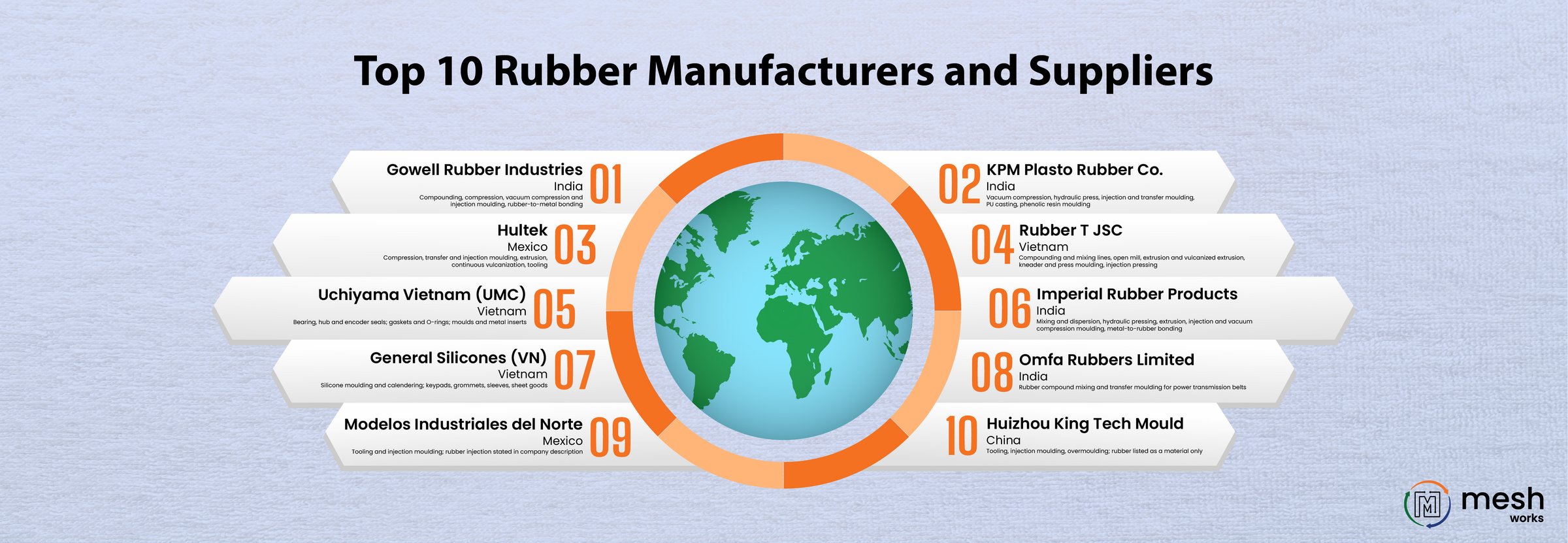
The suppliers below are grouped by what they make rather than ranked by score, because a company that compounds its own rubber and a company that moulds belts are not competing for the same enquiry. All ten are drawn from MESH Works supplier profiles across India, China, Vietnam and Mexico, and every capability, certification and compound named here is taken from those profiles.
This is a curated selection, not an independently verified ranking of manufacturing quality. Profile information is provided by the manufacturers. Please confirm current certifications, capacity and commercial terms directly with any supplier before placing an order.
How This Guide Is Organised
Rubber manufacturing covers a wide range of businesses. Organizing them by capability makes this guide more user-friendly than a single ranked list:
Full-service rubber manufacturers: Companies that mix or compound their own rubber and mould it in house, often including rubber-to-metal bonding.
Sealing and component specialists: Manufacturers focused on a specific product family, such as bearing seals or engine mountings.
Silicone and specialty components: Silicone-based parts and sheet goods, often used in electronics and appliance applications.
Power transmission belts: A distinct product category with specific processes and standards.
Moulding and tooling partners with rubber injection: Tooling-led manufacturers whose profiles include rubber along with other materials.
If a profile does not specify a compound, certification, or capacity, this guide notes it. For buyers, any unstated capability should be the first question to ask.
Full-Service Rubber Manufacturers
These four manufacturers manage the entire process from compounding to finished parts. For custom components, this integration is important because suppliers who mix their own rubber can tailor formulations to your specific temperature or chemical requirements, unlike those who use pre-mixed compounds.
1. Gowell Rubber Industries – India
Location: Faridabad, Haryana, India
MESH Works profile rating: 4.56 / 5
Processes listed: Rubber compounding, compression moulding, vacuum compression moulding, injection moulding, rubber-to-metal bonding
Compounds stated: Nitrile, EPDM, Butyl, Neoprene, ACM, CSM, Silicone, FKM
Certifications listed: IATF 16949:2016, certified by TUV Rheinland; qualified as a Green supplier by MACE
Industries served: Automotive, agricultural machinery, appliances, construction, electronics, valves and instruments
Gowell lists eight elastomers, offering the broadest compound range in this comparison. The variety is significant: ACM and FKM are high-temperature automotive compounds used where nitrile is insufficient, CSM is Hypalon, and butyl is chosen for low gas permeability. Managing all these compounds indicates in-house compounding expertise rather than reliance on pre-mixed stock.
The manufacturing process includes compounding, injection and vacuum compression moulding, metal preparation, deflashing, trimming, and in-house inspection and testing. Gowell produces both rubber-to-metal bonded components and moulded parts, with applications in suspension damping, sealing, and fuel tank systems.
IATF 16949:2016 certified by TUV Rheinland is the strongest quality credential in this list for automotive work.
Best fit for: Custom automotive rubber components where the compound has to be matched to a specific fluid, temperature or ageing requirement, and for rubber-to-metal bonded parts.
View Gowell Rubber Industries on MESH Works
2. KPM Plasto Rubber Co. – India
Location: Coimbatore, Tamil Nadu, India
MESH Works profile rating: 4.41 / 5
Processes listed: Vacuum compression moulding, hydraulic rubber moulding presses, injection and transfer moulding, PU casting, phenolic resin moulding, in-house compounding, CNC machining and tooling
Compounds stated: EPDM and NBR, both covered by its ANSI/NSF 61 certification
Certifications listed: ISO 9001:2015, ISO 14001:2015, ISO 45001:2018; ANSI/NSF 61 for EPDM and NBR
Industries served: Aerospace, agricultural machinery, electronics, energy equipment, medical instruments, valves and instruments, oil and gas
KPM offers the broadest moulding range in this guide, with five distinct processes, PU casting, and phenolic resin moulding, all supported by in-house compounding and precision tooling. This versatility accommodates part families that include both small precision seals and larger bonded assemblies requiring different processes.
The NSF/ANSI 61 certification for EPDM and NBR is the most specific credential in this guide. NSF/ANSI 61 covers materials used with drinking water and is a strict requirement: for potable water, HVAC, and certain process applications, suppliers must hold this certification for the relevant compound to be eligible to quote.
KPM provides development support from design through prototyping and testing, including stage-wise inspection and laboratory testing to ASTM standards. Products include O-rings, seals, gaskets, washers, bushes, profile rings, and rubber-metal bonded parts.
Best fit for: O-rings, seals and gaskets across multiple moulding processes, and any EPDM or NBR component with a potable water or sanitary requirement.
View KPM Plasto Rubber Co. on MESH Works
3. Hultek – Mexico
Location: Garcia, Nuevo Leon, Mexico
MESH Works profile rating: 4.40 / 5
Processes listed: Compression, transfer, and injection moulding; extrusion; continuous vulcanization; mould and tooling fabrication.
Compounds stated: Not stated on the profile
Certifications listed: ISO 9001:2015. The profile states the company follows practices aligned with IATF 16949 and identifies ISO 14001 and ISO 45001 as part of a planned certification program.
Industries served: Automotive, home appliances, petrochemical, electrical, and construction.
Hultek is the only supplier on this list that combines moulding, extrusion, and continuous vulcanization with in-house mould and tooling fabrication. Continuous vulcanization enables the production of long extruded profiles such as weatherstrip, edge trim, tubing, and cord, which differs significantly from producing discrete moulded parts.
The profile notes an in-house measurement and instrumentation laboratory, as well as technical support for tooling design and prototype development. For buyers developing new profiles or seals, having both tool fabrication and part production in one facility streamlines the process from identifying dimensional issues to implementing die corrections.
Regarding certification, note that ISO 9001:2015 is held, while IATF 16949 is described as alignment rather than formal certification. For automotive programs requiring IATF, confirm the current certification status directly before issuing an RFQ.
Best fit for: Extruded rubber profiles and continuous-vulcanized products, especially for North American programs where consolidated nearshore tooling and production are prioritized over lowest unit cost.
4. Rubber T JSC – Vietnam
Location: Ho Chi Minh City, Vietnam
MESH Works profile rating: 3.66 / 5
Processes listed: Mixing lines with automatic carbon black and oil feeding, open mill and mixing, extrusion and vulcanized extrusion, kneader and press moulding, injection moulding and injection pressing, plastic injection and blowing
Compounds stated: Produces its own rubber compound; also works in silicone
Certifications listed: ISO 9001:2015, ISO 14001:2015, NSF International certification, SA8000:2014, plus WCA, Costco GMP and Code of Conduct, and SMETA audits
Industries served: Agricultural machinery, appliances, construction, energy equipment, heavy equipment, valves and instruments, oil and gas, power and energy
Rubber T sells rubber compound as a standalone product, indicating its core business focus. The described mixing line with automatic carbon black and oil feeding, open mill, and kneader demonstrates dedicated compounding infrastructure rather than a moulding shop with incidental mixing capabilities.
The product range includes technical moulded parts and gaskets for water supply and drainage, as well as food-contact, breeding, and veterinary products. NSF International certification supports this diverse offering. The social compliance credentials are notably comprehensive for this list, with SA8000:2014, WCA, Costco GMP, and SMETA audits. For buyers requiring supplier code-of-conduct adherence, this level of compliance is often more difficult to source than standard quality certification.
The profile also lists plastic injection and blowing. Please confirm which production lines and capacities are dedicated to rubber for your specific requirements.
Best fit for: Technical moulded rubber, extruded profiles, purchased rubber compounds, and buyers whose approval processes prioritize both social compliance audits and quality certification.
View Rubber T JSC on MESH Works
Sealing and Component Specialists
These manufacturers focus on a specific product family. For sealing parts, specialized expertise is valuable: a company producing bearing seals daily has already addressed challenges that a general moulder may encounter for the first time with your tooling.
5. Uchiyama Vietnam Inc. (UMC) – Vietnam
Location: Binh Duong, Vietnam
MESH Works profile rating: 4.05 / 5
Processes listed: Rubber manufacturing, mould making, metal insert production
Compounds stated: Not stated on the profile
Certifications listed: ISO 14001 for environmental management. The profile states the company has upgraded its quality-management certification to IATF 16949.
Industries served: Automotive, aerospace, agricultural machinery, appliances, construction, electronics, energy equipment, EV, heavy equipment, lawn care, lighting, medical instruments, recreational vehicles, valves and instruments
UMC specializes in sealing products, including bearing seals, hub bearing seals, encoder seals, rubber and metal gaskets, O-rings, and small engine parts. The company focuses on high-volume production of a specialized product range rather than offering general moulding services.
Encoder seals are notable because they contain a magnetised element read by ABS or wheel-speed sensors. This gives them an electrical function and requires stricter magnetic and dimensional tolerances than standard lip seals. Few general rubber moulders produce these components.
The profile lists a mould capacity of 5,000 cavities per month across multiple factory locations, along with metal insert production. This is one of the few profiles to provide a specific capacity figure. UMC supplies customers in Japan and Europe.
Best fit for: Bearing seals, hub and encoder seals, and automotive sealing parts where insert moulding and consistent high-volume output are prioritized over compound flexibility.
View Uchiyama Vietnam Inc. on MESH Works
6. Imperial Rubber Products – India
Location: Pune, Maharashtra, India
MESH Works profile rating: 3.58 / 5
Processes listed: Rubber mixing and dispersion, hydraulic pressing, extrusion, injection moulding, vacuum compression moulding, drilling and finishing, bonding with spray booth equipment
Compounds stated: Not stated on the profile
Certifications listed: The profile states the company is a customer CQ certified vendor.
Industries served: Automotive, construction, electronics, EV, valves and instruments
Imperial manufactures anti-vibration and sealing parts for vehicles, including engine mountings, bushes, seals, gaskets, bellows, buffers, hoses, and O-rings. Metal-to-rubber bonding is a core capability. The profile lists TATA Motors and Lucas TVS as OEM customers.
Its in-house testing capabilities are extensive: universal testing machine, computerised rheometer, endurance testing machine, muffle furnace, oven, and tools for hardness and dimensional measurement. The presence of a rheometer and endurance rig indicates the company validates cure behaviour and fatigue life, which is essential for engine mounting work.
Best fit for: Engine mountings, bushes, bellows and metal-to-rubber bonded anti-vibration parts, where a buyer can run their own supplier qualification rather than relying on a third-party certificate.
View Imperial Rubber Products on MESH Works
Silicone and Specialty Components
7. General Silicones (VN) Co., Ltd – Vietnam
Location: Bac Giang, Vietnam
MESH Works profile rating: 3.98 / 5
Processes listed: Silicone moulding, calendering, silicone keypad and switch production, hybrid keypad production, appearance design and surface treatment
Compounds stated: Silicone
Certifications listed: The profile states the company operates quality management, environmental management and EHS management systems.
Industries served: Automotive, aerospace, appliances, medical instruments; the profile also names e-communication, display and panel, and consumer goods
General Silicones distinguishes itself from others on this list. Its offerings include silicone keypads, custom SR parts, hybrid components, grommets, and sleeves. The company also produces materials that are rubber-based but used in electronic applications, such as ACF bonding sheets, electro-conductive pads, silicone foam, light-shield sheets, thermal interface materials, and PCB custom sheets.
Calendering, in addition to moulding, enables the production of sheet products. This process creates continuous sheets with controlled thickness, which is essential for manufacturing thermal interface pads and conductive sheet stock. Calendering is a separate process from moulding.
Best fit for: Silicone keypads, grommets and sleeves, and silicone sheet products including thermal interface and conductive materials for electronics assemblies.
View General Silicones (VN) on MESH Works
Power Transmission Belts
8. Omfa Rubbers Limited – India
Location: Noida, Uttar Pradesh, India
MESH Works profile rating: 3.56 / 5
Processes listed: Rubber compound mixing, transfer moulding, belt manufacturing
Certifications listed: ISO 9001:2015, certified by LRQA, with scope covering industrial belts, agricultural belts, raw-edge belts, poly-V belts and synchronous belts
Industries served: Automotive, agricultural machinery, appliances, construction, electronics, energy equipment, EV, heavy equipment, textile, cement, oil and gas, power plant, recreational vehicles, valves and instruments; the profile also names ceramic, cold storage, food processing and mineral ore mining
Omfa specializes exclusively in power transmission belting, including V-belts, conical belts, poly-V belts, automotive belts, agricultural and lawn-mower belts, raw-edge cogged belts, wrapped construction banded belts, dry-cover and bareback belts, and cogged variable-speed belts.
Belting is a specialized field. A belt is a composite of rubber compound, tension cords, and fabric cover cured together. Its performance depends on cord construction and cover compound, not moulding tolerance. Buyers sourcing belts and those sourcing seals operate in distinct markets, which is why Omfa is listed separately.
The ISO 9001:2015 certification from LRQA specifically covers belt manufacturing, ensuring the quality system applies directly to Omfa’s product range.
Best fit for: Industrial, automotive, agricultural and variable-speed power transmission belts, including replacement and aftermarket programmes.
View Omfa Rubbers Limited on MESH Works
Moulding and Tooling Partners with Rubber Injection
The two companies listed below are tooling and injection moulding businesses that include rubber among their materials. They are included in the rubber sourcing shortlist for their tooling capability, not as custom rubber component manufacturers. Buyers should directly confirm each company's rubber-specific capabilities, compound range, and relevant production experience.
9. Modelos Industriales del Norte (MINSA) – Mexico
Location: Saltillo, Coahuila, Mexico
MESH Works profile rating: 4.62 / 5
Processes listed: Injection moulding. The company also offers casting moulds, cold-die stamping, hot stamping tooling, jigs and fixtures, machining, casting, plastic and rubber injection, and metal stamping and dies.
Materials listed: Plastics, rubber, steel, titanium
Certifications listed: ISO 9001:2015
Industries served: Automotive, aerospace, agricultural machinery, appliances, construction, lighting
MINSA specializes in tooling, with over 30 years of experience in plastic injection moulds, casting moulds, cold dies, hot stamping tooling, and jigs and fixtures. Capabilities include precision CNC machining, five-axis work, CMM, and optical inspection.
Rubber injection is listed among the company's processes, along with plastic injection, machining, casting, and metal stamping. The profile does not specify rubber products or compounds.
The practical case for MINSA on a rubber enquiry is tooling-led: a buyer who needs a die designed and built in Mexico, close to a North American assembly plant, and who is qualifying the moulding capability separately.
Best fit for: Nearshore tool and die development, and projects that combine tooling with injection moulding or stamping. Confirm rubber injection capacity, compound range, and production references before quoting a rubber part.
View Modelos Industriales del Norte on MESH Works
10. Huizhou King Tech Mould – China
Location: Huizhou, Guangdong, China
MESH Works profile rating: 4.57 / 5
Processes listed: Injection moulding, machining (CNC, VMC, HMC), overmoulding, precision machining
Materials listed: Plastics, stainless steel, aluminium, rubber, carbon steel, steel, copper
Certifications listed: ISO 9001:2015 and IATF 16949:2016
Industries served: Automotive, appliances, electronics; the profile overview also mentions industrial and medical markets
Huizhou King Tech Mould offers integrated tooling and injection moulding, including design for manufacturing, mould flow analysis, tool building and production moulding, with 16 years of tooling experience. The company produces plastic moulds and injection-moulded parts up to 2,000 grams.
IATF 16949:2016 alongside ISO 9001:2015 is a strong automotive quality position for the moulding work the profile does describe.
Best fit for: Plastic tooling, injection moulding and overmoulded assemblies. For a rubber component, treat rubber capability as unconfirmed and establish it with the supplier before an RFQ.
View Huizhou King Tech Mould on MESH Works
Comparison of the 10 Rubber Suppliers
Capability, compounds and certifications as stated on each MESH Works profile.
Supplier | Country | Rubber capability | Quality certifications listed |
Gowell Rubber Industries | India | Compounding, compression, vacuum compression and injection moulding, rubber-to-metal bonding | IATF 16949:2016 (TUV Rheinland); MACE Green supplier |
KPM Plasto Rubber Co. | India | Vacuum compression, hydraulic press, injection and transfer moulding, PU casting, phenolic resin moulding | ISO 9001:2015, ISO 14001:2015, ISO 45001:2018; ANSI/NSF 61 for EPDM and NBR |
Hultek | Mexico | Compression, transfer and injection moulding, extrusion, continuous vulcanization, tooling | ISO 9001:2015; states practices aligned with IATF 16949 |
Rubber T JSC | Vietnam | Compounding and mixing lines, open mill, extrusion and vulcanized extrusion, kneader and press moulding, injection pressing | ISO 9001:2015, ISO 14001:2015, NSF International, SA8000:2014; WCA, Costco GMP, SMETA |
Uchiyama Vietnam (UMC) | Vietnam | Bearing, hub and encoder seals; gaskets and O-rings; moulds and metal inserts | ISO 14001; states QMS upgraded to IATF 16949 |
Imperial Rubber Products | India | Mixing and dispersion, hydraulic pressing, extrusion, injection and vacuum compression moulding, metal-to-rubber bonding | None listed; described as a customer CQ certified vendor |
General Silicones (VN) | Vietnam | Silicone moulding and calendering; keypads, grommets, sleeves, sheet goods | None named; states quality, environmental and EHS management systems |
Omfa Rubbers Limited | India | Rubber compound mixing and transfer moulding for power transmission belts | ISO 9001:2015 (LRQA), scope covering industrial, agricultural, raw-edge, poly-V and synchronous belts |
Modelos Industriales del Norte | Mexico | Tooling and injection moulding; rubber injection stated in company description | ISO 9001:2015 (company description) |
Huizhou King Tech Mould | China | Tooling, injection moulding, overmoulding; rubber listed as a material only | ISO 9001:2015, IATF 16949:2016 |
Choosing a Rubber Supplier: Key Decision Factors
Begin by selecting the appropriate compound before considering the supplier.
The elastomer is the specification. If the compound is incorrect, process control cannot compensate:
NBR (nitrile) — oil and fuel resistance. Degrades in sunlight and ozone.
EPDM — weather, ozone and water resistance. Fails on contact with mineral oil.
FKM (fluoroelastomer) — high temperature with fuel and chemical resistance. Expensive; specified where nitrile cannot survive.
Silicone — wide service temperature range and good flexibility. Low tear strength and poor oil resistance.
Neoprene (CR) — balanced weather, oil and chemical resistance where no single property dominates.
Natural rubber — high elasticity, resilience and tear strength. Poor oil and ozone resistance.
Butyl (IIR) — very low gas permeability, used for air and vapour retention.
ACM and CSM — specialist automotive compounds for hot oil and chemical exposure.
Next, verify that the manufacturer has produced parts using the specified compound, rather than only listing it as available. Request the formulation reference, hardness range, and a sample part previously supplied.
Match the process to the part
Process selection drives tooling cost, achievable tolerances, and viable production volumes.
Compression moulding — low tooling cost, suits larger parts and lower volumes, and involves longer cycle times.
Transfer moulding — preferable for parts with inserts and provides tighter dimensional control than compression moulding.
Injection moulding — highest tooling cost, the shortest cycle times, and offers the best repeatability for high-volume production.
Extrusion with continuous vulcanization — used for producing continuous profiles, tubing, and weatherstrips.
Rubber-to-metal bonding — a specialized process that requires metal preparation, adhesive systems, and bond testing. Not all moulders offer this capability.
Check the certification scope, not just the certificate
A certificate applies to a specific scope at a particular site. ISO 9001 is a general quality-management standard, while IATF 16949 is required for automotive OEM programs. Application-specific approvals, such as NSF/ANSI 61 for drinking water contact or food-contact compliance for processing equipment, may be more important.
Request the current certificate, verify the issuing body, expiry date, and scope statement, and confirm it covers the plant producing your part. Certification data in any directory, including this one, is supplier-provided and should be verified at the source.
Separate sample capability from production capacity
A manufacturer that produces an excellent sample has shown it can make the part once. Production requires further assessment: number and tonnage of presses, mould cavitation, mixing capacity, and current line scheduling. Request details on press tonnage and count, mould cavitation, monthly compound throughput, and current utilisation.
Compare landed cost, not unit price
Rubber quotes are rarely directly comparable. Tooling may be included in the piece price or charged separately, minimum order quantities vary, and price breaks are typically based on order quantity rather than annual usage. EXW and DDP quotes from different countries are not equivalent.
Normalize all quotes to landed cost over a defined annual volume before comparing. Include unit price at your release quantity, tooling, freight, duty, payment terms, and quoted currency.
Find Rubber Manufacturers and Compare Quotes with MESH Works
Shortlisting manufacturers is the first step. Buyers then need to structure requirements, collect comparable quotations, and assess capability against the specification.
MESH Works gives industrial procurement teams a single platform for that work. With MESH Supplier Discovery, buyers can search manufacturers by country, process, material and commodity, and review company information, capabilities, industries served, certifications and audit details where available.
The platform also supports the steps after discovery:
● RFQ Management — structure sourcing requirements and run requests for quotation.
● AI RFQ Analyzer — review RFQ documents and support RFQ preparation.
● AI Supplier Quote Analysis — upload supplier quotations in PDF, Excel or Word and compare unit prices, tooling, lead times and commercial terms side by side. Free to use.
MESH Works lists 19,000+ suppliers across 40+ countries, of which 4,000+ have been audited in person against a 45-point audit carried out at the factory.
Browse rubber manufacturers on MESH Works
The rubber supplier directory lists manufacturers by location, process, certification and audit status, with profile ratings shown against each. View rubber suppliers on MESH Works.
Final Thoughts
Selecting the right rubber manufacturer depends on the part’s requirements. For example, a compounder with eight elastomers and IATF certification is well-suited for custom automotive seals but not for V-belts. A sealing specialist producing encoder seals at scale has experience with challenges that general moulders may not have encountered. Choosing a tooling house with rubber injection is primarily a tooling decision rather than a rubber selection.
First, specify the compound. Then, align the process with the part, ensure the certification scope includes the site and product, and compare quotes based on landed cost for actual annual volumes. The suppliers in this guide meet these criteria; your task is to match the right supplier to your application.