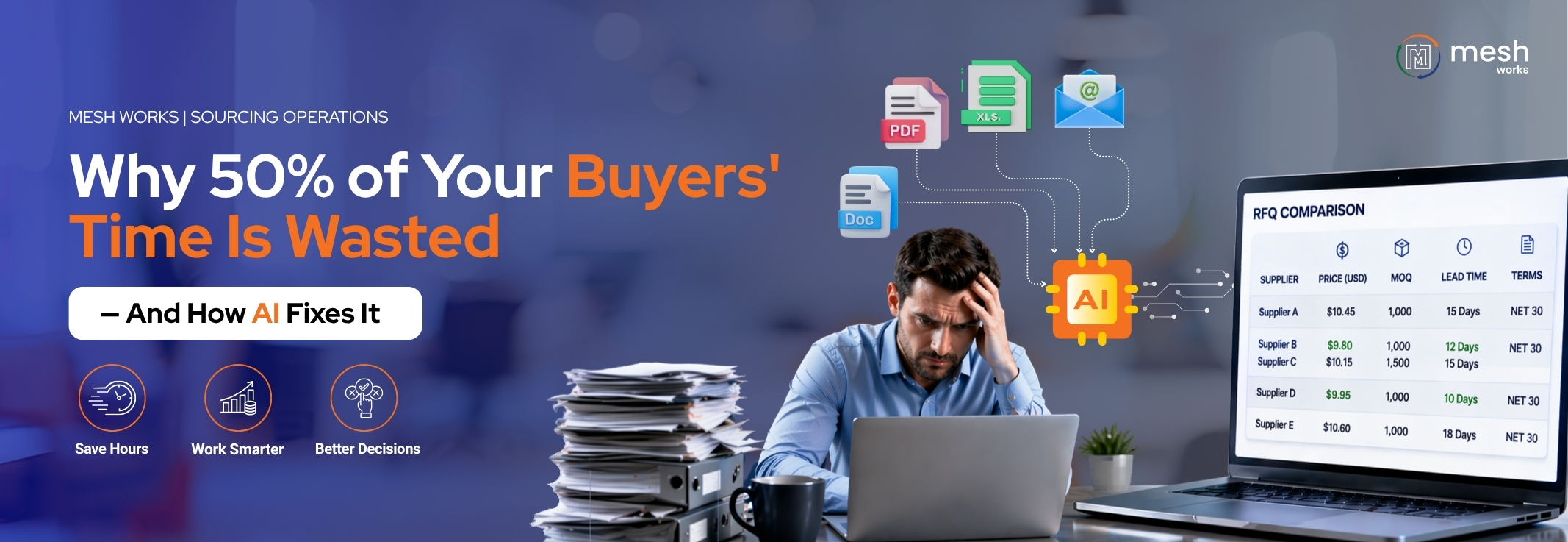
It's 4 PM on a Friday. You sent the RFQ out on Monday. Fifteen suppliers responded. Fifteen different formats. Three Excel files. Four PDFs. Two Word documents. Six emails with data pasted directly into the body. All using different column headers, different units, different price structures.
Your buyer now has a choice: leave it for Monday, or spend the next two hours copying and pasting before they can compare a single line item.
This is not a one-off. This is Tuesday, and Thursday, and the Tuesday after that.
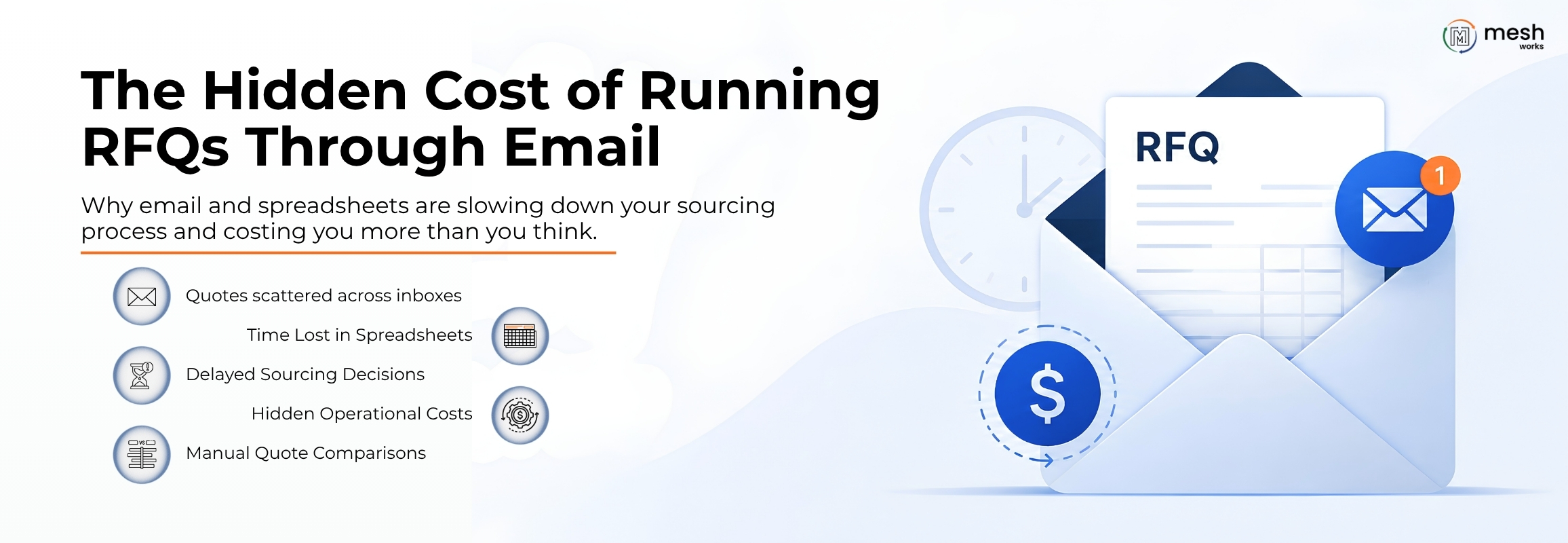
The uncomfortable truth for most sourcing leaders is this: over 50% of a buyer's working day is spent on mechanical processing — not sourcing. Not analysis. Not supplier development. Not negotiation. Processing. Data translation. Format wrangling. Spreadsheet maintenance.
Your buyers were hired to make decisions. They're spending half their time doing work that doesn't require their judgment at all.
This piece breaks down exactly where the time goes, why the obvious fixes haven't worked, and how AI is eliminating each time sink — with specific examples from teams that have already made the shift.
The Time Audit: Where 50% Actually Goes
Let's be specific, because vague efficiency claims don't help anyone. According to procurement teams utilizing automated RFQ management software, a single RFQ with 10–15 suppliers involves roughly the following work before a buyer makes a single sourcing decision:
Activity | Avg. time/RFQ | Requires human judgment? |
Opening and reading supplier attachments | 45–60 min | No — purely mechanical retrieval |
Extracting price, MOQ, EAU, lead times, terms | 60–90 min | No — structured data that exists in every quote |
Normalizing units, currencies, delivery terms | 30–45 min | No — rule-based translation |
Building the comparison spreadsheet | 45–60 min | No — data assembly, not analysis |
Following up on incomplete submissions | 30–60 min | Minimal — mostly status tracking |
Analyzing quotes, negotiating, awarding | 60–90 min | Yes — this is the actual job |
Add it up: roughly 3.5 to 5.5 hours of mechanical work before the buyer does anything that actually requires them to be a buyer. The analysis, negotiation, and award — the parts that justify having an experienced sourcing professional in the role — get compressed into whatever time is left.
This isn't a buyer performance problem. It's a tooling problem. Over 70% of procurement teams cite inconsistent quote formats as the primary driver of RFQ cycle time delays. The problem is structural, not individual — and it's been structural for 20 years because the tools to solve it didn't exist yet.
The pattern we see consistently
Buyers who are good at their jobs become expert spreadsheet builders. They develop elaborate macros, templates, and personal systems to shave time off the consolidation work. It's impressive — and it's entirely the wrong use of their skills. The energy that goes into managing data should go into reading markets, developing relationships, and making calls that save the company money.
Why the 'Just Use a Template' Fix Doesn't Work
When sourcing leaders first identify the quote consolidation problem, the instinct is usually the same: standardize the input. Force suppliers to use a common template. If everyone submits data in the same format, the comparison builds itself.
It's a reasonable idea. It doesn't work.
The supplier compliance problem
Unless you're one of a supplier's top three customers by volume, you don't have the leverage to dictate their quoting format. Suppliers have their own ERP systems, their own pricing tools, their own established workflows. They'll use your template when it's easy, and revert to their own format when it isn't — which is most of the time.
The result: buyers spend time chasing compliance, then end up doing the manual consolidation anyway for the 40–60% of responses that came back in the wrong format or not at all.
The supplier portal problem
The next solution companies try is a supplier portal — a dedicated platform where suppliers log in and submit structured data. This works well when suppliers are motivated to adopt it. It works poorly when they aren't.
Onboarding friction is real. Small and mid-size suppliers, often the most capable ones for specialized categories, are the least likely to invest time learning a new portal for a customer that represents a fraction of their revenue. Adoption lags. The buyer ends up maintaining a hybrid system — portal for compliant suppliers, manual processing for everyone else — which is more work, not less.
The right framing
The question most teams are asking is: "How do we make suppliers send data our way?" The more useful question is: "How do we handle whatever format they send, instantly?"
Those are different problems with different solutions. The first is a change management problem. The second is a technology problem — and it's the one AI actually solves.
Where AI Actually Fits: Three Specific Workflow Wins
There's a lot of noise around AI in procurement right now. Most of it is either vague ("AI will transform your supply chain") or overreaching ("AI will replace your buyers"). Neither is useful. What's useful is knowing which specific activities in the sourcing workflow AI handles well today, with what results.
Here are the three areas where the impact is clearest — and most immediate.
Win 1: Automated RFQ Management Software and Quote Comparison
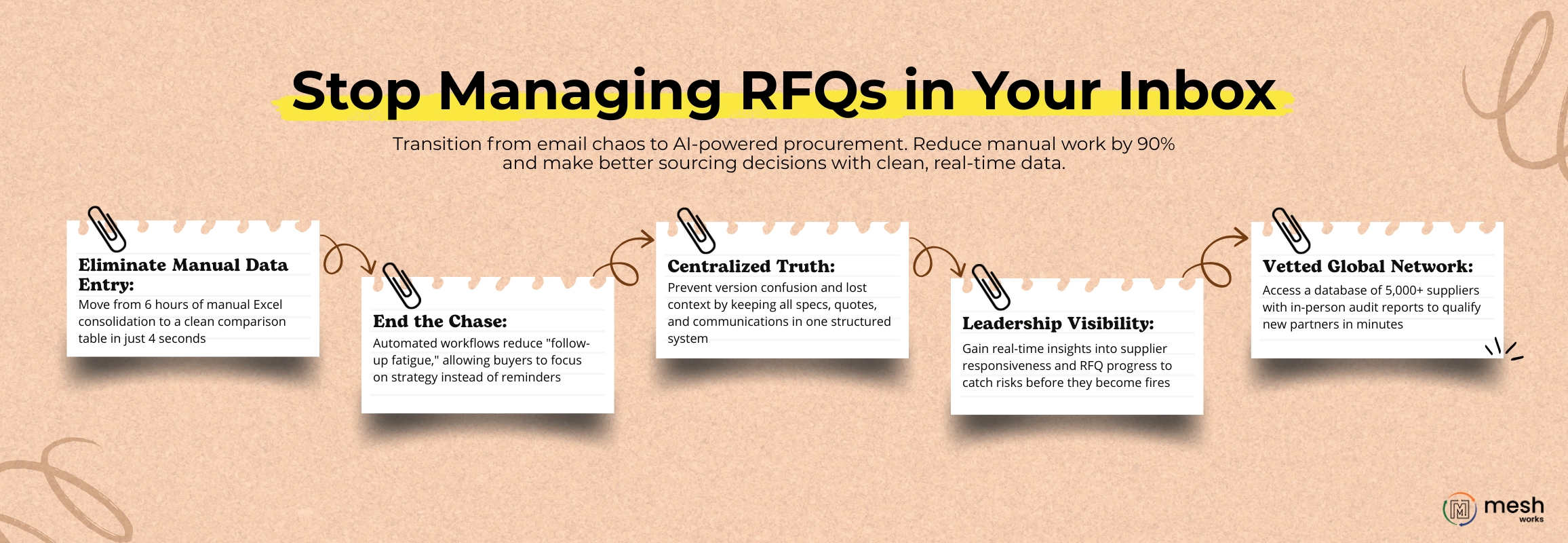
This is the highest-value, lowest-effort AI application in sourcing right now. Instead of buyers opening attachments and manually extracting data, AI reads supplier submissions — PDFs, Excel files, Word documents, plain-text emails — and pulls the key fields into a single structured comparison table.
Price. MOQ. EAU. Lead time. Shipping terms. Delivery terms. Payment terms. All extracted, normalized, and displayed side by side — without the buyer touching a single cell.
Suppliers respond in whatever format works for them. Buyers get a clean comparison in seconds. The mechanical work is gone entirely.
The downstream effect matters too: when comparison is instant, buyers run more competitive RFQs. They include suppliers they'd previously skipped because "it's not worth the consolidation time." More competition, better pricing, less effort — the compound effect of removing a single friction point.
Traditional supplier relationship management (SRM) platforms track basic vendor data but fail when handling the actual data extraction required for complex direct materials procurement. That is where an AI-powered RFQ solution bridges the gap.
Without AI (Today) | With MESH AI RFQ Management Software |
|---|---|
Open 15 separate supplier emails | Suppliers respond in a structured format |
Suppliers respond in any format they choose | Standardized responses across suppliers |
Extract data from PDFs, Excel, Word manually | AI extracts all key fields automatically |
Build comparison spreadsheet manually | Comparison table generated in seconds |
Normalize units, currencies, lead times manually | Automated normalization & standardization |
4+ hours invested before any analysis | Under 30 minutes to decision-ready insights |
Win 2: Supplier discovery and pre-qualification
Finding a new supplier has always been the other major time sink — separate from the RFQ process entirely, but equally painful. For most sourcing teams, identifying and qualifying a new supplier for a specialized category takes three to six weeks. That's not because buyers are slow — it's because the process requires searching directories, cold outreach, requesting information packages, evaluating capability claims, and verifying quality certifications. None of that has a shortcut when you're starting from scratch.
AI-powered supplier databases that include on-site audit data change the math fundamentally. When you can filter by manufacturing process, geographic location, quality certifications, equipment lists, and past customer history — and trust that data because it came from an on-site engineer visit, not a supplier self-assessment — the front-end qualification work that took weeks takes hours.
Example: $300M US manufacturer
Reduced time to identify and qualify a new supplier from 20+ days to under 3 days using MESH's audited supplier database. The team filters by process, location, certifications, and prior project history — and shortlists candidates before making a single supplier call. The weeks they used to spend on discovery are now spent on evaluation and relationship building.
Win 3: RFQ communication and status tracking
The time-audit table above lists "following up on incomplete submissions" as 30–60 minutes per RFQ. That estimate is conservative for teams managing high volumes. The actual cost is usually higher once you account for the inbox archaeology — finding the original email thread, determining whether a supplier opened the RFQ, tracking down partial submissions, chasing clarifications on ambiguous terms.
Structured RFQ tools with built-in supplier communication eliminate this almost entirely. Buyers can see who has opened the RFQ, who has submitted, what's missing, and what needs a follow-up — from a single screen. Supplier responses come back into the same system, not into an inbox where they compete with everything else.
The result is less time spent searching, less risk of a response getting buried, and a complete audit trail of the sourcing process — something email threads can't provide.
What Buyers Do With the Time Back
The efficiency argument for AI in sourcing is straightforward: if buyers spend 4+ hours per RFQ on mechanical work, and AI handles that work in minutes, buyers get those hours back. But "efficiency" undersells what's actually happening.
This isn't about doing the same work faster. It's about doing fundamentally different work. The hours that come back aren't going back into more spreadsheets — they're going into the activities that actually create value for the organization.
What the reclaimed time actually looks like
More competitive RFQs: when comparison is easy, buyers run RFQs they'd previously avoided because the consolidation wasn't worth the effort. More bidders, more competition, better outcomes on pricing and terms.
Deeper supplier development: relationship-building with strategic suppliers — the kind that creates preferential capacity allocation, early access to pricing changes, collaborative cost reduction — requires time buyers haven't had.
Faster dual-sourcing: for teams trying to build qualified backups on China-exposed categories, the bottleneck is often buyer bandwidth. Freeing time accelerates the qualification work that reduces supply chain risk.
Better negotiation preparation: buyers who've spent 4 hours copying data don't have 90 minutes to prepare for a pricing negotiation. Remove the copying; the preparation happens.
The capacity math for CPOs and CFOs
If you're making the business case for AI tooling in your sourcing team, here's a simple way to frame it:
Team size | Time saved/person | Total weekly hours | Annual value |
3 buyers | 10 hrs/week saved each | 30 hrs/week | ~$75,000/year in capacity |
5 buyers | 10 hrs/week saved each | 50 hrs/week | ~$125,000/year in capacity |
10 buyers | 10 hrs/week saved each | 100 hrs/week | ~$250,000/year in capacity |
Your team | Calculate your number | Time to strategy | Headcount-equivalent gain |
For a 5-person buying team at average industrial buyer salaries, 50 reclaimed hours per week represents roughly $125,000+ per year in productive capacity — without adding a single headcount. At a time when most sourcing teams are being asked to cover more categories, more geographies, and more supplier relationships with the same or fewer people, that's not an efficiency gain. It's a structural change in what the team can do.
The reframe for executive conversations
"AI isn't replacing buyers — it's elevating them." If your buyers are spending 50% of their time on work that doesn't require their judgment, that's not an efficiency problem. It's a capacity problem. The buyers you hired for their experience, relationships, and market knowledge are being rationed to the hours left after the spreadsheet work is done. AI fixes the allocation, not the headcount.
Where to Start
The AI tools that address these problems exist now — they're not on a roadmap. The buyers who benefit from them earliest are the ones whose teams are already feeling the squeeze: more categories to cover, fewer resources to cover them with, and leadership asking for more competitive outcomes on every spend category.
The question isn't whether AI belongs in your sourcing workflow. It's which part of your process is losing the most time right now. Start there.
If it's RFQ consolidation and quote comparison — the AI RFQ Analyzer is the fastest path. Suppliers respond in any format; buyers get a comparison table in seconds.
If it's supplier discovery and qualification — access to MESH's audited supplier database cuts the front-end qualification work from weeks to days, with verified on-site data on 4,000+ manufacturers across 40+ countries.
If it's both — most teams find that once one workflow gets fixed, the capacity it frees up makes the second bottleneck visible in a new way.
Buyers aren’t inefficient — they’re spending too much time on work that doesn’t require their judgment.
When 50% of sourcing time is consumed by manual processing, the real constraint isn’t headcount — it’s how that time is allocated.
AI removes the mechanical work entirely, allowing teams to focus on analysis, supplier strategy, and negotiation. The result isn’t just faster RFQs — it’s better sourcing outcomes across the board.
If you’re evaluating how to reduce manual RFQ effort, book a demo to see how this works in practice.