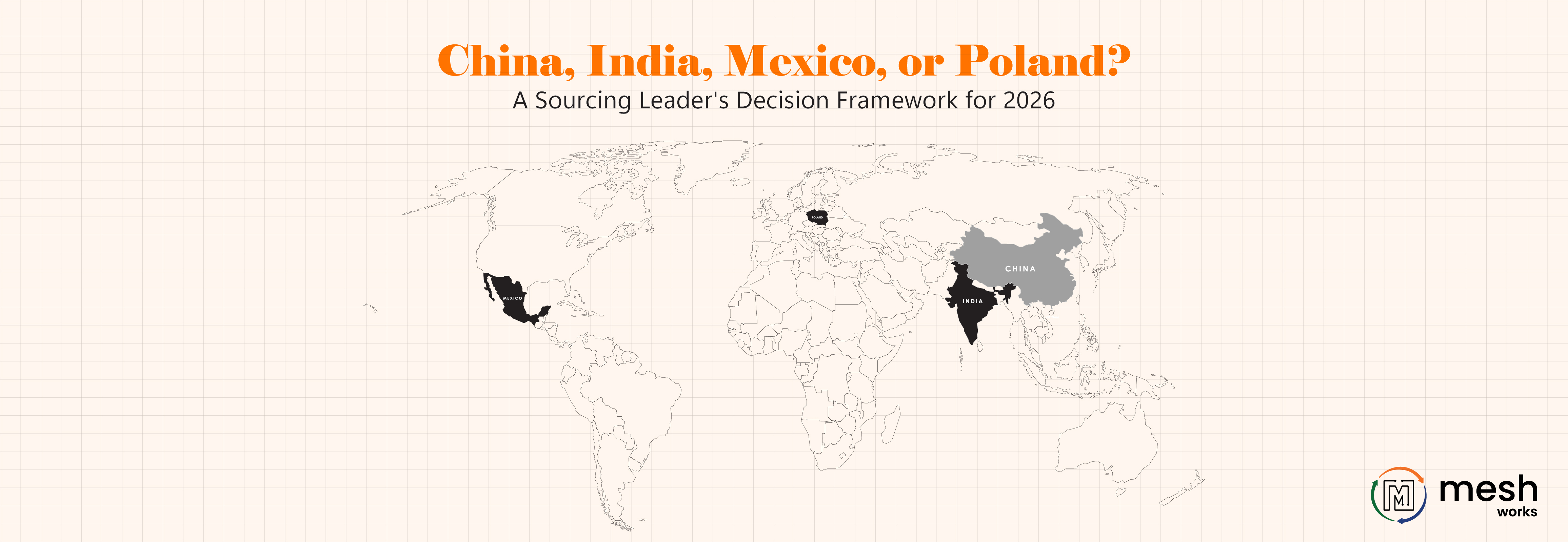
Every sourcing leader we talk to is sitting with the same question right now: not whether to reduce China exposure, but where to go instead — and how to make that call with confidence.
The tariff picture has clarified that decision. Across many industrial categories, effective China tariff rates have exceeded 100% since 2025. Most purchasing teams absorbed the first wave of cost increases. Now leadership wants a plan — not just a reaction.
The problem isn't awareness. Most sourcing leaders already know they need to diversify. The problem is that deciding between India, Mexico, Poland, or some combination of all three involves tradeoffs that are genuinely different depending on what you're sourcing, who you're selling to, and what your biggest constraint is.
This guide is built to give you a practical framework for making that call — category by category, region by region. By the end, you'll know which regions fit your situation, what the real tradeoffs look like, and what to prioritize first.
We'll focus on the industrial manufacturing categories we see most frequently: machining, castings, forgings, fabrication, assemblies, and precision components.
Why 2026 is Different: Four Forces Reshaping Sourcing Geography
This isn't a trend piece about supply chain diversification being a good idea. It's about the structural changes that make 2026 a different decision environment than 2022 or even 2024.
1. The tariff math has fundamentally changed
For many industrial categories, 100%+ effective tariffs on China-sourced parts mean the cost advantage that made China the default option for two decades has largely evaporated. What used to be a 30–40% cost gap in China's favor is now, in many categories, a net negative once tariffs are factored in.
2. Alternative regions have matured — faster than expected
India's manufacturing export growth tells the story clearly: 65% growth in auto component exports to the US from 2018 to 2023, 70% growth in machinery exports over the same period, and electronics exports that tripled. This isn't a developing supply base anymore — it's a developed one, with established quality systems, rising engineering talent, and logistics infrastructure catching up to demand.
Mexico's nearshoring boom is real, but it has a constraint: most of the qualified manufacturing capacity that expanded over the last five years went to automotive. For non-automotive buyers, finding capable, certified suppliers in Mexico requires a much more curated search than it did three years ago.
3. Eastern Europe is an underused asset for US buyers
Poland, the Czech Republic, and Romania have been quietly supplying German and French OEMs for 20+ years. The precision machining, wire harness, and fabrication capabilities that European Tier 1 suppliers rely on are well-developed, cost-effective, and largely invisible to US sourcing teams who haven't been looking there.
4. Regionalization takes longer than you think
On average, a full supply chain transformation takes 2+ years. That means teams who haven't started identifying and qualifying alternatives are already behind. The window for accessing the best suppliers in these regions — before capacity constraints mirror what happened in Mexico — is now.
The Decision Variables: What Actually Matters
Before going region by region, it's worth establishing the evaluation criteria that actually move the needle. Here's how the four main alternatives compare across the variables that matter most to industrial sourcing teams:
Variable | India | Mexico | Poland | China (baseline) |
Est. cost savings vs. China | 15–25% | 8–15% | 10–18% | Baseline |
Typical lead time | 4–8 weeks | 2–4 weeks | 3–6 weeks | 6–12 weeks |
Qualification complexity | Medium | Medium–High | Low–Medium | Low (established) |
Duty / tariff exposure | Low (favorable structure) | Low (USMCA) | Low (for EU-sell) | Very High (100%+ on many categories) |
Best categories | Castings, machining, forgings, auto components, assemblies | Nearshore speed plays, automotive-adjacent, US sell | Precision metal, harnesses, fabrication, plastics | Complex tooling, high-vol commodities (with risk tradeoff) |
Best fit for | High-volume engineered parts, cost-reduction mandates | Speed, US proximity, risk reduction | EU-facing supply chains, precision manufacturing | Categories where no alternative yet exists |
A few things worth calling out in that table: Poland's qualification complexity is lower than you'd expect because the supplier base has already been verified and certified by European OEMs — you benefit from that without doing the work yourself. And China's 'low qualification complexity' reflects familiarity, not safety — the risk profile on China-sourced parts has changed even where quality hasn't.
Region-by-Region Breakdown: Honest Strengths, Real Limitations
India: The Volume and Engineering Play
The case for India has shifted over the last three years from 'interesting option' to 'must-have node in modern supply chains.' The combination of deep manufacturing clusters (especially in automotive, industrial, and engineering), favorable duty structures, rising technical talent, and strong ISO/IATF certification penetration makes India the most compelling cost-reduction opportunity available right now for US industrial buyers.
Best categories: castings, forgings, machined components, auto components, electrical assemblies, precision parts.
The myths that hold teams back are worth addressing directly:
"Lead times are too long." India suppliers we work with regularly achieve 4–6 week lead times for established relationships. The 12-week assumption is based on early-2010s experience, not current reality.
"Quality is inconsistent." ISO 9001 and IATF 16949 certified suppliers are abundant — the challenge is identifying them without local knowledge. Once you're past that qualification hurdle, quality consistency is comparable to other regions.
"Remote management is too hard." This was true when management meant email and phone calls. With on-site audit data, factory videos, real-time performance tracking, and structured supplier portals, remote management of India suppliers is operationally feasible in a way it wasn't five years ago.
A U.S. buyer working with a MESH-qualified India supplier reduced per-part costs by 20% while achieving consistent ISO/IATF compliance and lead times under 6 weeks. The key was having audit data upfront — equipment lists, quality certifications, production photos — before committing to the supplier.
Mexico: The Nearshoring Speed Play
Mexico's value proposition is clear and specific: if your primary constraint is speed and you're selling into the US market, Mexico is hard to beat. Two-to-four week lead times, USMCA duty treatment, and proximity-driven logistics simplicity make Mexico the obvious nearshoring choice.
The honest limitation: qualified manufacturing capacity outside the automotive sector is genuinely scarce. The nearshoring boom of 2021–2024 was largely absorbed by automotive OEM investment. If you're sourcing non-automotive categories — industrial equipment components, lighting, agricultural machinery parts, energy sector fabrications — finding a capable, certified supplier in Mexico requires a more curated approach than most teams expect.
The teams winning in Mexico right now are the ones who have access to pre-vetted supplier databases rather than relying on trade directories or cold outreach. Capacity is there — it just isn't easy to find without the right network.
Best categories: castings and machined parts for US-sell programs, fabrication and welding for nearshore programs, any category where 2-week delivery is a competitive advantage.
Risk reduction in practice
MES Inc, one of our group companies, dual-sourced 75% of its projects to reduce supply chain risk — with Mexico as a key nearshore node for US-sell programs. The dual-sourcing strategy also provided pricing leverage that single-source arrangements couldn't match.
Poland and Eastern Europe: The Underrated Option
Poland is the region most often missing from US sourcing conversations — and that's precisely why the opportunity exists. German and French automotive OEMs have been developing Poland's manufacturing base as a Tier 2–3 supplier ecosystem for more than two decades. The result is a precision manufacturing capability that rivals Western European costs at a meaningful discount, with quality systems and certifications that were built to meet EU automotive standards.
For US buyers with European operations or European sales channels, Poland is the logical choice. The qualification complexity is lower than India or Mexico because the supplier base has already been validated by demanding OEM customers.
Best categories: precision machining, CNC components, wire harnesses, electrical assemblies, sheet metal fabrication, welding, plastic molding, mechanical equipment and components.
The scenario where Poland makes the most sense: you have a European facility or a significant EU-facing product line, and you're currently single-sourcing those components from either China or Western Europe. Poland gives you cost reduction without sacrificing the qualification standards your EU customers require.
China: The Honest Assessment
The guidance here isn't 'exit China' — it's 'be intentional about where you stay and where you move.'
China remains competitive for: highly complex tooling and dies, certain electronics and PCB categories, and very high-volume commodity components where the manufacturing infrastructure is genuinely unmatched. If you don't have viable alternatives for a category yet, forcing a move before you do is a mistake.
The right framework for China exposure isn't binary. It's this: identify the top 20% of your China-sourced spend by tariff exposure and lead time risk. Start diversifying those categories first. Don't try to exit China everywhere at once — prioritize by where the exposure is highest and the alternatives are most ready.
The dual-sourcing principle
The goal for most teams isn't full China exit — it's qualified backup. Even having a second, audited supplier ready in India or Mexico for your highest-exposure categories changes your negotiating position and your risk profile meaningfully. You don't have to move volume to benefit from having the option.
How to Actually Decide: The Three-Question Framework
The region breakdown above is useful context. But when you're sitting in a category review trying to decide where to start, context isn't what you need — a decision tool is. Here's the framework we've seen work most reliably across sourcing teams in industrial segments:
Question | If YES | If NO |
Q1: Is speed the primary constraint (lead time under 4 weeks)? | Start with Mexico. Nearshoring gives you 2–4 week lead times and eliminates most logistics complexity. | Proceed to Q2. Cost, quality, and duty structure can be optimized across India, Poland, or a mix. |
Q2: Are you primarily selling into the US, EU, or both? | US: India or Mexico. EU: Poland / Eastern Europe. Both: plan for a dual-region portfolio from the start. | If market geography is flexible, default to India for volume plays — the cost savings are the most significant of any alternative region. |
Q3: Is this a high-volume engineered part or a commodity/precision component? | Engineered parts with volume: India. Deep supplier clusters, rising engineering talent, and IATF-compliant manufacturers across castings, machining, and forgings. | Commodity or precision: Poland for EU supply chains, Mexico for US. Both regions have developed tier 2–3 supplier bases for precision metal, harnesses, and fabrication. |
One important principle behind all three questions: the answer is rarely one region. The best sourcing strategies in 2026 look like portfolios — India for high-volume engineered parts, Mexico for US-facing speed plays, Poland for EU-supply precision categories. The teams who move first have the most options. The teams who wait are fighting for whatever capacity is left.
The Qualification Bottleneck: Why the Region Decision Is the Easy Part
Here's what most sourcing strategy content leaves out: deciding where to source is roughly 20% of the challenge. Finding a qualified supplier in that region — one you'd actually trust with a production program — is the other 80%.
Most sourcing teams spend 3–6 weeks on supplier identification and qualification before a single purchase order is placed. That timeline isn't a process problem — it's a data problem. Without pre-existing relationships, audit data, and verified capability information, the front-end qualification work is slow because it has to be.
The challenge is different by region:
India has deep supplier clusters but is genuinely hard to navigate without local knowledge. Finding the IATF-compliant machining supplier in Pune that has the right equipment list and capacity for your volume isn't something a directory search will get you to reliably.
Mexico has qualified suppliers, but capacity constraints mean the good ones are already spoken for. You need network access, not just search access.
Poland is effectively opaque to most US sourcing teams. The supplier base exists and is well-developed — but it was built to serve European customers, not to market itself to the US.
This is the gap that on-site audit programs are built to close. When you have a database of manufacturers with verified equipment lists, quality certifications, factory photos, production capacity data, and performance history — the front-end qualification work that takes 3–6 weeks manually takes hours.
Time-to-qualify in practice
One sourcing leader at a $300M US manufacturer reduced the time to identify and qualify a new supplier from 20+ days to under 3 days using MESH's audited supplier database — filtering by process, location, certifications, and prior project history to shortlist candidates before making a single supplier call.
Where to Start
The teams making the most progress on supply chain diversification right now share one characteristic: they're not waiting for the perfect plan before taking the first step. They're identifying their highest-exposure categories, finding qualified alternatives in one new region, and building confidence from there.
If you know which categories you want to evaluate and which regions fit the framework above, the fastest path forward is access to audited, verified suppliers — so your team is evaluating real options rather than spending months on discovery.
MESH Works gives sourcing teams access to 5,000+ MESH-audited manufacturers across 40+ countries — searchable by process, certifications, capacity, and past performance across 220+ commodities. For India, Mexico, Poland, and beyond, the supplier base is already vetted.
Explore MESH-audited suppliers for your categories on our platform | Connect with our team to learn more.