You've got 14 active suppliers across three commodity categories. Six of them are managed in a spreadsheet your predecessor built in 2019. Four exist only in your inbox. Two have open quality issues that haven't been formally logged anywhere other than email. And your CPO wants a supplier performance review by end of quarter.
This isn't hypothetical. It's a regular Tuesday for most mid-market and enterprise procurement teams — and it's not a sign that those teams are doing something wrong. It's a sign that the tools they're using weren't built for the complexity of what they actually manage.
Vendor management software exists to fix this. The right platform centralizes your supplier data, automates your RFQ workflow, tracks performance against real KPIs, and flags risk before it becomes a disruption. The wrong one adds a new system without solving the underlying problem.
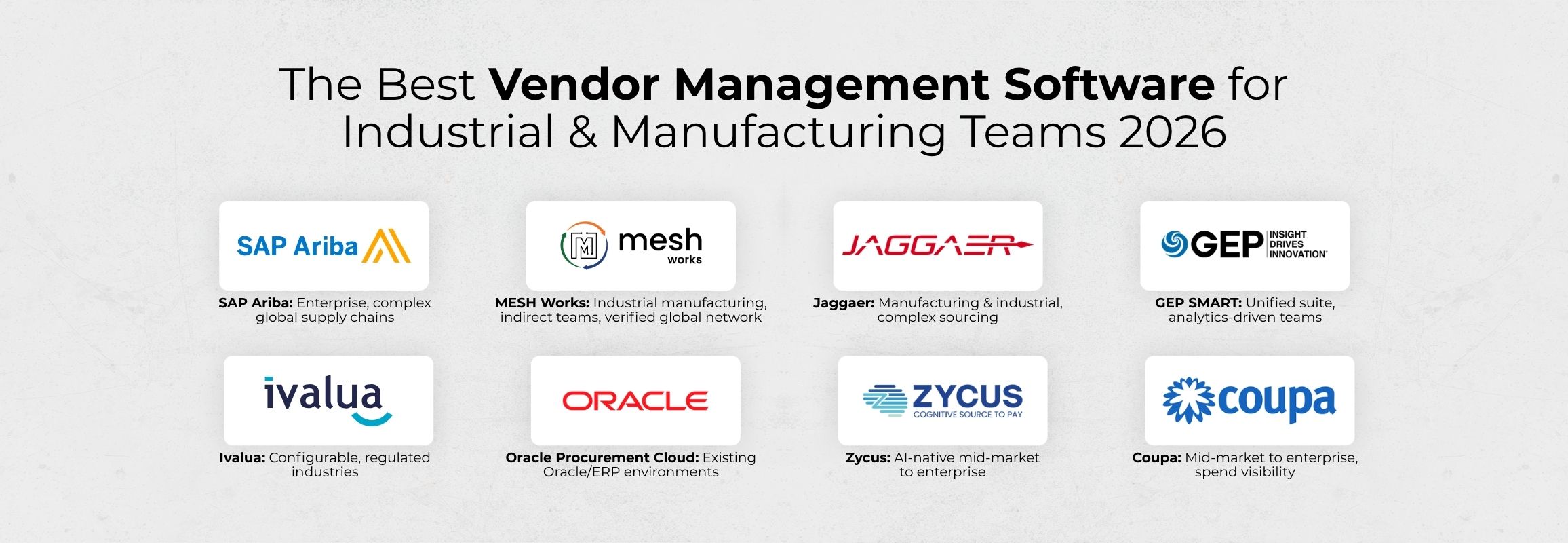
The best vendor management software for industrial and manufacturing teams in 2026 includes platforms like SAP Ariba, Coupa, Jaggaer, GEP SMART, Ivalua, Oracle Procurement Cloud, Zycus, and MESH Works — each built for different scales, workflows, and levels of supplier complexity. This guide breaks down what each one does, who it's built for, and how to figure out which one matches your team.
What Does Vendor Management Software Actually Do?
Vendor management software (VMS) is the operating system for your supplier relationships. At its core, it does five things that spreadsheets, shared drives, and inbox threads can't:
Centralizes supplier data — contacts, contracts, certifications, audit history, and performance records in one place
Manages RFQ and sourcing workflows — from issuing a request to comparing quotes to awarding business
Tracks supplier performance — on-time delivery, quality metrics, cost variance, and responsiveness against defined benchmarks
Flags risk before it surfaces — expiring certifications, financial instability signals, regulatory gaps, and single-source concentration
Replaces the patchwork — the combination of Excel, email, shared folders, and tribal knowledge that most teams are still running on
The difference between a team with a VMS and a team without one isn't that the first team has better data. It's that they can act on it. Vendor management software is the difference between reacting to supplier problems and anticipating them.
What to Look for Before You Choose Vendor Management Solutions
Most vendor management platforms will check the same general boxes on a feature list. The real differences show up in depth, usability, and fit for your specific sourcing environment. Before evaluating platforms, get clear on five things:
Supplier database & discovery — Can you find and onboard new suppliers from within the platform, or do you have to bring your own list? For teams expanding into new regions or categories, this distinction is critical.
RFQ & quoting workflow — Does the platform automate quote collection, comparison, and normalization? Or does it just store the responses you collect manually? There's a wide gap between those two.
Performance tracking & scorecards — Can you track on-time delivery, quality rejection rates, and cost variance by supplier, category, or region? Or does "performance tracking" mean a notes field?
Risk & compliance management — Does it proactively flag expiring certifications, financial risk signals, or dangerous supply concentration? Or does it just tell you what's already happened?
ERP integration — Does it connect cleanly with SAP, Oracle, or whatever system your team already runs? A platform that lives outside your ERP eventually becomes shelfware.
"The mistake most teams make: choosing a platform built for general procurement and trying to make it work for industrial supply chains. The categories are different, the supplier base is different, and the verification requirements are different. A platform that works for a services company managing 20 software vendors won't work for a Tier 1 manufacturer managing 300 suppliers across machining, casting, and assemblies."
At a Glance: 2026 Vendor Management Software Comparison
Platform | Best For | Supplier Discovery | RFQ Automation | Performance Tracking | Risk Management | Pricing Model |
SAP Ariba | Enterprise, complex global supply chains | ✓ Ariba Network | ✓ | ✓ | ✓ | Enterprise contract |
Coupa | Mid-market to enterprise, spend visibility | Partial | ✓ | ✓ | ✓ | SaaS |
Jaggaer | Manufacturing & industrial, complex sourcing | ✓ | ✓ | ✓ | ✓ | Enterprise contract |
GEP SMART | Unified suite, analytics-driven teams | ✓ | ✓ | ✓ | ✓ | SaaS |
Ivalua | Configurable, regulated industries | ✓ | ✓ | ✓ | ✓ | Enterprise contract |
Oracle Procurement Cloud | Existing Oracle/ERP environments | Partial | ✓ | ✓ | ✓ | Enterprise contract |
Zycus | AI-native mid-market to enterprise | ✓ | ✓ | ✓ | ✓ | SaaS |
MESH Works | Industrial manufacturing + indirect teams, verified global network | ✓ Audited suppliers | ✓ AI-powered | ✓ | ✓ | SaaS |
The 8 Best Vendor Management Platforms in 2026
1. SAP Ariba
SAP Ariba is the market-leading enterprise procurement suite — anchored by the Ariba Network, the world's largest B2B commerce network with millions of connected suppliers globally.
Strengths:
Unmatched supplier network reach through the Ariba Network
Deep ERP integration, especially with SAP S/4HANA environments
Robust contract management, compliance tracking, and spend analytics
Strong global support infrastructure for complex multi-region deployments
Limitations:
Complex and lengthy implementation — typically 6–18 months for full deployment
High total cost of ownership; usually requires dedicated procurement IT resources
Can feel over-engineered for teams that don't need enterprise-wide rollout
Ideal for: Large OEMs and Tier 1 manufacturers with global supply chains, existing SAP infrastructure, and dedicated procurement IT support.
2. MESH Works
MESH Works is a supplier collaboration and intelligence platform built for industrial and manufacturing buyers — and increasingly deployed by non-manufacturing companies and indirect purchasing teams as the platform has expanded its scope.
Where most platforms on this list start with the procurement workflow and layer in supplier data, MESH Works starts with the supplier — verified through in-person audits — and builds the collaboration, RFQ, and performance infrastructure around that foundation.
Strengths:
Global database of 5,000+ audited suppliers across 40+ countries — each verified through in-person 45-point capability assessments, not self-reported supplier profiles
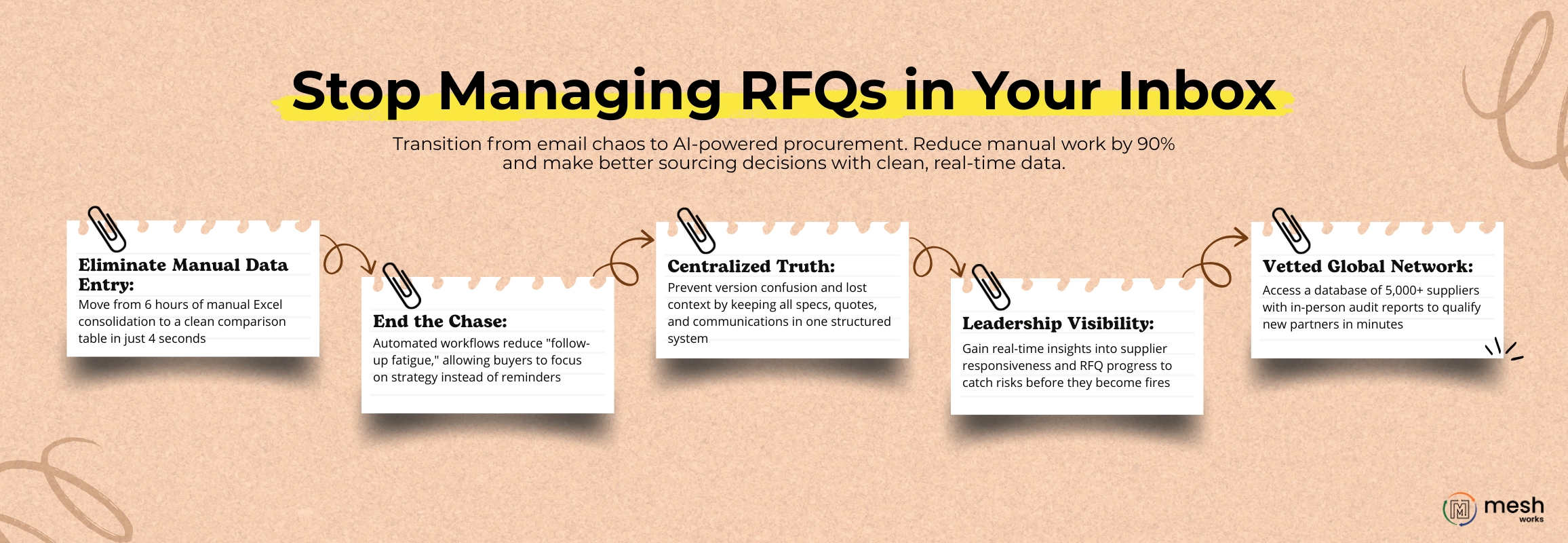
AI RFQ tools that automatically extract and compare quotes from any format (PDF, Excel, email), eliminating manual consolidation and delivering decision-ready comparison in minutes
Enterprise RFQ and procurement compliance workflows trusted by publicly traded manufacturers, including Hubbell and Mueller Water Products
Built for complex industrial categories — machining, casting, forging, fabrication, assemblies — but increasingly used by indirect procurement teams and non-manufacturing organizations
Combines supplier discovery, RFQ, performance tracking, and project collaboration in a single platform rather than requiring separate tools for each
Limitations:
Not a general-purpose source-to-pay suite — strongest where verified supplier data, direct supplier relationships, and RFQ automation are the core requirement
Indirect spend management and broad ERP coverage are less developed than dedicated enterprise suites
Ideal for: OEMs, Tier 1s, and industrial manufacturers who need a verified global supplier network with direct collaboration capabilities — and enterprise procurement teams managing complex RFQ workflows and compliance requirements who need more than a standard procurement SaaS tool.
3. Jaggaer
Jaggaer (formerly BravoSolution) is a procurement and supplier management platform with deep roots in manufacturing, life sciences, and higher education. It's one of the few enterprise platforms explicitly built with industrial procurement complexity in mind.
Strengths:
Strong sourcing and RFQ capabilities with solid support for complex, multi-round events
Category management tools and structured supplier development workflows
Solid supplier performance tracking built for industrial KPI environments
Good configurability for teams with non-standard category structures
Limitations:
UI can feel dated compared to newer SaaS-native competitors
Implementation timelines for complex deployments can be long
Requires more procurement process maturity to get full value
Ideal for: Manufacturing and industrial companies running complex multi-category sourcing programs that need structured supplier development alongside standard procurement workflows.
4. GEP SMART
GEP SMART is an AI-powered unified procurement platform covering the full source-to-pay cycle — with a particular reputation for analytics depth and a modern, intuitive interface.
Strengths:
Strong spend intelligence and analytics — one of the better platforms for cross-category visibility
Modern, mobile-friendly interface that procurement teams actually use
Solid AI features for spend classification, contract analysis, and supplier risk
Good cross-functional visibility for organizations where procurement sits alongside finance and operations
Limitations:
Can be more expensive than alternatives at mid-market scale
Analytics depth is a genuine strength but can feel like more than necessary for teams with straightforward procurement needs
Ideal for: Analytics-driven procurement teams managing large, diverse spend portfolios where visibility and intelligence are as important as workflow automation.
5. Ivalua
Ivalua is a highly configurable source-to-pay platform known for its ability to adapt to complex, non-standard procurement workflows — particularly in regulated industries.
Strengths:
Exceptional configurability — can be shaped to match almost any workflow, approval structure, or compliance requirement
Strong track record in highly regulated industries including aerospace, defense, and pharmaceuticals
Covers the full source-to-pay cycle with solid depth at each stage
Good supplier collaboration and development tools
Limitations:
Configurability comes with implementation complexity — not a fast platform to stand up
Requires significant upfront process definition to get the most out of the flexibility
Ideal for: Companies in regulated industries or with complex, non-standard procurement workflows that need a platform they can shape to their process — not the other way around.
6. Oracle Procurement Cloud
Oracle Procurement Cloud is Oracle's cloud-native procurement suite, part of the Oracle Fusion Cloud ERP ecosystem — making it the natural choice for organizations already standardized on Oracle infrastructure.
Strengths:
Deep integration with Oracle ERP — minimal data fragmentation for teams already on Oracle
Broad feature coverage across procurement, supplier management, and contract lifecycle
Strong for global organizations with complex multi-entity structures
Ongoing investment from Oracle in AI and automation features
Limitations:
Best value realized only if you're already an Oracle shop — standalone deployment is cost-intensive without the ERP integration benefit
Less compelling as a best-of-breed procurement platform for non-Oracle environments
Ideal for: Companies running Oracle ERP who want procurement and vendor management on the same infrastructure without managing a separate system.
7. Zycus
Zycus is an AI-native source-to-pay platform that built artificial intelligence into its core workflow from the ground up — rather than adding AI capabilities onto a legacy system. For teams that want intelligence embedded throughout the procurement process, it's worth serious evaluation.
Strengths:
AI embedded across contract analysis, supplier risk scoring, spend classification, and sourcing recommendations
Solid coverage of the full source-to-pay cycle without enterprise-level implementation complexity
Strong fit for teams that want AI-driven insights without the overhead of an SAP or Oracle deployment
Competitive pricing relative to tier-one enterprise alternatives
Limitations:
Less recognized in North American enterprise markets compared to SAP Ariba or Coupa — smaller reference customer base at the largest enterprise scale
Best-fit use cases skew toward organizations with existing procurement process maturity
Ideal for: Mid-market to enterprise procurement teams looking for an AI-first platform that covers the full cycle — without the complexity and cost of a tier-one enterprise deployment.
8. Coupa
Coupa is a cloud-based spend management platform that covers procurement, invoicing, supplier management, and expense — with a strong focus on spend visibility across the entire organization.
Strengths:
Excellent spend visibility and analytics across categories and business units
User-friendly interface that drives higher adoption than many enterprise alternatives
Strong supplier collaboration and community intelligence features
Good fit for organizations standardizing procurement processes across multiple sites
Limitations:
Supplier discovery is limited compared to sourcing-first platforms — better for managing known suppliers than finding new ones
RFQ automation depth varies; not the strongest fit for complex industrial sourcing workflows
Ideal for: Mid-market to enterprise companies focused on spend control, procurement process standardization, and cross-functional visibility — particularly where multiple business units need to operate from the same system.
How to Match the Platform to Your Team
The right platform isn't the one with the most features — it's the one built for the problem you're actually trying to solve. Here's a fast way to self-select:
If you're managing a large, global supply chain with complex ERP dependencies: → SAP Ariba or Oracle Procurement Cloud are the natural starting points. The integration depth justifies the complexity and implementation investment.
If you need spend visibility and procurement process standardization across a mid-size organization: → Coupa or GEP SMART offer the right balance of capability and usability without enterprise-scale implementation requirements. Both have strong user adoption track records.
If you want AI embedded throughout your procurement workflow without full enterprise complexity: → Zycus is the strongest AI-native option in this space — particularly for teams that want intelligent spend classification, contract analysis, and risk scoring from day one.
If you're in industrial manufacturing and need to find, vet, and manage suppliers across global categories: → Jaggaer or MESH Works are purpose-built for this environment. Jaggaer covers the full procurement cycle with manufacturing-specific depth. MESH Works specializes in verified supplier discovery, AI-powered RFQ automation, and direct supplier collaboration — and is increasingly the platform of choice for enterprise procurement compliance at publicly traded manufacturers.
"The biggest mistake in platform selection isn't choosing the wrong features — it's choosing a platform built for the wrong problem. A general procurement suite won't have audited supplier data for precision machining in Southeast Asia. A sourcing platform built for direct materials won't manage your indirect spend or office supply contracts. Know which problem you're solving first — the rest of the decision gets easier."
What Vendor Management Software Won't Fix
Every platform on this list will improve your procurement process. None of them will create a process that doesn't exist.
Before selecting a tool, be honest about a few things software can't solve on its own:
Poorly defined supplier KPIs. If your team hasn't agreed on what "good" looks like for on-time delivery, quality, and responsiveness, no dashboard will define it for you. The platform surfaces the data — your team has to decide what it means.
Lack of cross-functional alignment. Vendor management touches procurement, engineering, quality, and finance. A platform that procurement adopts without buy-in from the functions that interact with suppliers every day will be underused within six months.
Relationships that have never been actively managed. Software can make supplier relationship management more structured and scalable. It can't substitute for the conversations, reviews, and direct engagement that build supplier trust and preferential treatment over time.
The teams that get the most out of vendor management software are the ones who treat the platform implementation as the moment they formalize a process — not as the process itself.
Managing suppliers across multiple industrial categories or regions — and still relying on spreadsheets and email threads to do it? It's worth seeing what a platform built for this problem actually looks like.