For most manufacturers, the RFQ process hasn’t changed much in the last 20 years.
A sourcing manager receives a request from engineering. Drawings are collected. An Excel spreadsheet is created. Suppliers are selected. Emails are sent. Follow-up emails begin. Responses start arriving as PDFs, spreadsheets, ZIP files, and attachments. Then someone spends hours manually compiling everything into a comparison sheet.
The process feels normal because it’s familiar.
The problem is that it’s incredibly inefficient.
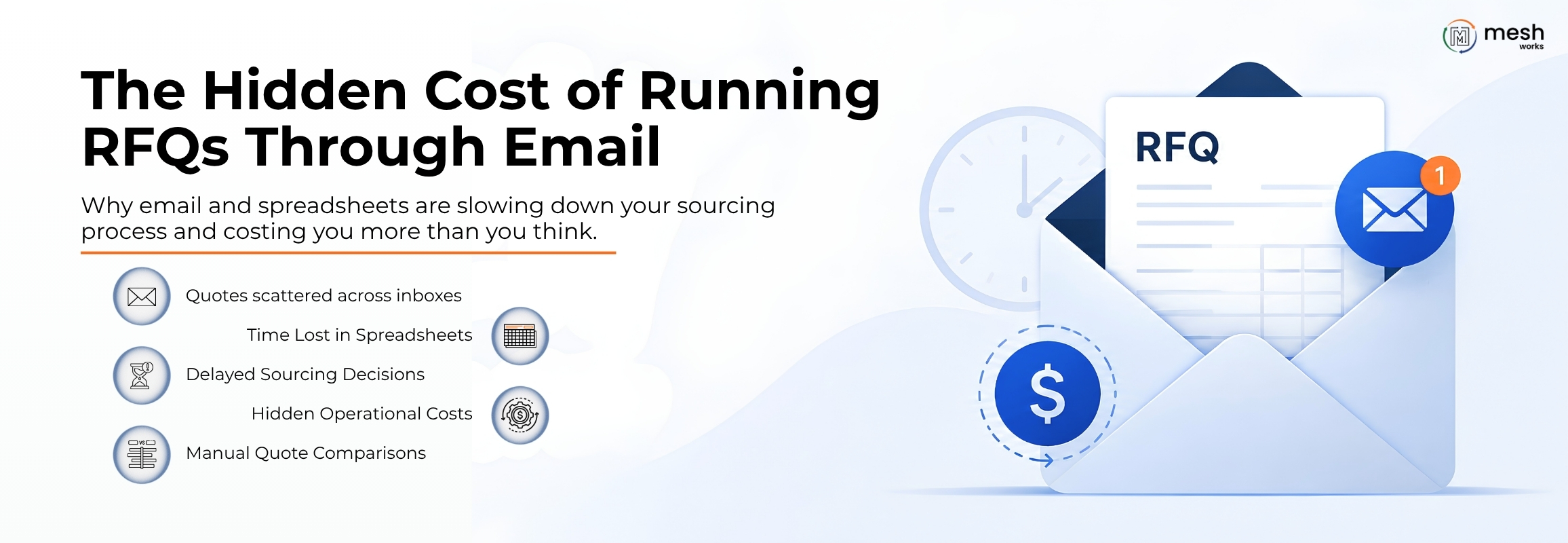
Most procurement teams don’t realize how much time they spend managing RFQs rather than actually making sourcing decisions.
The Typical RFQ Process
Imagine a buyer needs quotes from five suppliers.
The process might look something like this:
Create an RFQ spreadsheet
Gather drawings and specifications
Email five suppliers
Answer supplier questions
Send reminders
Download responses
Save files to folders
Update tracking spreadsheets
Compare supplier pricing
Share information internally
Now multiply that by dozens or hundreds of RFQs per year.
What starts as a sourcing activity quickly becomes an administrative burden.
One procurement leader recently described their process as managing everything through email and Excel. Supplier questions, reminders, follow-ups, and quote submissions all flowed through inboxes. When quotes arrived, the team had to manually compile and analyze supplier responses before making a decision.
Sound familiar?
The Visibility Problem Nobody Talks About
Most sourcing leaders focus on supplier costs, lead times, and quality.
But one of the biggest hidden challenges is visibility.
When sourcing activities happen through email, leadership often has no clear view into what’s happening.
Questions become difficult to answer:
Which RFQs are currently active?
Which suppliers have responded?
Which suppliers still owe quotes?
How many sourcing events are underway?
Who is managing each project?
The information exists, but it’s scattered across inboxes and spreadsheets.
For managers and directors, this creates a blind spot.
They often see the final sourcing decision but have little visibility into the process that produced it.
Procurement Teams Spend More Time Managing Information Than Analyzing It
The most expensive part of an RFQ process isn’t sending the initial request.
It’s everything that happens afterward.
Buyers spend time:
Reading supplier emails
Downloading attachments
Saving files
Renaming documents
Updating spreadsheets
Tracking supplier participation
Sending reminder emails
None of these activities create strategic value.
They’re simply administrative tasks required to keep the process moving.
As RFQ volumes increase, these manual activities consume more and more of a buyer’s day.
The result?
Highly skilled sourcing professionals spend less time evaluating suppliers and more time managing communication.
Why Email Breaks Down at Scale
Email works reasonably well when you’re managing a handful of sourcing events.
It becomes problematic when:
Multiple buyers are involved
Engineering teams participate
Dozens of suppliers are invited
Hundreds of drawings are exchanged
Projects run simultaneously
At that point, information becomes fragmented.
One supplier responds to Buyer A.
Another sends files to Engineering.
A third sends revised pricing a week later.
Someone updates a spreadsheet.
Someone else forgets.
No single person has complete visibility.
The organization becomes dependent on individual employees remembering where everything lives.
What Modern RFQ Management Looks Like
Modern sourcing teams are moving toward centralized RFQ management.
Instead of managing sourcing events across dozens of email threads, they create a single workspace where:
Drawings are stored
Specifications are maintained
Suppliers participate
NDAs are tracked
Internal teams collaborate
The benefits are immediate.
Buyers can see who has responded.
Managers can see RFQ status.
Engineering can access the same information as procurement.
Supplier communication becomes transparent.
Most importantly, the sourcing process becomes repeatable.
Knowledge stays with the organization rather than individual employees.
The Future of Procurement Isn’t More Email
The reality is that most procurement teams aren’t struggling because they lack suppliers.
They’re struggling because they lack visibility and efficiency.
Email was never designed to manage sourcing events.
It was designed to send messages.
As sourcing teams face increasing pressure to reduce costs, identify new suppliers, and move faster, the organizations that modernize their RFQ processes will gain a significant advantage.
The future of sourcing isn’t about sending more emails.
It’s about spending less time managing communication and more time making better procurement decisions.
See how MESH Works helps manufacturers centralize RFQ management, improve supplier visibility, and streamline sourcing workflows.
Contact our team to learn how a digital RFQ process can reduce administrative effort and improve procurement efficiency.