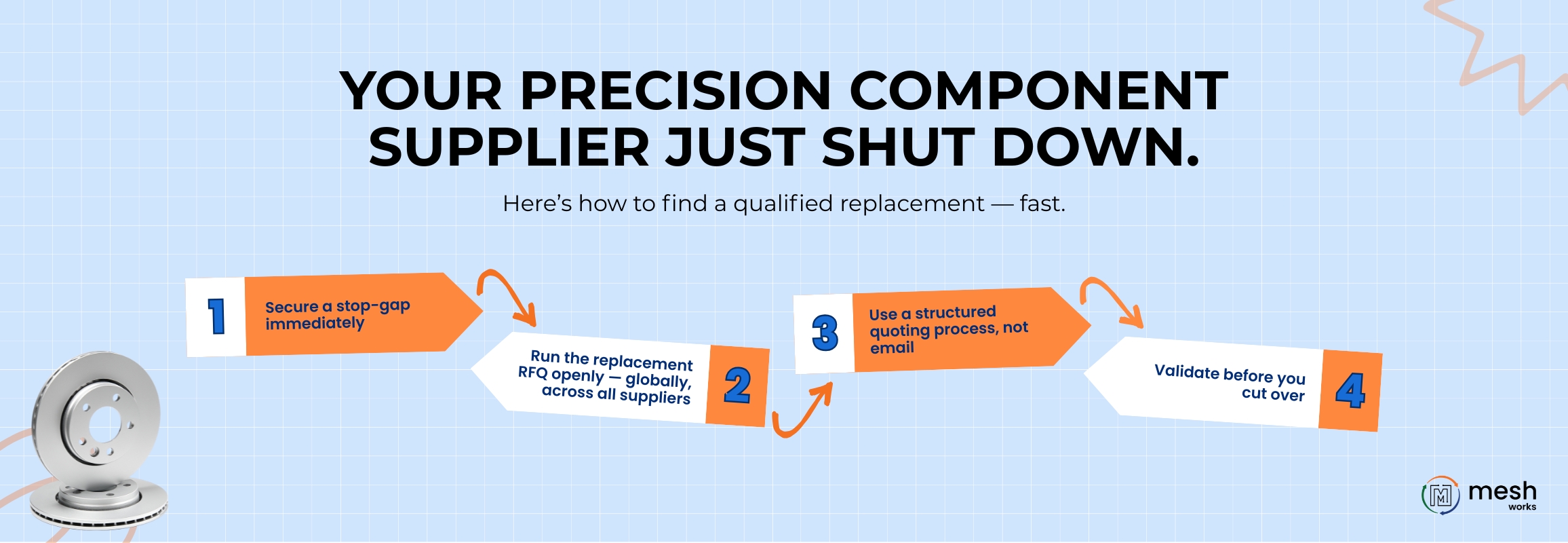
When a critical supplier closes, your first move and your long-term move need to run in parallel — not one after the other. Secure a stop-gap to keep production running while you run a structured replacement search that goes beyond your existing network. The category managers who handle this well aren’t lucky. They have a process that works under pressure.
When a precision component supplier goes out of business, category managers often have only days to identify qualified alternatives before production schedules are affected. The challenge is not just finding a replacement quickly, but ensuring the new supplier can meet quality, cost, and delivery requirements.
The scenario every category manager dreads — and almost no one prepares for
You get the call. A supplier you’ve relied on for a specialty component — precision gears, ductile iron castings, custom machined parts — has shut down, gone under, or can no longer fulfill. Your plant is waiting. You have days, not weeks.
The compounding problem: most category managers carry one or two qualified alternates at best. For highly engineered components, that bench is often empty. So you do what every buyer does in this moment — you start calling people you already know, sending emails to the same five suppliers, and hoping someone can step in fast.
“Our gear supplier went out of business — they scrambled and found someone who’s not really ideal, but there’s a stop gap keeping them going.” — Rick Jackson, Category Manager, Mueller Water Products
That stop-gap mode is expensive, stressful, and almost always results in a weaker long-term supplier relationship. The real question isn’t just how to survive the disruption — it's how to find a replacement manufacturing supplier quickly and come out with a stronger supply base than before.
Why is replacing a specialty component supplier so hard in industrial manufacturing?
The incumbent bias problem
Most buyers default to their existing supplier network when something breaks. When that pool comes up empty — and for specialty components, it often does — there’s no obvious next step. The problem isn’t a lack of capable suppliers globally. It’s a lack of visibility into who exists beyond your current relationships.
Specialty specs narrow the field fast
A buyer sourcing standard fasteners has options everywhere. A buyer sourcing ductile iron gear castings with tight tolerances needs to search across geographies and supplier types they may have never engaged before. The more engineered the component, the harder it is to find the right supplier just by asking around.
Email-and-Excel breaks under urgency
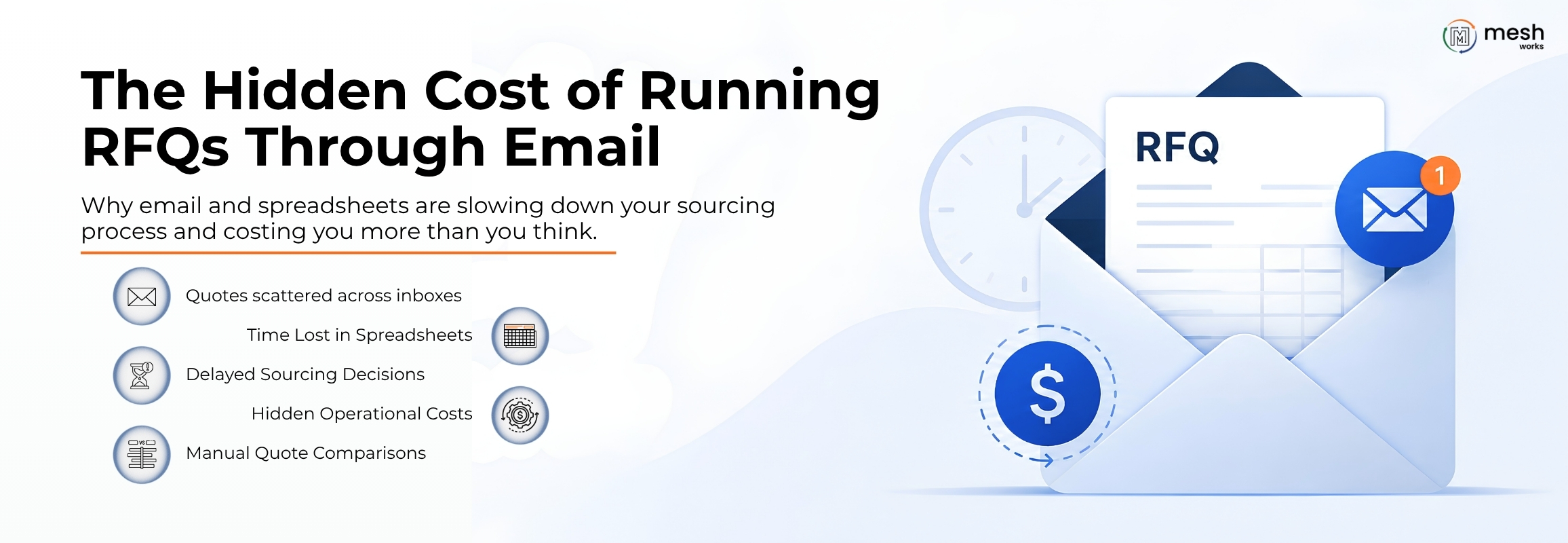
When time is short, the limitations of manual RFQ management become acute: you can only reach suppliers you already know, you’re chasing responses across inboxes, and you have no way to see who’s actually engaged versus who just hasn’t replied yet. The process wasn’t built for speed.
What’s the right sequence of steps when a supplier disruption hits?
Step 1: Secure a stop-gap immediately
Before you do anything strategic, protect production continuity. A non-ideal supplier at a higher price is better than a line stoppage. Accept the stop-gap, document it as temporary, and don’t let the urgency of keeping the line running slow down your replacement search. Those two tracks need to run at the same time.
Step 2: Run the replacement RFQ openly — not just to your existing network
This is where most teams leave value on the table. When you limit your RFQ to suppliers you already know, you get the same options you’ve always had. Opening the RFQ to any qualified supplier who can see the spec — globally, across categories — is often the fastest way to find global suppliers for specialty parts and discover capabilities that exist beyond your current network.
“I wasn’t specifically looking for India. I was looking for anyone, anywhere, that was proficient at making gears. It just happened to be that their quote came in and it was very attractive compared to our last price paid.” — Rick Jackson, Category Manager, Mueller Water Products
That’s the mechanic worth understanding: the supplier wasn’t found through a search. They showed up because the RFQ was visible to them. Capability got proven through a real, live quote on a real job.
Step 3: Use a structured quoting process, not email
When you’re managing an urgent multi-supplier search, you need to know in real time: who has your drawings, who has signed your NDA, who has quoted, and how prices compare. A digital RFQ workflow gives sourcing teams this visibility in one place. Scattered across an inbox, that visibility doesn’t exist — and under time pressure, every hour you spend chasing responses is an hour your stop-gap supplier stays permanent.
Step 4: Validate before you cut over
Urgency doesn’t change your validation requirements. First articles, PPAP, incoming inspection — whatever your process requires, build it into the timeline from day one. A structured sourcing process lets you run supplier evaluation and validation in parallel, so you’re not starting the qualification clock after you’ve already made the decision.
Can you actually find qualified global suppliers through an open RFQ — or is it just noise?
The honest answer: it depends entirely on how the RFQ is structured. Posting a spec to a directory and hoping someone responds is noise. Running a structured RFQ through a platform where suppliers self-select based on actual capability — and prove it by quoting — is a different process.
Here’s what that looks like in practice. A manufacturer with a factory in Illinois lost their gear supplier. They posted the gear RFQ openly — available to any supplier globally who had the right capability profile. A company in India called Ascent submitted a quote. The pricing came in well below the previous price paid. Tooling costs were reasonable. They’re now in the PPAP process.
The category manager running that search wasn’t targeting India. He was targeting quality and cost. The geography was irrelevant. What mattered was that the supplier had the capability and was willing to prove it on a real job.
The other thing worth noting: every supplier who participated in that RFQ — signed the NDA, downloaded the drawings, submitted a quote — is now in that buyer’s partner network. The next time a disruption hits, the bench is deeper. The search starts from a better position.
How do you protect yourself from this happening again?
Dual-source critical categories before you need to
The best time to find an alternate supplier is when you don’t need one. Category managers who run open RFQs regularly — not just when something breaks — accumulate a qualified bench without the pressure of a crisis timeline. When the disruption hits, you’re selecting from a shortlist, not starting from scratch.
Let the network build itself as a byproduct of normal sourcing
After four months of running RFQs through an open platform, one category manager had built a partner network of 156 suppliers across China, India, Mexico, Poland, South Korea, Spain, Turkey, UAE, the United States, and Vietnam. He didn’t run a supplier onboarding initiative to get there. He ran RFQs, and every supplier who participated got added to his network automatically.
That’s the compounding effect: each RFQ makes the next disruption cheaper to solve.
Centralize your quoting data so you can see your exposure
You can’t manage supplier risk if your RFQs, response history, and supplier data live in individual inboxes. Knowing which categories run on a single supplier, which suppliers are critical to multiple sites, and where your volume is concentrated — that visibility only exists if your sourcing activity is in one place.
What good looks like when a supplier disruption hits
The category managers who handle supplier failures well share a few things in common. They move fast on the stop-gap without letting it become permanent. They run the replacement search openly rather than defaulting to the same five names. They use a structured process that gives them visibility into what’s happening in real time. And they come out of the disruption with a stronger supply base than they went in with.
That last part is what separates reactive sourcing from resilient sourcing. The disruption is unavoidable. How far it sets you back is not.
See how MESH helps category managers run open RFQs, build a global supplier network, and move fast when disruptions happen — without adding headcount.
Need help finding a qualified replacement supplier? Contact our team today to discuss your sourcing requirements and explore qualified supplier alternatives.