Every sourcing conversation we have eventually lands on one of three terms. Nearshoring. Regionalization. Localization. Sometimes all three, sometimes in the same sentence, sometimes used as if they're interchangeable.
They're not interchangeable. And when procurement leaders blur the lines between them, they end up with the wrong strategy for the problem they're actually solving — or they walk into a vendor conversation without being sure what they just agreed to.
This piece breaks down what each term actually means, where they're different, and which industrial companies have executed each one in a way worth paying attention to.
Why do these terms get confused in the first place?
Because they often happen at the same time.
A manufacturer moving production to Mexico is nearshoring. If that same manufacturer is building out a broader North American supply network around that move, that's regionalization. And if they're redesigning the product to meet U.S. regulatory standards or certifications, that's localization.
Three different decisions. One initiative. Three different words thrown at it in the same board presentation.
The confusion is understandable — but it's also expensive. Each lever has distinct costs, timelines, and trade-offs. Treating them as the same thing means you're not being precise about what you're actually committing to.
What is nearshoring?
Nearshoring is the decision to source or manufacture in a country close to your end market — rather than a distant, lower-cost country.
For U.S. companies, nearshoring typically means Mexico or Canada instead of China or Southeast Asia. For European companies, it usually means Eastern Europe or North Africa instead of Asia.
The logic is transit time, logistics cost, time zone alignment, and reduced geopolitical exposure. The goal is proximity to the customer — keeping production close, not necessarily domestic.
What nearshoring is not: Nearshoring isn't reshoring (bringing production back to your home country). And it's not a supply chain redesign — it's a geographic sourcing decision. You can nearshore a single product category without changing anything else about how your supply chain is structured.
The most visible industrial example of nearshoring right now is Foxconn's Mexico investment — over $241M in Chihuahua, with a new Guadalajara facility being built specifically to assemble Nvidia's GB200 superchip for U.S. customers. That's not a cost play. It's a proximity play. Foxconn is nearshoring because being one border away from their end market matters more than being in the cheapest country. Whirlpool's Mexican manufacturing operation tells a similar story — 80% of what they produce there ships directly to the U.S. and Canada. The plant exists because Mexico lets them serve North American customers faster and at a lower landed cost than Asia.
What is regionalization?
Regionalization is a supply chain architecture decision — deliberately building multiple regional supply chains instead of one centralized global one.
A regionalized company doesn't just move a factory closer to home. It builds out regional clusters: suppliers, manufacturers, distribution centers, sometimes R&D, all organized to serve a specific geography. The goal is resilience and speed. If one region gets hit — tariffs, a port disruption, a geopolitical event — the others keep running independently.
Think of it as the shift from a single hub-and-spoke model (everything flows through one global center) to a multi-hub model (several regional centers, each largely self-sufficient).
What regionalization is not: It's not nearshoring at scale. You can nearshore one product line without regionalizing your supply chain. Regionalization implies a deliberate, structural redesign of the whole network — not just a new sourcing geography.
ABB is one of the clearest examples of disciplined regionalization in industrial automation. With production in over 30 countries, ABB doesn't run a single global supply chain — it runs regional ones, with local manufacturing, local R&D, and local service ecosystems. When COVID, trade conflicts, and logistics disruptions hit simultaneously between 2020 and 2023, ABB's regional structure absorbed the impact without the whole business stalling. That's what regionalization is built to do. Enphase Energy made a similar move in Europe — building regional capacity for its solar microinverter business rather than shipping everything from a central location, a decision that paid off visibly during the supply disruptions of that same period.
What is localization?
Localization is about adapting — adapting your product, your service, or your operations to meet the specific regulatory, market, or customer requirements of a given country or region.
In industrial and manufacturing contexts, localization often means meeting local content requirements (government-mandated minimum percentages of locally sourced components), complying with country-specific safety or environmental standards, or engineering a product that fits local infrastructure — voltage, climate, language, certification bodies.
Localization is less about where you make something and more about whether what you make actually fits where it's going.
What localization is not: It's not just translating a label or a manual. For industrial companies, localization is a serious operational and engineering decision. It can mean requalifying suppliers, redesigning components, or building in-country service capability. Companies underestimate this one most often.
Siemens has practiced localization as a structural strategy for decades. Their joint ventures in India and China aren't just commercial arrangements — they're deliberate adaptations. Local engineering talent. Local regulatory compliance. Products built for local infrastructure, not adapted from a global default. Their digital factory in Chengdu mirrors their Amberg facility technically, but it's designed for Chinese manufacturing conditions and customers — not retrofitted. SKF has done the same through local supplier qualification programs and in-market engineering support. They don't just sell bearings globally — they adapt specifications, certify locally, and build service ecosystems market by market.
So how are the three actually different?
The cleanest way to separate them is by the question each one answers:
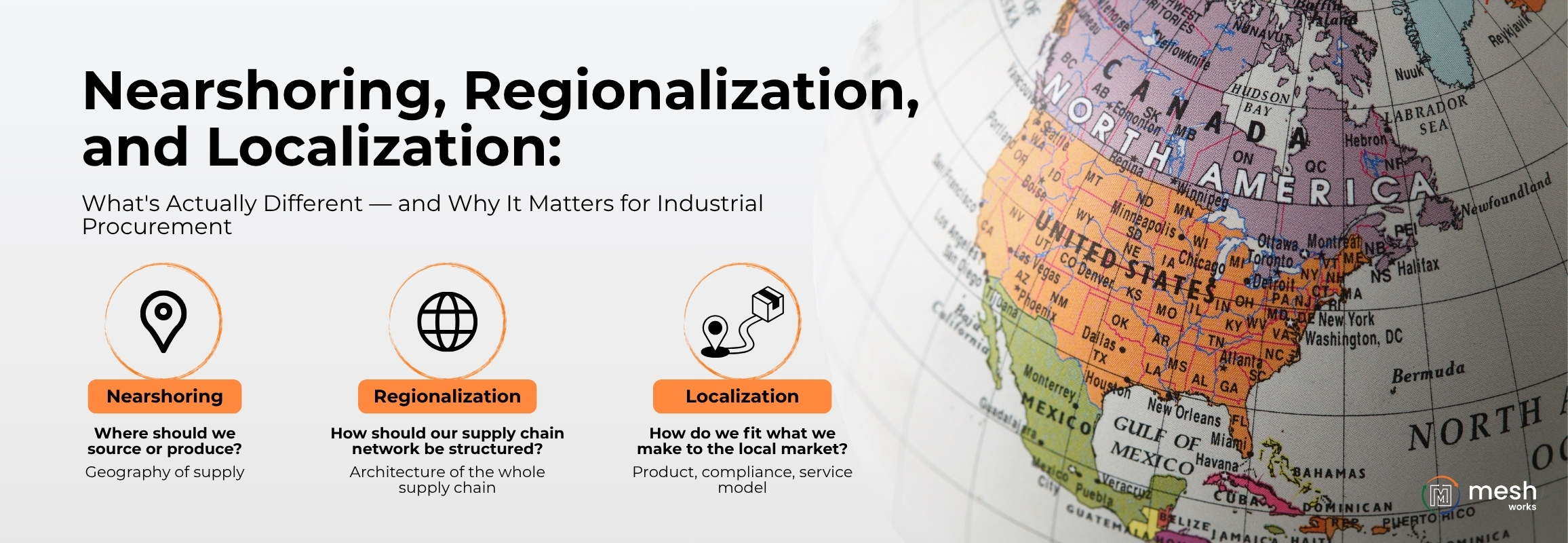
The question it answers | What changes | Who owns the decision | |
Nearshoring | Where should we source or produce? | Geography of supply | Sourcing / Procurement |
Regionalization | How should our supply chain network be structured? | Architecture of the whole supply chain | Supply Chain / Operations leadership |
Localization | How do we fit what we make to the local market? | Product, compliance, service model | Engineering / Commercial |
They often happen together — and that's fine. But each involves different stakeholders, different budgets, and different timelines. Conflating them in a boardroom conversation is how you get a nearshoring pilot approved when what leadership actually wants is a regionalized supply chain.
What does this mean for procurement teams evaluating vendors or partners?
If you're evaluating suppliers, sourcing partners, or platforms, these distinctions matter because they signal fundamentally different capabilities and risk profiles.
A supplier who has nearshored production has reduced your logistics exposure and transit time. That's a real benefit — but it's a narrow one.
A supplier who has regionalized their operations has built structural resilience into their model. When something goes wrong in one geography, they have alternatives already running. That's a different risk conversation.
A supplier who has localized for your market has done the hard compliance, certification, and service work to actually fit your environment. That's the one most teams discover they needed after the contract is signed.
When these terms come up in vendor conversations, it's worth asking specifically which one they mean — and what the evidence is. Nearshoring is easy to claim. Regionalization and localization require proof.
Understanding the distinction between these three strategies is step one. Knowing which suppliers and partners have actually executed them — and can prove it with on-site data, certifications, and track records — is step two.
MESH Works gives procurement teams access to 5,000+ audited manufacturers across 40+ countries, with verified capability data on process, certifications, and past performance. Whether you're evaluating nearshore options in Mexico, building a regionalized supply base across India and Eastern Europe, or qualifying suppliers for markets with specific localization requirements — the supplier data you need to make that call is already verified.
Explore MESH-audited suppliers → | Talk to our sourcing team