You're managing eight suppliers out of your inbox. One is a critical component supplier you found through a referral three years ago. His contact info is in your phone. His certifications are in a PDF you saved somewhere. The last time you reviewed his performance, it was in your head on a drive home.
That works — until it doesn’t. Until he misses a delivery. Until he raises prices with no warning. Until you need a backup supplier and realize you have no documented history of what you’ve actually sourced from him, at what price, and whether it went well.
Small businesses don’t need enterprise software to fix this. But “just use a spreadsheet” stops working faster than most teams expect. The tools on this list are built for businesses that have outgrown ad-hoc supplier management but aren’t ready to spend $200K on a procurement platform and six months on an implementation.
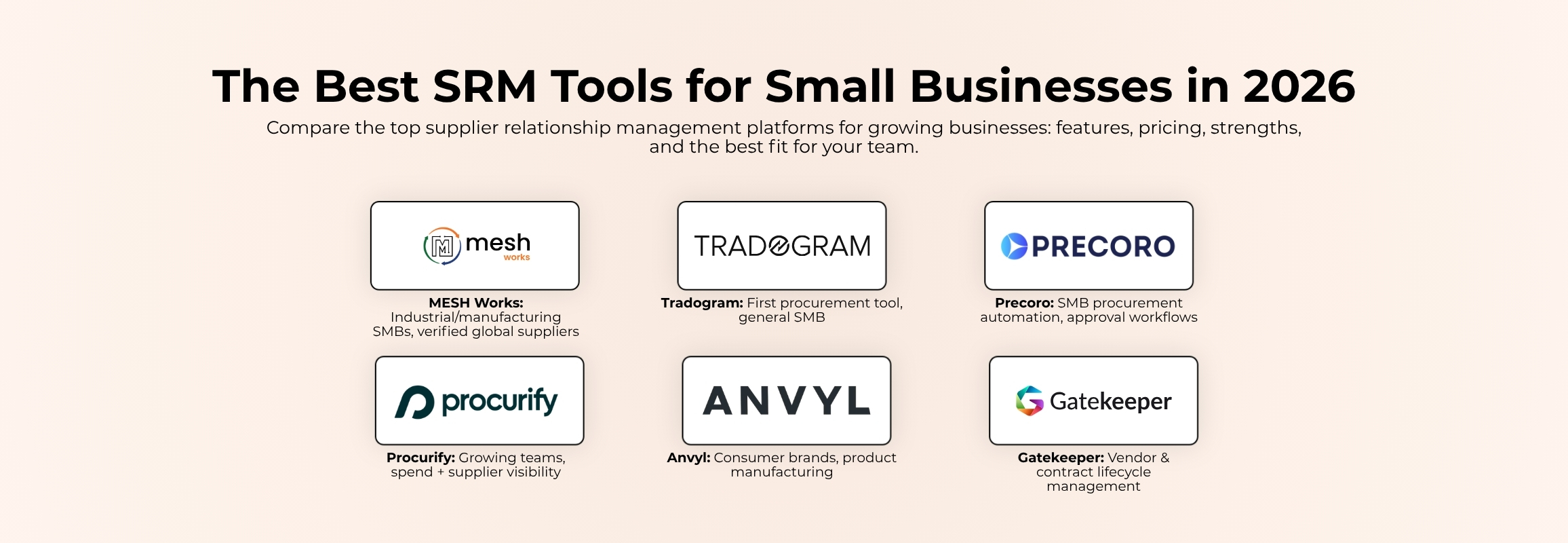
The best SRM tools for small businesses in 2026 include MESH Works, Tradogram, Precoro, Procurify, Anvyl, and Gatekeeper — platforms that offer real supplier relationship management without the complexity or cost of enterprise procurement suites.
What Is SRM Software and Why Do Small Businesses Need It?
SRM software — supplier relationship management software — is a platform that helps businesses manage supplier relationships in a structured way. It centralizes who your suppliers are, tracks how they’re performing, and standardizes how you source from them. For small businesses specifically, it’s the step between “everything lives in my inbox and one person’s phone” and “we have a real process.”
The common objection is “we’re too small for that.” But the cost of not having a system compounds quietly. Certifications expire without anyone noticing. Single-source dependency builds up across categories that nobody’s audited. RFQ processes that should take a day eat two days of someone’s time every month because all the context lives in an email thread from 18 months ago.
The tools built for small businesses today are lightweight enough that the implementation cost is low. The cost of continuing without a system is usually higher.
What Should Small Businesses Look for in SRM Software?
The right SRM tool for a small business has different priorities than an enterprise platform. Forget the 200-feature checklist. The five things that actually matter at small business scale are:
Fast setup — can you be running in days, not months? Enterprise platforms take 6–18 months to implement. Small businesses need tools that are operational this week. If the vendor’s answer to “how long to get started?” involves a dedicated implementation team, it’s probably the wrong tool.
Cost that scales with you Look for SaaS pricing that starts accessible and grows with your user count or supplier volume — not enterprise contracts with multi-year minimums. Most small businesses should expect to spend somewhere between $3,000 and $20,000 per year at this stage, depending on the platform and team size.
Usability without an IT department If it takes a technical administrator to manage, it won’t get used consistently. The best SMB tools are built so a procurement manager or operations lead can run the platform without needing to file an IT ticket.
Supplier communication built in For small businesses, the relationship side of SRM matters as much as the data side. Look for platforms where you can communicate with suppliers directly, track conversations, and manage RFQs — not just store a contact list.
Room to grow The tool you start with should handle double or triple your current supplier volume without requiring you to migrate platforms. Moving supplier history is painful. Build in headroom from the start.
“One thing worth testing before you commit: load your current supplier list into the platform during a free trial and run one real RFQ through it. If that process is faster and cleaner than what you’re doing today, the platform is probably the right fit. If it’s not obviously better by the end of the trial, keep looking.”
How Do the Top SRM Tools for Small Businesses Compare?
Platform | Best For | Setup Time | Supplier Discovery | RFQ Tools | Approx. Starting Price |
MESH Works | Industrial/manufacturing SMBs, verified global suppliers | Days | ✓ Audited network | ✓ AI-powered | Contact for pricing |
Tradogram | First procurement tool, general SMB | Days | — | ✓ | ~$168/mo |
Precoro | SMB procurement automation, approval workflows | Days | — | ✓ | ~$499/mo |
Procurify | Growing teams, spend + supplier visibility | 1–2 weeks | — | ✓ | Custom |
Anvyl | Consumer brands, product manufacturing | 1–2 weeks | — | ✓ | Custom |
Gatekeeper | Vendor & contract lifecycle management | Days | — | — | ~$995/mo |
Pricing figures are approximate based on publicly available information — verify directly with each vendor before committing.
What Are the Best SRM Platforms for Small Businesses in 2026?
1. MESH Works
MESH Works is a supplier collaboration and intelligence platform built for industrial and manufacturing buyers — and increasingly accessible to smaller companies that need enterprise-grade sourcing capability without an enterprise-scale commitment.
The platform was originally built for OEMs and Tier 1 manufacturers. Over the last year, it has matured to a point where smaller industrial companies and growing product businesses can get up and running quickly — without a lengthy implementation or a dedicated IT team.
Strengths:
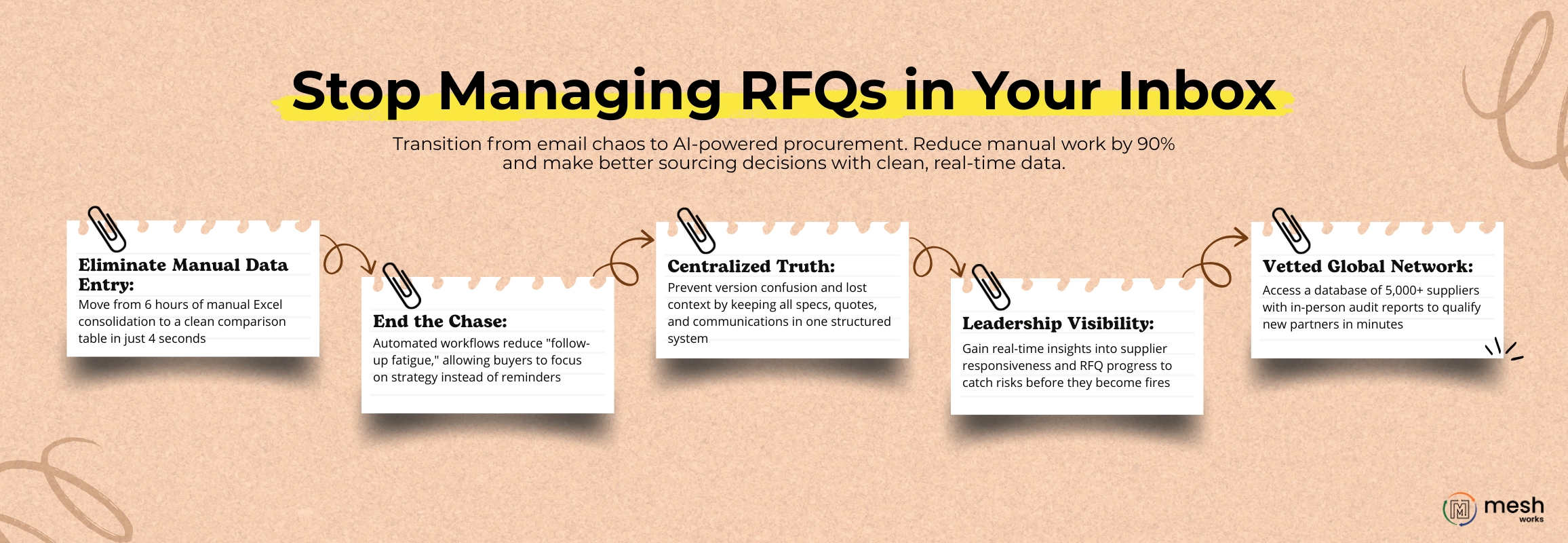
Access to a global database of 5,000+ audited suppliers across 40+ countries — every supplier has been through an in-person 45-point capability assessment, not a self-reported profile. Small businesses get the same verified supplier network used by publicly traded manufacturers like Hubbell and Mueller Water Products.
AI-powered RFQ tools that automatically extract and compare quotes from any format — PDF, Excel, email. For small teams without a dedicated buyer, eliminating manual quote consolidation is often the single biggest workflow improvement.
Combines supplier discovery, RFQ automation, and performance tracking in one platform — so small businesses aren’t stitching together three separate tools to cover the same ground.
A product that has meaningfully matured for smaller teams — faster to start, less implementation overhead than it historically required.
Limitations: Strongest for industrial and manufacturing categories. Not the right fit for service businesses or indirect spend management.
Ideal for: Small industrial manufacturers, contract manufacturers, and growing product companies that need access to a verified global supplier network and want to run structured sourcing processes without a full-time procurement team.
2. Tradogram
Tradogram is a lightweight procurement platform built specifically for small and mid-size businesses. It covers purchase orders, RFQs, supplier management, and spend tracking in a simple, no-frills interface — and it’s one of the most accessible entry points from spreadsheets to a real system.
Strengths:
Fast to set up — most teams are operational within a day or two
Affordable entry pricing makes it an easy internal business case
Covers the core workflow most small businesses need: supplier profiles, basic RFQ tools, PO management, and spend tracking
No IT support required to administer
Limitations: Limited supplier discovery — you bring your own list. Performance tracking and risk management are more basic than mature platforms. Best suited as a first tool, not a long-term platform for fast-growing procurement teams.
Ideal for: Small businesses looking for their first structured procurement tool — a meaningful step up from spreadsheets without overwhelming a small team with features they won’t use.
3. Precoro
Precoro is a cloud-based procurement automation platform with strong approval workflow and purchase order management features. It’s designed for growing businesses that need to bring structure to how buying decisions get made internally — particularly where multiple people are involved in approving purchases.
Strengths:
Excellent approval workflow automation — particularly useful for small businesses where the CFO or owner wants visibility before purchases are committed
Integrates with QuickBooks and Xero, which matters for small businesses that don’t run a full ERP
Supplier portal allows structured communication and document sharing
Clean interface with strong user adoption relative to cost
Limitations: RFQ functionality is more basic than sourcing-first platforms. Better for managing the procurement process and supplier compliance than for running competitive multi-supplier sourcing events.
Ideal for: Small businesses with a defined internal approval process that need to bring structure to how buying decisions are documented and approved — particularly where financial oversight is the primary driver.
4. Procurify
Procurify is a spend management and procurement platform designed for growing companies — strong on spend visibility and supplier management for teams scaling from early-stage into mid-market.
Strengths:
Good visibility into who’s spending what and with which suppliers — especially valuable when multiple departments are making purchasing decisions independently
Solid supplier management features alongside spend controls
Modern, mobile-friendly interface with strong adoption rates
Integrates with major ERP and accounting systems as the business grows
Limitations: Better for spend management and procurement controls than for complex, multi-round sourcing events. Pricing can be harder to justify at very early-stage companies where supplier volume is still low.
Ideal for: Growing businesses in the 50–500 employee range that need spend visibility and procurement controls alongside supplier management — particularly where the problem is that buying is happening across departments without central oversight.
5. Anvyl
Anvyl is a supply chain and supplier collaboration platform built specifically for consumer product companies and brands that manufacture physical products. If you’re a product company managing contract manufacturers or overseas suppliers, it’s one of the few tools built with your exact workflow in mind.
Strengths:
Strong supplier collaboration features — production timelines, milestone tracking, and manufacturing visibility built specifically for product development workflows
Built for the specific reality of consumer brands managing contract manufacturers, not generic supplier management
Good supplier onboarding tools and communication tracking
Makes production visibility and supplier accountability much easier to manage without a dedicated supply chain team
Limitations: Purpose-built for consumer products and manufacturing. Not a good fit for industrial supply chains, B2B manufacturers, or services businesses. Limited RFQ automation compared to sourcing-first platforms.
Ideal for: Consumer brands, e-commerce companies, and small product manufacturers managing product development and production with contract manufacturers or overseas suppliers — where production visibility and milestone tracking matter as much as cost management.
6. Gatekeeper
Gatekeeper is a vendor and contract lifecycle management platform — focused on managing vendor relationships through the lens of contracts, renewals, and compliance. It’s a different angle on supplier management than the sourcing-first tools on this list.
Strengths:
Excellent contract management and compliance tracking — arguably the best on this list for managing what’s actually in your vendor agreements
Automated renewal alerts so certifications and contract terms don’t expire without notice
Good vendor portal for structured document sharing and communication
Strong for businesses where vendor relationships are primarily defined by contracts and compliance obligations
Limitations: Not an RFQ or sourcing tool. If your primary need is running competitive quotes and managing active supply relationships, this isn’t the right fit. It’s contract and compliance management, not procurement.
Ideal for: Small businesses where managing vendor contracts and compliance obligations is the primary pain point — particularly in legal, SaaS, professional services, or any industry where vendor agreements carry real liability.
Which SRM Tool Is Right for Your Small Business?
The right platform depends on which problem you’re actually trying to solve. Here’s a fast way to self-select:
If you’re a small industrial or manufacturing company sourcing physical components globally: → MESH Works gives you access to a verified global supplier network that most small businesses could never build independently — and the AI RFQ tools mean a lean team can run competitive sourcing events without a full-time buyer. It’s the option that most closely bridges small business accessibility with enterprise-grade supplier data.
If you need your first structured procurement tool and want something fast and affordable: → Tradogram or Precoro are the fastest paths from spreadsheet to system. Both can be operational in days, require no IT support, and cover the core workflow a small team needs without overcomplicating it.
If spend visibility across your organization is the underlying problem: → Procurify covers both supplier management and spend controls — the right fit when multiple people are making purchasing decisions and nobody has a clear picture of what’s being committed and to whom.
If you’re a consumer brand or product company managing manufacturing suppliers: → Anvyl is the only tool on this list purpose-built for that workflow. Production timelines, milestone tracking, and contract manufacturer collaboration are built into its core — not added on.
If contracts and vendor compliance are your primary headache: → Gatekeeper handles the contract lifecycle better than anything else on this list. It’s the right tool when the problem is managing what’s in your vendor agreements and making sure nothing renews or expires without you knowing.
When Should a Small Business Move to an Enterprise SRM Platform?
The goal of your first SRM tool isn’t to find the platform you’ll use forever — it’s to build the process of managed supplier relationships while the supplier base is still small enough to make mistakes cheaply.
The signals that suggest you’ve outgrown SMB-tier tools:
You're managing 50+ active suppliers across multiple categories or regions
Compliance or audit trail requirements have become more formal — particularly if you’ve taken institutional investment or are approaching public company territory
You have a dedicated procurement team and need platform depth to match their capabilities
Your sourcing events are complex enough that basic RFQ tools are creating bottlenecks
The transition is easier when you’ve spent time in a structured tool first. Teams that move from spreadsheets to an enterprise platform often struggle because they haven’t built the underlying process habits. Teams that go from a structured SMB tool to an enterprise platform usually adapt faster — the workflow is familiar, the data is cleaner, and the team already knows what good looks like.
“Don’t stay on a tool that’s limiting you. But don’t buy enterprise complexity before you need it. The right time to upgrade is when the current platform is the constraint — not before.”
Managing suppliers out of your inbox is fine until the day it isn’t. If you’re at the point where the spreadsheet system is starting to cost more than it saves — in time, in missed risks, or in sourcing opportunities you couldn’t act on — it’s worth seeing what a purpose-built tool looks like. Book a demo with MESH Works.