In a recent discovery call with the VP of Purchasing for a $600 million Tier 1 supplier, the MESH team asked, “What is your typical process for RFQs?”
This benign question led to exciting findings as the customer team, and MESH representatives began to unthread their existing process. The supplier has made several acquisitions over the last four years leading to the current state of staffing about 15 or so buyers across all divisions.
The following discoveries were made:
RFQ prep to suppliers is complicated
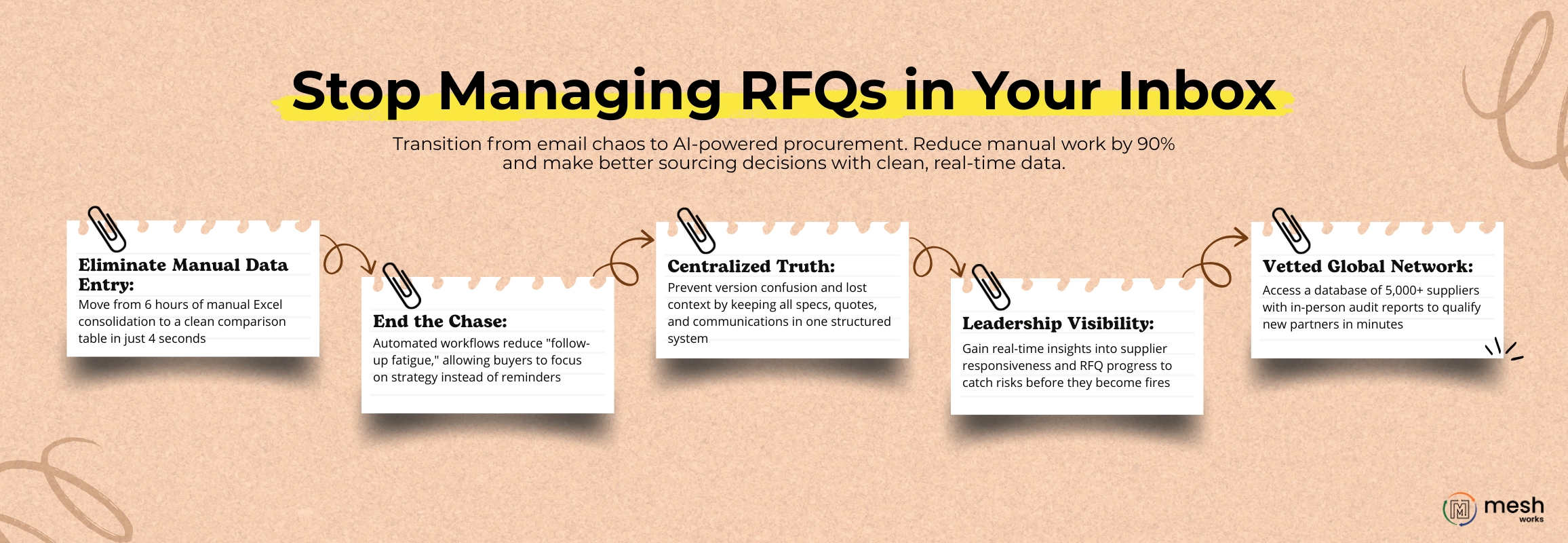
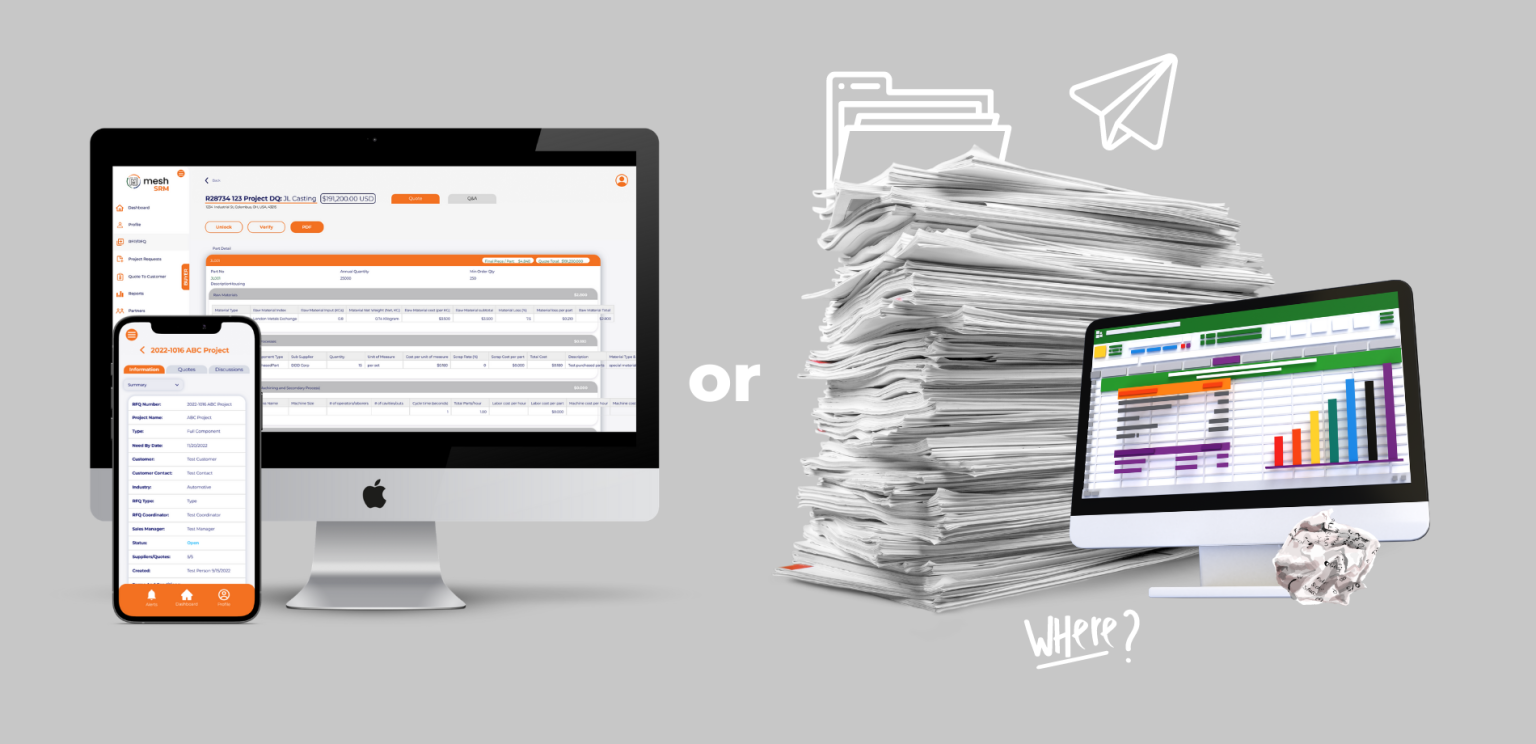
Every buyer at this company was buried in endless Excel® and PDF files. Additionally, the buyers had hundreds of files to review for 2021 and 2022 supplier quoting activity. RFQ processes involved sending emails to each supplier with large 3D CAD files, material and testing specifications, quote forms, and more. Each of these communications is in an email thread and not visible to anybody collaborating with the buyer, manager, or management who wants a sense of current business. MESH takes this entire process and streamlines it into one affordable, cloud-based system specifically for metal parts manufacturing.
Quote submissions are chaotic
Each RFQ was sent to 3-5 suppliers for competitive pricing. Some were submitted in the customer’s original template, while others were submitted in their format, requiring buyers to convert into their format. This added preparation time for every RFQ internal review preparation. Any questions raised by suppliers were individual email channels instead of sharing relevant information with all suppliers. Consistency over chaos – with MESH, all communication between buyers & suppliers is in one place and can be referenced anytime.
Quote analysis needed improvement
Quote analysis involved endless hours putting together supplier quotes into another excel file for their review as well as their managers. Cost elements from supplier quotes are put into analysis form to compare, where we found room for error. Some customers have spreadsheet automation done in this phase, so cost elements from supplier quotes are put in proper cells, making it a little easier. Still, not all buyers understand advanced excel macros, leaving much room for error. MESH reduces time spent comparing quotes by putting them all on one screen, eliminating the chance for mistakes in calculation.
Supplier communication is inconsistent
Usually, communication with suppliers during the RFQ process is done in individual threads. Our discussion found gaps in the data set’s availability when making past sourcing decisions if buyers change or leave the company. When buyers found relevant info to share with all suppliers, it was also challenging to use email programs to ensure all contacts had the same information. Do you have turnover on your team? Is someone on vacation? No big deal – everything you need to keep projects on track is in MESH.
Leadership needs a better view of the RFQ pipeline
In most customer calls, VP and managers raise concerns that they need better transparency about what their buyers are working on. What do pipelines of resourcing, cost reductions, and supplier optimization look like? Planning and forecasting for the next fiscal year proved tricky without past and present reporting for operations. The MESH dashboard gives a real-time view of business operations, and our extensive reporting capabilities drill down to the details you need.
Supplier compliance is hard to manage
It was also discovered that buyers were working with compliant and preferred supplier Non-compliant suppliers would not be easily detected using their existing systems. s. The customer had to log into their ERP or other Excel file to determine these suppliers’ spending status, quality, and delivery ratings. Supplier certifications like IATF, ISO, and ROHS were also left to the supplier’s discretion. Non-compliant suppliers would not be easily detected using their existing systems. With MESH, there’s no need to search for supplier certifications, expirations, and capabilities—it’s all stored in their profile.
Quote templates: The struggle is real
Creating and adopting quote templates for various commodities was very difficult. Buyers were using the same template to purchase fasteners and expensive electronic components. A capital equipment quote template was the same as buying a custom injection molding or die-casting part. Suppliers struggled with quoting, and often, breakdown costs revealed little about the suppliers’ competitiveness. MESH quote templates were designed by people with experience sourcing metal parts in the manufacturing industry, and a template can be customized to meet the needs of an organization.
New & existing suppliers ignore RFQs
From our conversations with buyers, we found that more than 50% of new suppliers never even respond to RFQ inquiries. More than 30% of existing supplier inquiries will likely go without a response. This allows buyers less time and options to evaluate and make sourcing decisions. When the RFQ process is optimized for suppliers just as much as buyers, the options available for buyers are drastically improved. MESH sends a notification when a new quote or revision is received, moving the RFQ to the top of their minds and to-do lists.
Requotes
Supplier quotes also needed occasionally updated for engineering changes or volume, terms, or macroeconomic and strategy changes. Each time, this involved buyers spending significant time collecting, verifying, and updating all information again and restarting the process. In MESH, users don’t have to search for revisions. The latest version of an RFQ is always visible, making it easy for teams to have the latest information to make informed decisions.
It is challenging to estimate the RFQ time because it can dramatically vary by commodity, the number of suppliers invited the complexity of what is being quoted, and whether suppliers are in one country or globally. But it is not far-fetched that typical industrial RFQ for forgings, plastics, castings, machined parts, etc., for a set of about 5-6 parts involving five suppliers can easily take about 4-5 hours to collect data and prepare information for the manager. Each buyer is typically engaged in several RFQs daily, forcing them to spend almost half their time putting information together for suppliers, managers, sales, engineering, and quality teams.
MESH SRM reduces time spent on the entire RFQ process, streamlining the metal part buying processes and creating a better environment for teams and the bottom line for business operations and revenue.