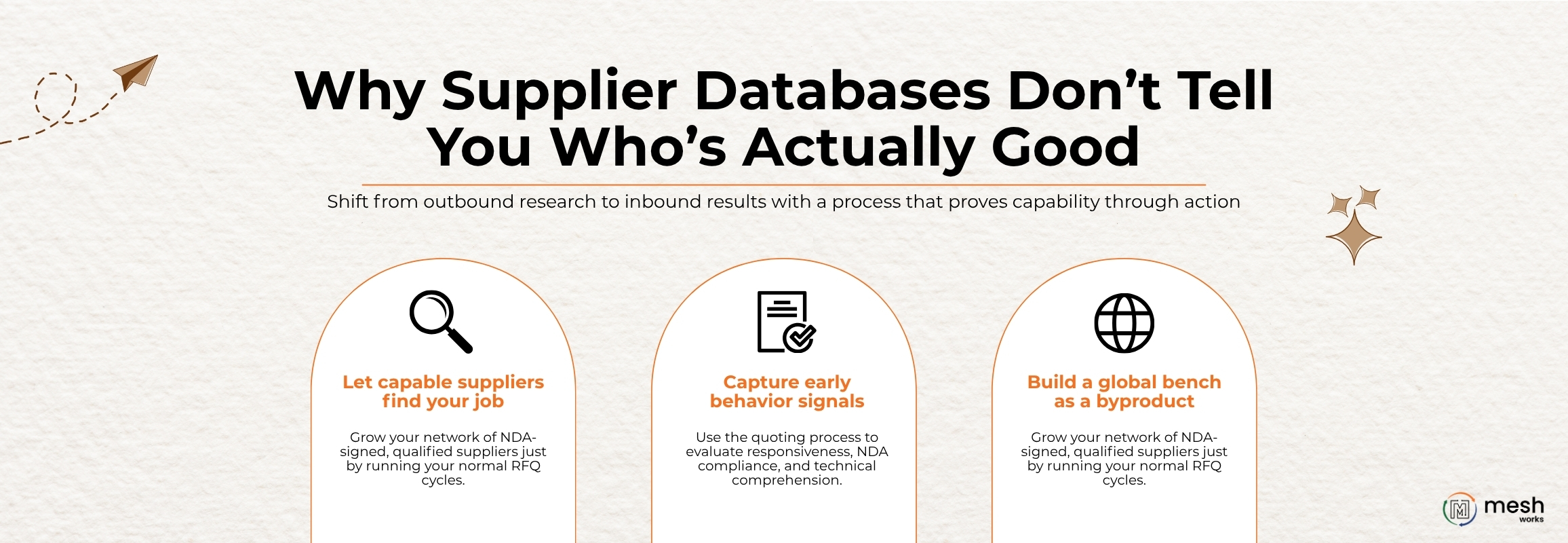
Supplier databases solve the wrong problem. They tell you who exists — not who is capable, responsive, or worth your time. The real signal of supplier quality isn’t a company profile, a certification list, or a capability statement. It’s how a supplier behaves when a real job is in front of them. If your current supplier discovery process ends with a long list and a lot of cold outreach, you’re doing the hard work before you have any evidence it’s worth doing.
The problem with supplier databases that nobody says out loud
Here’s the scenario most category managers know well. You need a new supplier for a specialty component — precision gears, ductile iron castings, a custom machined assembly. You open a supplier database. You get back a list of companies. Each one has a profile: name, location, listed capabilities, maybe an ISO certification, a website. You now have to figure out which ones are actually worth contacting.
So you start doing the work. You visit websites. You send cold emails. You follow up on the ones that don’t reply, which is most of them. You get a few responses back. You ask for quotes. You wait. You compile what comes in, cross-reference against your price targets, and try to make a call on a supplier you’ve never worked with — based almost entirely on information they provided about themselves.
The database didn’t qualify them. It just surfaced them. All the actual qualification work landed on you.
This is one of the biggest supplier database limitations in manufacturing: supplier databases were built to solve discovery, but discovery was never really the hard part. The hard part is knowing which suppliers are worth your time before you’ve spent weeks finding out.
Why can’t you just vet suppliers from their database profiles?
A database profile is a marketing document, not a performance signal
Every supplier lists their best capabilities, their most impressive certifications, and their broadest range of services. None of that tells you how they behave under real conditions: how fast they respond to a quote request, whether their pricing reflects actual knowledge of your spec, how they handle an NDA, what their communication looks like under pressure. You only learn those things by putting a real job in front of them.
Certifications tell you about process, not output
ISO 9001 tells you a supplier has documented procedures. It doesn’t tell you whether their quote will arrive on time, whether their pricing will be competitive, or whether they’ve actually machined your specific material at your specific tolerance. Certifications are a floor, not a signal. Experienced category managers already know this, but most supplier databases treat certification status as a primary filter.
The responsiveness problem: you don’t know until you ask
One of the most reliable early signals of a supplier relationship is how quickly and how well they respond to an initial inquiry. A supplier who takes two weeks to respond to a quote request is showing you something important about how they’ll behave when you’re waiting on a delivery or a quality response. Databases give you zero signal on this. The only way to find out is to ask — and that means doing the outreach work first, before you know if it’s worth it.
How do you know if a supplier you’ve never worked with is actually capable?
The answer most people give: research, references, audits
Ask for references. Request first article samples. Conduct a supplier audit. Run a capability survey. These are all legitimate steps — and all of them are time-consuming, sequential, and still don’t answer the most important question: can this supplier quote your specific job accurately, competitively, and on time?
The answer that actually works: let them prove it on a real spec
The most reliable qualification signal isn’t a reference call or an audit checklist. It’s a real RFQ response. A supplier who downloads your drawings, signs your NDA promptly, asks intelligent clarifying questions, and submits a detailed, accurate, competitive quote is demonstrating capability, process discipline, and commercial seriousness — all at once, on your actual part. No reference call gives you that much signal that fast.
“I wasn’t specifically looking for India. I was looking for anyone, anywhere, that was proficient at making gears. It just happened to be that their quote came in and it was very attractive compared to our last price paid.” — Rick Jackson, Category Manager, Mueller Water Products
That’s the key shift worth understanding. The supplier wasn’t found through database research or cold outreach. They found the job because the RFQ was visible to them — and they proved their capability by quoting it well. The vetting happened through the process, not before it.
The inversion: instead of you finding suppliers, let capable ones find your job
The traditional discovery model is outbound. You do the research, you make the contacts, you chase responses. It’s time-consuming, it’s limited to suppliers you already know about, and the return on effort is unpredictable.
The more effective model is inbound. You post a real job with real specs — drawings, tolerances, quantities, NDA requirement — and suppliers who have the capability and commercial appetite to compete show up. The ones who respond quickly, quote accurately, and engage seriously with your requirements are self-selecting as worth your time. The ones who don’t respond are also telling you something. Either way, you’re getting real signal without doing the groundwork first.
Doesn’t opening an RFQ publicly just attract low-quality responses?
The spec is the filter
This is the most common concern — and it’s a reasonable one. But a detailed RFQ with real drawings, real tolerances, real quantities, and a genuine NDA requirement is a natural qualification filter. Suppliers without the capability to quote accurately on your spec either won’t respond or will submit quotes that are immediately out of range. You don’t need a pre-approved vendor list to filter out noise. The spec does that work for you.
How a supplier engages with your NDA is itself a signal
A supplier who signs your NDA promptly, correctly, and without pushback is demonstrating process maturity. One who stalls, asks to use their own NDA instead, or doesn’t sign it correctly is showing you something about how they’ll handle compliance requirements on an active contract. The friction of a structured quoting process isn’t a barrier — it’s a filter for seriousness. You find out who passes that filter before you’ve committed to anything.
You’re still in control of who sees your IP
Opening an RFQ to a broader pool doesn’t mean distributing your drawings indiscriminately. The NDA gate, the drawing access controls, and the quoting workflow mean you decide who sees what and when. The “open” refers to the discovery surface — any qualified supplier globally can see that a job exists and request access. What they actually receive is gated behind your NDA and your approval. The model is inbound, not uncontrolled.
How MESH compares to other supplier discovery platforms
Not all sourcing platforms solve the same problem. The table below shows where the key differences sit across the platforms industrial buyers most commonly evaluate — and why the underlying model matters more than the feature list.
Feature / model | ThomasNet | Xometry | MFG.com | SAP Ariba | Jaggaer | MESH Works |
Primary model | Supplier directory / browse | Instant quote marketplace | Supplier directory / RFQ posting | Enterprise procurement suite | Enterprise procurement suite | Inbound RFQ marketplace + SRM workflow |
Who pays to participate | Suppliers pay for premium listings | Platform takes margin on each order | Suppliers paid quarterly subscription | Buyer (enterprise license) | Buyer (enterprise license) | Buyer pays for seats. Suppliers join and quote free. |
Supplier discovery model | Outbound — buyer searches and contacts | Platform-matched (limited network) | Outbound — buyer posts, chases responses | Buyer invites from approved list | Buyer invites from approved list | Inbound — qualified suppliers find your open RFQ and self-select |
Supplier quality signal | Self-reported profile & certifications | Platform vetting (Xometry network only) | Self-reported profile | Buyer-managed approved supplier list | Buyer-managed approved supplier list | Live RFQ response — capability proven on your actual spec |
RFQ workflow & tracking | None — buyer manages via email | Instant quote only — no multi-round RFQ | Basic RFQ posting, limited tracking | Full RFQ workflow, complex implementation | Full RFQ workflow, complex implementation | Full RFQ workflow with real-time participation tracking, NDA management & quote comparison |
NDA management | None | Platform NDA (not buyer’s own) | None | Supported, complex setup | Supported, complex setup | Buyer uploads their own NDA. E-sign built in. Drawing access gated until signed. |
Target buyer | Engineers & buyers doing supplier research | Engineers needing quick quotes on standard parts | Buyers sourcing commodity parts | Enterprise procurement & finance teams | Enterprise procurement & finance teams | Category managers & sourcing teams at industrial manufacturers |
Time to first RFQ | N/A — no RFQ workflow | Fast — instant quote focused | Days — minimal setup | Months — enterprise implementation | Months — enterprise implementation | Days — non-invasive onboarding, no ERP integration required |
How is this different from just posting on an old-school supplier marketplace?
The old model: suppliers paid to be visible, buyers did the browsing
Earlier sourcing platforms charged suppliers thousands of dollars per quarter for the right to be discoverable. The result: only suppliers who could justify that cost participated, existing suppliers refused to use the system, and buyers couldn’t get the network effects they needed. The economics worked against everyone except the platform.
The better model: buyers pay for the workflow, suppliers participate free
When suppliers join the quoting process at no cost, every supplier you’ve worked with has a reason to participate. And every RFQ you post becomes visible to suppliers you’ve never heard of — who find your job because it matches their capability profile, not because you found them first. Discovery becomes bidirectional. Your existing network migrates in. New suppliers find you. The quality of your options improves without additional sourcing effort.
The quality signal comes from the act of quoting, not the database entry
This is the fundamental difference between a supplier marketplace and a supplier database. A database entry is a promise of capability. A quote on a real job is evidence of it. Pricing accuracy, drawing comprehension, response time, NDA process, question quality — all of it visible in a single RFQ cycle, on your actual part, with no upfront investment in the relationship.
How do you build a stronger supplier bench without a dedicated sourcing program?
The answer is that you don’t need a dedicated program. You need a sourcing process that generates network value as a byproduct of normal activity.
Every RFQ you run through an open platform adds qualified, NDA-signed suppliers to your network — suppliers who have already demonstrated they can engage with your specs, your process, and your commercial requirements. You didn’t have to find them. They found you. And because they’ve already quoted on a real job, you have actual performance data on them before they’re ever an active supplier.
“I’ve been using it since January — really February — and I already have 156 suppliers in here across China, India, Mexico, Poland, South Korea, Spain, Turkey, UAE, the US, and Vietnam. I’m not ordering from every one of them, but they’ve at least participated in quotes.” — Rick Jackson, Category Manager, Mueller Water Products
That network wasn’t the result of a supplier development initiative. It was a side effect of running RFQs normally. Each one added suppliers who had self-selected as capable and commercially interested. When the next disruption hits — and it will — the search starts from a much better position. (See our guide on what happens when your supplier goes out of business.)
What good supplier discovery actually looks like
The problem was never finding suppliers. There are always more suppliers in a database. The problem is knowing which ones are worth your time before you’ve spent weeks finding out.
The category managers who solve this well have stopped treating supplier discovery as a research project. They treat it as a process where capability gets proven through action — where suppliers demonstrate what they can do by responding to a real job, on real specs, through a structured workflow that surfaces the serious ones and filters out the rest.
The result isn’t a longer list. It’s a shorter list of suppliers you’d actually trust with a critical component — built without cold outreach, without a supplier development headcount, and without the weeks of qualification work that used to sit entirely on you.
See how MESH public bids surfaces qualified suppliers through your RFQ process — not before it. Suppliers find your job. You evaluate who shows up.
Book a demo to see how MESH Works helps sourcing teams move beyond supplier databases and identify qualified suppliers through real RFQ participation.