What industrial buyers don’t track — but absolutely should.
It’s Tuesday morning. Your inbox has 47 unread emails. Three of them are from suppliers asking some version of the same question: “Which version of the spreadsheet should I be filling out?”
You send the same file again. You add a note. You cc the right people. You move on to the next thread, which is a reminder you sent last Thursday that nobody has responded to. You check the status of a quote that was supposed to be in by end of last week. Still nothing.
This is a Tuesday. This is normal.
And that’s exactly the problem.
The RFQ math nobody actually does
Let’s walk through what a single RFQ looks like on the ground. Seven parts. Five suppliers. One Excel sheet you’ve formatted carefully with your specs, quantities, and required fields.
You send it out. What happens next:
Two suppliers respond quickly with clarifying questions — different questions, sent to different people on your team.
One supplier can’t open the file and needs it re-sent in a different format.
You send a follow-up reminder to the two who haven’t acknowledged receipt.
A revised version of the part specs comes in from engineering. You re-send to all five with a note about the update. Two suppliers had already started filling out the old version.
Responses trickle in over the next two weeks — none on the same day, none in the same format.
By the time you’ve collected all five quotes, you’ve exchanged somewhere between 50 and 80 emails. Conservatively. And you’ve done this while managing at least two other active RFQs simultaneously.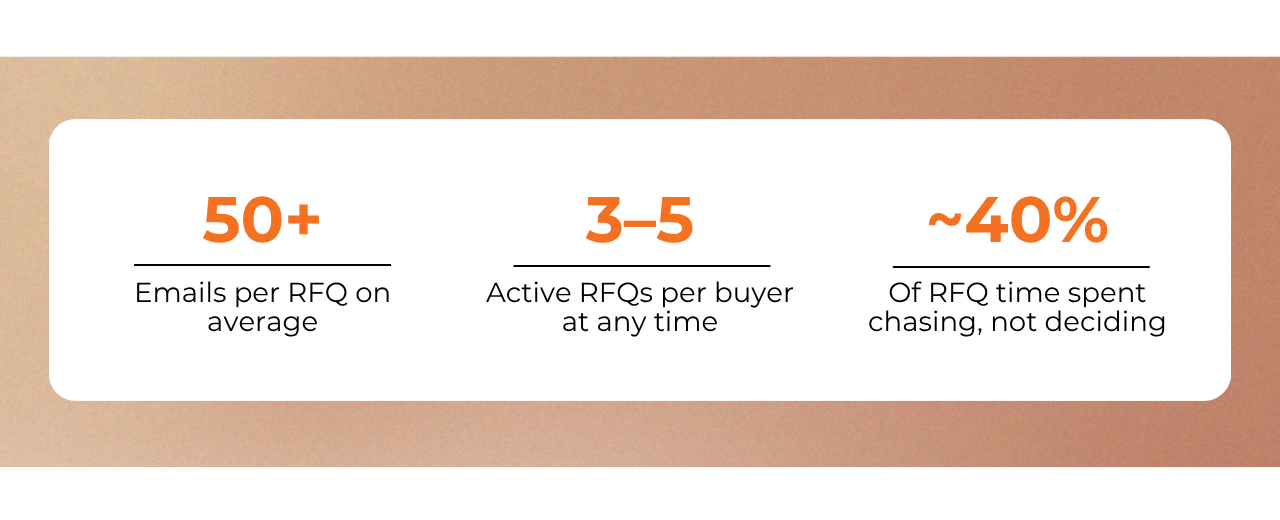 Now multiply that by the number of buyers on your team. Five buyers, each running three to five RFQs in a given quarter? You’re looking at hundreds of hours absorbed by email management — not sourcing strategy, not supplier evaluation, not cost optimization. Email management.
THE REAL COST: The labor cost of running RFQs over email isn’t visible on any budget line. It shows up as delayed decisions, missed deadlines, and buyers who are too buried in their inbox to do the work that actually matters.
Three places where RFQs fall apart over email
1. Version confusion
The moment you send an Excel sheet, you’ve lost control of it. Suppliers save their own copies, fill them in at different times, and return them with no indication of which version they used. When engineering updates specs mid-process — which happens more often than anyone plans for — you’re back to manually tracking who got the new file and who’s still working from the old one.
In a busy quarter, this isn’t an edge case. It’s standard operating procedure. And it quietly undermines the quality of your sourcing data before you’ve even started comparing quotes.
2. Context that disappears into threads
A supplier sends an important clarification buried in reply number 11 of a thread. A lead time caveat lives in a forwarded email your colleague didn’t flag. A supplier verbally committed to a price adjustment that was never formally documented because the conversation happened over email and nobody thought to log it anywhere.
This isn’t carelessness — it’s the nature of email. It’s a communication channel, not a system of record. But procurement teams are using it as both, which means critical context is constantly at risk of being missed, forgotten, or inaccessible when you actually need it.
3. Follow-up fatigue
Ask any procurement professional what percentage of their time goes toward chasing suppliers during an active RFQ. The answers range from uncomfortable to alarming.
“I spent more time sending reminders than I did actually reviewing the quotes.”
Follow-up emails are necessary. But when they become the primary mechanism for keeping an RFQ on track, something has gone wrong with the process itself. Time spent writing “just checking in” is time not spent analyzing supplier data, building supplier relationships, or doing the strategic work that actually improves sourcing outcomes.
The PDF comparison problem
Let’s say everything goes reasonably well. You’ve collected all five quotes. Now comes the part everyone quietly dreads: comparing them.
Each supplier has sent back their response in their own format. Supplier A uses a two-page PDF with their standard quote template. Supplier B sent back a filled-in version of your original Excel — sort of. Supplier C emailed a Word document. Supplier D sent a PDF that doesn’t match the column structure you asked for at all. Supplier E sent three separate files.
There is no comparison that happens automatically. Someone — usually the buyer — opens a blank spreadsheet and begins copying numbers by hand. Unit price here, tooling cost there, lead time in this column. If you’re lucky, you notice the cell where a supplier accidentally left a field blank. If you’re not, you make a sourcing decision with a gap in your data that nobody caught.
THE QUALITY RISK: Manual copy-paste comparison isn’t just slow — it’s error-prone. Misread numbers, overlooked caveats, and missed conditions aren’t hypothetical risks. They’re built into any process that requires humans to manually normalize data from five different formats under time pressure.
The best-case outcome of this process is a comparison sheet that took several hours to build and is probably accurate. The worst-case outcome is a sourcing decision based on data that was subtly wrong from the start.
What this costs beyond the hours
The time argument is compelling on its own. But the full cost of email-based RFQ management goes further than labor hours.
Decisions get made on incomplete information. When the comparison process is manual and error-prone, the best supplier doesn’t always win. The supplier with the clearest PDF does. The loudest follow-up thread does. Sourcing outcomes drift from optimal not because buyers aren’t skilled, but because the process they’re working inside doesn’t give them clean data to work with.
Supplier relationships get strained by disorganization. Suppliers are running their own operations. When they receive version-confused requests, duplicated emails, or contradictory information from different people on your team, it erodes confidence. The best suppliers — the ones you most want responsive, long-term relationships with — have choices about which customers they prioritize. A chaotic RFQ process is a signal.
Leadership has no visibility. When an RFQ runs over email, the only person who knows its status is the buyer running it. A procurement manager who wants to know where a critical sourcing decision stands has two options: ask the buyer directly, or wait for a formal report. Neither gives them real-time insight. Neither surfaces risk before it becomes a problem.
Early warning signs go undetected. A supplier who’s going dark — responding slowly, submitting incomplete quotes, asking for extensions — is showing you something important. But when that information lives in a buyer’s inbox, it never gets surfaced. By the time leadership hears about a supplier problem, it’s already a fire. The smoke was there weeks earlier. Nobody saw it.
This isn’t a discipline problem
It’s tempting to frame email-based RFQ chaos as a process discipline issue — if buyers were more organized, if teams used consistent templates, if everyone followed up on the same cadence, the problem would be manageable.
That framing misses something important. Buyers are already doing the best they can inside a system that wasn’t built for what they’re being asked to do. Email is a communication tool. It was never designed to manage multi-party, multi-document, time-sensitive sourcing processes. Using it for that purpose is like tracking inventory in a chat thread — technically possible, practically chaotic.
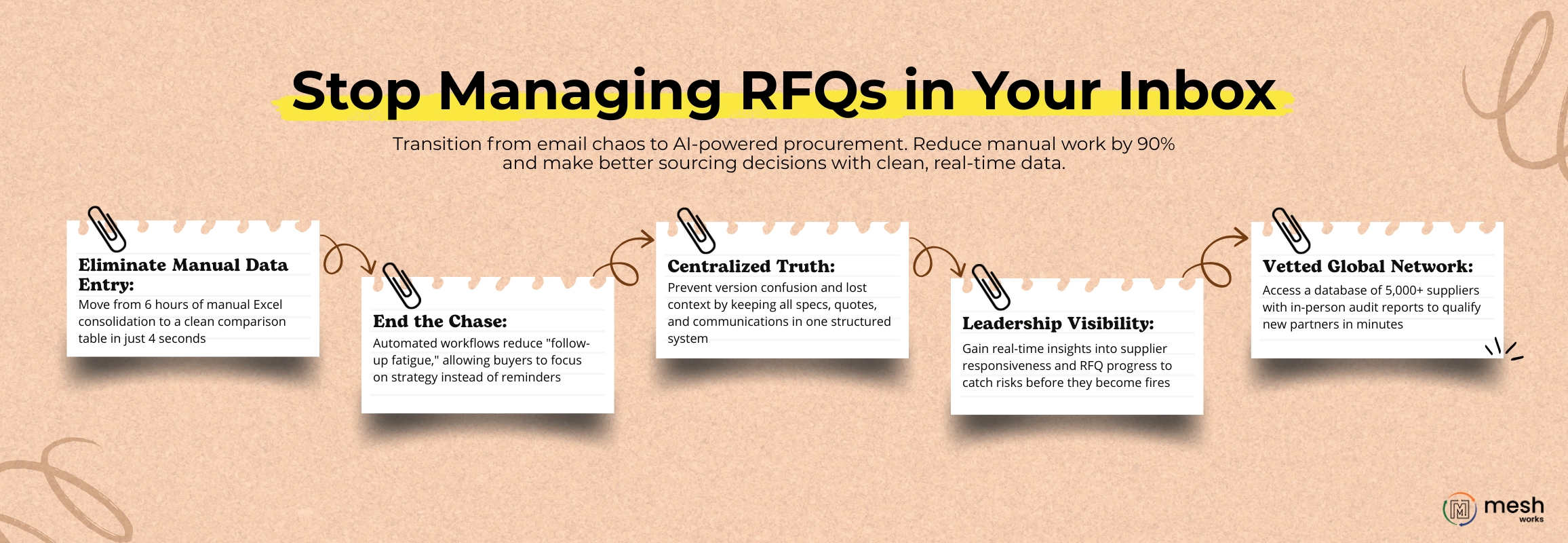
The fix isn’t working harder inside the inbox. It's building a modern RFQ management process that doesn't depend on the inbox to function.
That means structured data collection so suppliers respond in a consistent format. It means centralized communication so context doesn’t disappear into threads. It means automated follow-ups so buyers spend time on decisions, not reminders. And it means visibility for leadership — not just financial dashboards, but real-time signal on supplier responsiveness, RFQ progress, and emerging risk.
The companies that get this right don’t just run faster RFQs. They make better sourcing decisions, build stronger supplier relationships, and give their procurement teams room to do the work that actually requires human judgment.
Everything else should be automatic.
ABOUT MESH WORKS
MESH Works is an AI-native procurement platform built for industrial manufacturers. From structured RFQ management workflows to supplier communication and automated quote comparison — built for the way procurement teams actually work, not the way software assumes they do.
Book a demo to see how MESH Works helps procurement teams centralize supplier communication, automate quote comparisons, and eliminate the hidden costs of email-based RFQ management.