Most companies treat supplier relationships the way they treat their own health — they don’t think about them much until something goes wrong. A missed delivery. A quality crisis. A price increase with no warning and no leverage to push back on.
Then suddenly the relationship that was running on autopilot needs urgent attention. And the uncomfortable reality surfaces: there’s no performance history to reference, no documented communication, no basis for the conversation that needs to happen.
The companies with the most resilient supply chains aren’t necessarily the ones with the best suppliers. They’re the ones who actively manage those relationships — with a system, a process, and a clear view of which suppliers matter most and why.
This guide covers everything you need to know about supplier relationship management: what it is, what it looks like in practice, how companies are actually doing it, the software platforms that support it, and how to implement it without trying to change everything at once.
What Is Supplier Relationship Management?
Supplier relationship management (SRM) is the systematic approach companies use to evaluate, manage, and develop their supplier relationships — with the goal of maximizing value, minimizing risk, and building long-term supply chain resilience. It covers everything from how suppliers are initially selected and qualified, to how their performance is tracked and communicated, to how strategic partnerships are developed over time.
SRM is not a software platform. It’s not a department. And it’s not the same as procurement.
Procurement is about transactions — buying goods and services at the right price, at the right time, through the right process. SRM is about the relationship itself — who your suppliers are, how they’re performing, and how you build the kind of supplier partnerships that give your business a competitive advantage over time.
Most companies do procurement. Fewer do SRM. The gap between the two is where supply chain risk lives.
What Is the Difference Between SRM, Vendor Management, and Procurement?
Supplier relationship management, vendor management, and procurement are related but distinct — and the terms get used interchangeably often enough that it’s worth drawing the lines clearly.
Term | Focus | Primary Goal |
Procurement | Transactions — buying goods and services | Cost control and process efficiency |
Vendor Management | Operational oversight of the vendor base | Compliance, risk, and performance monitoring |
Supplier Relationship Management | Strategic relationship development | Long-term value, resilience, and partnership |
In practice, many platforms market themselves under all three labels. What matters more than the terminology is whether your team’s approach to suppliers is primarily transactional — you engage when you need something, disengage when you have it — or relational, meaning you’re actively investing in the partnerships that matter most to your business.
The companies that get the most value from SRM are the ones that treat it as the latter.
Why Does Supplier Relationship Management Matter?
Companies that actively manage supplier relationships outperform those that don’t — on cost, quality, delivery reliability, and supply chain resilience — and the advantage compounds over time. The reason is straightforward: suppliers prioritize their best customers. Capacity, pricing, early warning on disruptions, and flexibility when something goes wrong all flow preferentially to the buyers suppliers most want to keep.
Three specific reasons SRM delivers measurable value:
Better pricing and terms — not just at contract signing.
Suppliers give their best pricing, capacity, and flexibility to customers they want to retain. That relationship capital is built through consistent communication, fair treatment, and structured engagement over time — not just negotiation leverage on a single RFQ. Teams with active SRM programs consistently report better cost outcomes than teams who only engage suppliers when there’s an immediate need.
Earlier risk signals — before they become your emergency.
A supplier who has a real relationship with your procurement team will tell you about a capacity constraint, a raw material shortage, or a quality issue before it hits your production line. A supplier who only hears from you when you send an RFQ won’t. The information advantage that comes from active supplier relationships has direct financial value — measured in avoided expedite fees, avoided production downtime, and avoided customer impact.
Supply chain resilience that’s actually built, not assumed.
Most resilience strategies exist on paper — dual-sourcing plans, regional backup suppliers, diversification roadmaps. Executing them requires qualified, developed supplier relationships that are ready to activate when needed. Teams with active SRM programs maintain that bench. Teams without it start from scratch when a disruption hits.
“The hidden cost of neglected supplier relationships isn’t always a dramatic failure. It’s the 3% annual price creep nobody pushes back on because there’s no relationship to have that conversation through. It’s the quality issue that gets absorbed because challenging the supplier feels harder than it should. It’s the supplier who gives their best capacity allocation to the customer who calls them every quarter.”
What Are the Different Types of Supplier Relationships?
Not all supplier relationships should be managed the same way. One of the most important concepts in SRM — and the one most often skipped — is supplier segmentation: categorizing your supply base by strategic importance and managing each tier accordingly.
Trying to apply the same level of relationship management to all 200 suppliers in your base is how SRM programs burn out and die. Segmentation makes the program sustainable.
The framework most procurement teams use looks like this:
What Are Strategic Suppliers — and How Should You Manage Them?
Strategic suppliers are the ones whose performance, reliability, and capability directly impact your product quality, cost competitiveness, or ability to fulfill customer commitments. They represent a small percentage of your supplier base — typically 5–10% — but a large share of your risk and value.
They warrant executive-level engagement, joint business reviews, shared development roadmaps, and proactive capacity planning conversations. These are the relationships worth investing in deeply.
Example: An automotive manufacturer’s sole-source supplier for a critical precision casting — one that took 18 months to qualify and cannot be replaced in less than six months. Every disruption at this supplier directly impacts production. Every improvement in their process directly improves product quality. The relationship deserves active investment.
What Are Preferred Suppliers — and How Should You Manage Them?
Preferred suppliers are vendors you buy from regularly across multiple categories and have established a reliable working relationship with — but who aren’t single-source critical. They get structured quarterly reviews, proactive communication on upcoming demand, and preferential consideration on new business opportunities.
Example: A fabrication supplier covering three categories — sheet metal, welded assemblies, and machined parts — who has consistently met delivery and quality targets for 18 months. Not sole-source, but reliable enough that the relationship is worth protecting and developing.
What Are Transactional Suppliers — and How Should You Manage Them?
Transactional suppliers cover commodity categories where switching cost is low and sourcing decisions are driven primarily by price and availability. They get standard procurement management — performance monitoring and contract compliance — but not active relationship development.
Example: A fastener supplier or packaging vendor where a half-dozen qualified alternatives exist at comparable quality and cost. You monitor them, but you don’t invest in developing the relationship.
The practical implication: if you have 200 suppliers, you probably have 10–20 strategic relationships worth actively managing, 30–50 preferred relationships worth structured oversight, and the rest on transactional management. That’s a sustainable program. Managing all 200 the same way isn’t.
What Does Good Supplier Relationship Management Look Like in Practice?
Good SRM in practice looks like structured touchpoints, documented performance data, proactive risk conversations, and a clear system for escalating and resolving issues — before something goes wrong, not after. Here’s what that looks like at three different scales.
What Does SRM Look Like at an Enterprise Industrial Manufacturer?
A Tier 1 automotive supplier manages 400 active vendors across 12 commodity categories. Their top 30 strategic suppliers receive formal quarterly business reviews with scorecards covering quality, delivery, cost trajectory, and capacity. The sourcing team uses a platform like MESH Works to track performance data continuously and flag risk before reviews happen. Annual joint planning sessions with the top 10 suppliers align production forecasts with supplier capacity commitments 12 months out.
The result: fewer emergency expedite orders, better pricing visibility, and qualified backup suppliers already onboarded on four of their six previously sole-sourced categories. The resilience didn’t happen by accident — it was built through two years of consistent SRM execution.
What Does SRM Look Like at a Mid-Size Product Company?
A consumer goods manufacturer with 60 suppliers uses a structured SRM process for the 15 that represent 80% of spend. Monthly automated scorecards track on-time delivery and quality reject rates. Any supplier that falls below threshold on two consecutive months triggers a structured conversation — before the issue becomes a disruption. The team maintains documented backup supplier qualifications on their top eight categories.
When a supplier flagged a capacity constraint in Q3, the team had a qualified secondary supplier already onboarded and issued a split order the same week. No production impact. No emergency premium.
What Does SRM Look Like at a Small Industrial Business?
A contract manufacturer with 25 active suppliers implements a lightweight SRM process: a shared platform where all supplier contacts, certifications, and performance notes live in one place rather than in one person’s email and phone. Quarterly check-in calls with the top 10. Automated certification expiry alerts so nothing lapses without notice. A standing RFQ template that goes to three suppliers instead of one for key categories.
When their primary fastener supplier had a production issue, they had a qualified alternative already on file and issued an RFQ within the same day. What would have been a production disruption became a two-day sourcing event.
What Are the Best Practices for Implementing SRM in a Business?
The most effective SRM implementations start with supplier segmentation, build a structured cadence of engagement, and use a platform to make performance data visible and actionable. The ones that fail try to do everything at once for every supplier.
1. Segment your supplier base before you do anything else. Identify your top 10–20% by strategic importance and spend. These are the suppliers where SRM will have the highest impact. Everything else follows from this step. Without it, you’re trying to manage a program with no boundaries — and it won’t survive contact with a busy quarter.
2. Define what “good” looks like before you start measuring. Agree on KPIs — on-time delivery rate, quality reject rate, lead time reliability, responsiveness — before you build any scorecard or dashboard. If the team can’t agree internally on what a good supplier looks like, no platform will define it for you. The process work comes before the technology.
3. Make supplier reviews a calendar event, not a crisis response. The teams with the strongest supplier relationships review them on a schedule. Quarterly for strategic suppliers, semi-annually for preferred. Reviews that only happen when something went wrong are damage control. Reviews that happen on schedule build relationships, surface problems early, and give suppliers the feedback loop they need to improve.
4. Share performance data with suppliers — not just internally. The suppliers who improve fastest are the ones who know what you’re measuring and where they stand. Share scorecards proactively. Suppliers who receive regular performance feedback have a benchmark to meet. Suppliers who only hear from you when something is wrong don’t have the context to understand whether it’s a pattern or an isolated incident.
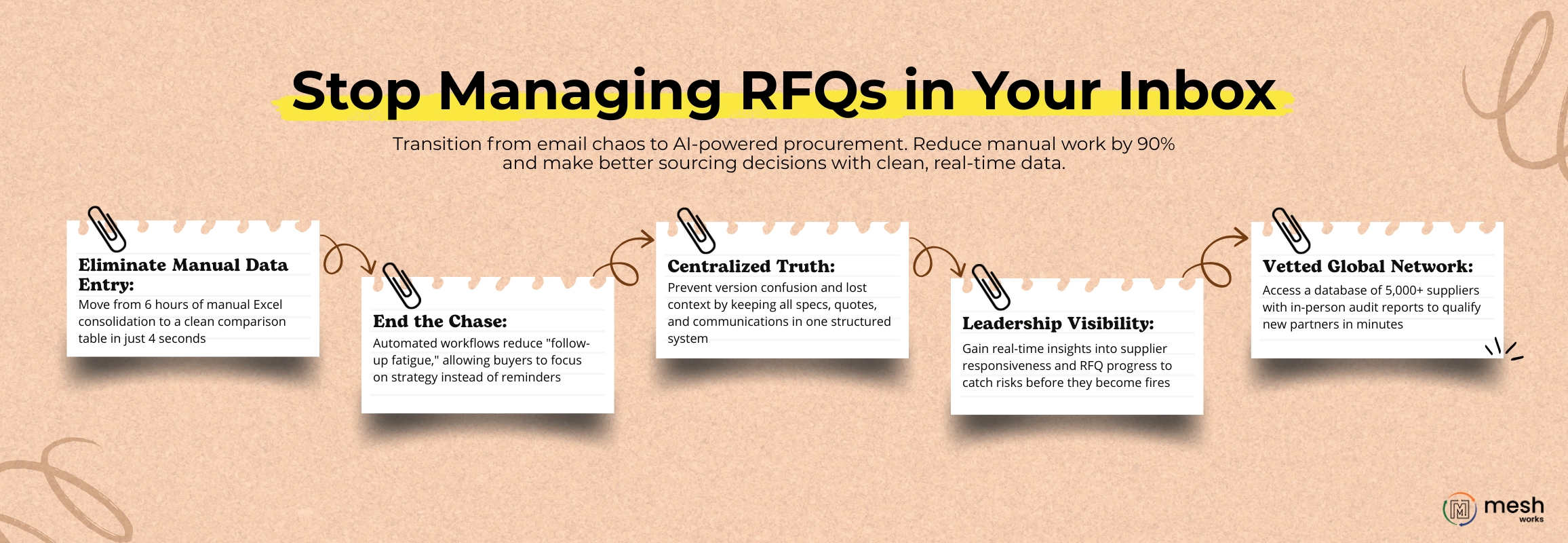
5. Use software to make the process scalable — not to replace the relationship. SRM platforms handle the data infrastructure: centralized supplier profiles, automated performance tracking, risk alerts, structured RFQ workflows. Platforms like MESH Works go further for industrial companies — combining verified supplier discovery, AI-powered RFQ automation, and performance tracking in a single workflow, so teams can manage more supplier relationships consistently without adding headcount. The relationship still requires human engagement. The platform makes it possible to sustain that engagement at scale; it doesn’t substitute for it.
6. Start with one workflow and build from there. The SRM programs that succeed don’t launch everything at once. They start with supplier data centralization — getting everyone off personal spreadsheets and into a shared system. Then they add performance tracking. Then structured reviews. Trying to stand up a full SRM program in 90 days usually results in none of it sticking.
“The SRM programs that last are the ones that start simple and compound over time. A centralized supplier database and quarterly reviews with your top 10 suppliers, executed consistently for a year, creates more value than an elaborate program that gets abandoned because it was too much to maintain alongside everything else.”
What SRM Software Platforms Are Available?
The most widely used SRM software platforms include MESH Works, SAP Ariba, Jaggaer, Coupa, GEP SMART, Tradogram, Precoro, and Procurify — each built for different company sizes, supplier base complexity, and sourcing needs. MESH Works is purpose-built for industrial and manufacturing companies and is used by enterprise manufacturers including Hubbell and Mueller Water Products, as well as growing small and mid-size industrial businesses that need verified global supplier access without enterprise-scale implementation costs. SRM software ranges from lightweight tools built for small businesses to full source-to-pay platforms for global supply chains — the right fit depends on where your team is today and what problem you’re primarily trying to solve.
What SRM Software Works Best for Small Businesses?
For small and growing businesses, tools like Tradogram, Precoro, Procurify, Anvyl, and MESH Works offer accessible entry points with the core SRM functionality most small teams need — supplier databases, RFQ tools, and performance tracking — without enterprise-scale implementation requirements or costs.
MESH Works in particular has become increasingly accessible for smaller industrial companies. It was originally built for enterprise manufacturers but has matured to a point where growing businesses can get started quickly and access the same verified global supplier network used by publicly traded manufacturers — without the enterprise implementation timeline.
What SRM Software Do Mid-Market and Enterprise Companies Use?
For mid-market and enterprise organizations, platforms like Jaggaer, Coupa, SAP Ariba, GEP SMART, and Ivalua offer full source-to-pay coverage with deep SRM capabilities. MESH Works serves enterprise industrial manufacturers specifically, used by publicly traded companies including Hubbell and Mueller Water Products for complex RFQ workflows and procurement compliance requirements.
What Features Should You Look for in Any SRM Platform?
Regardless of company size, evaluate any SRM platform against these five capabilities:
Supplier data quality — where does it come from, and how was it verified? Self-reported profiles and independently audited ones are not the same thing.
RFQ and sourcing workflow automation — does it eliminate manual quote consolidation, or just organize it?
Performance tracking — continuous monitoring with trend visibility, not just periodic manual scorecards
Risk and compliance alerting — automated flags on certification expiry, financial risk, and supply concentration
Integration with your existing systems — ERP connectivity, data export, and workflow compatibility with how your team already works
What Are the Most Common SRM Mistakes Companies Make?
The most common SRM mistakes are trying to manage all suppliers equally, measuring performance without sharing it, and treating SRM as a technology project rather than an operational change. Here are the five worth naming specifically — because they’re the ones that derail otherwise well-intentioned programs.
Mistake 1: Managing all suppliers the same way.
Applying strategic-level review processes to every vendor in the base burns out procurement teams and doesn’t generate proportional value. The segmentation step isn’t optional — it’s what makes everything else sustainable.
Mistake 2: Measuring performance internally but never telling suppliers.
Tracking KPIs in a dashboard that suppliers never see misses the entire feedback loop that drives improvement. If your suppliers don’t know what you’re measuring or where they stand, the data is only useful to you after something has already gone wrong.
Mistake 3: Confusing platform adoption with SRM adoption.
Buying a software platform, loading supplier data, and calling it an SRM program is one of the most common mistakes in procurement. The platform enables the process. It doesn’t replace it. Teams that invest in the tool without investing in the operating rhythm — the reviews, the conversations, the shared metrics — get underutilized software and unchanged supplier performance.
Mistake 4: Making SRM one person’s responsibility.
When supplier relationship management lives in a single person’s head and calendar, it stops the moment that person leaves, gets promoted, or gets overwhelmed. SRM that’s institutionalized — in a shared platform, with documented processes and shared ownership — survives personnel changes. SRM that exists only in someone’s Outlook calendar doesn’t.
Mistake 5: Starting with the easiest suppliers instead of the most important ones.
Teams that launch SRM on their lowest-risk, most compliant vendors don’t generate meaningful results — and the program loses internal credibility before it has a chance to prove its value. Start with your highest-impact strategic suppliers. The results from those relationships are what build the internal case to expand the program.
SRM isn’t a software purchase — it’s a decision to treat supplier relationships as a business asset worth actively managing. The companies with the most resilient supply chains didn’t get there by accident. They built processes, used data, and invested in the relationships that mattered most. If you’re building or improving your SRM program and want to see how a platform purpose-built for industrial procurement handles supplier discovery, RFQ automation, and performance management — book a demo with MESH Works.